
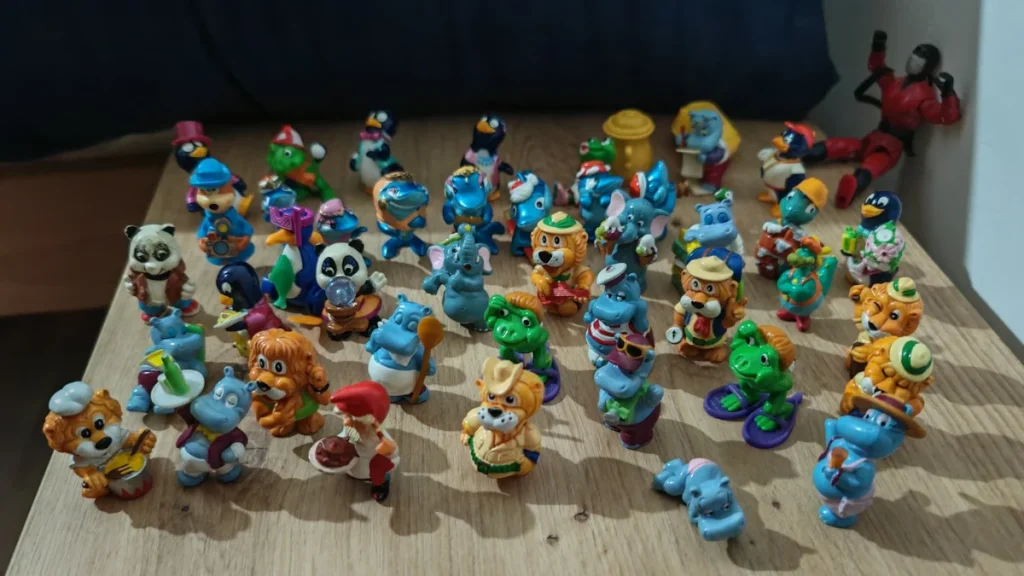
Kinder figures from the 1990s are often easier to recognise than to name. A blue hippo with an enormous cooking spoon, a lion holding a guitar or a penguin in a top hat can be enough to make you think, “I had that one!” Even a tiny detail can bring back a figure you once owned or hoped to find.
They were small toys, but collecting them could become serious business. The little paper insert showed the whole group, while you had only a few of its characters. The next egg might contain the one you were missing, or another figure you already had. A duplicate could then become something worth swapping.
The photographs in this article show my own collection of lions, hippos, penguins, green frogs and blue sharks. Comparing them with collector catalogues revealed their names and release years, along with a few details that are easy to overlook: the frogs can be mistaken for crocodiles, the hippos appear to come from two different series, and some figures are missing accessories.
How collecting Kinder figures began
The Kinder brand began in 1968, and Kinder Surprise followed in 1974. According to Ferrero's official history, the idea grew out of the Italian Easter tradition of chocolate eggs containing a surprise. Kinder Surprise brought that idea to a treat that could be enjoyed throughout the year.
Hand-painted Kinder figures had a particular appeal among the toys hidden inside those chocolate eggs. The animals did more than wear different colours. One was a cook, another a musician, while others slept or prepared for an adventure. Seeing the complete group was often enough to suggest a game or a story.
For many children, collecting was the best part: comparing figures, arranging swaps and looking for the missing character. Small objects took on a similar importance in the games we played before smartphones and the internet, especially when marbles were involved. What something was worth among friends did not always have much to do with its price in a shop.
Leo Venturas: a 1993 collection of Kinder figures
The lions in the photograph belong to the European Leo Venturas series from 1993. The catalogue lists ten characters, and eight are shown here. Their manes, outfits and accessories help tell them apart.
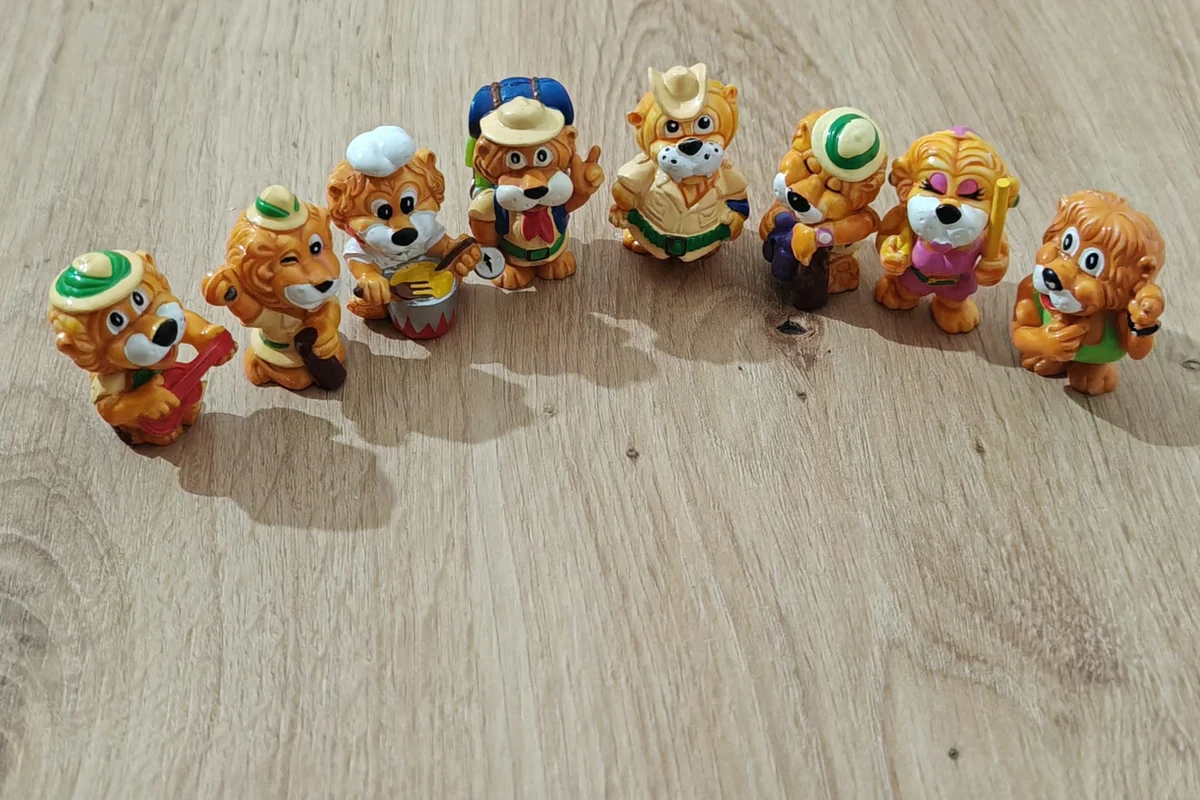
The lion with the guitar is Leo Romeo, the cook wearing a white hat is Leo Chef, and the woodcutter is Timber Leo. The explorer with the compass is called Scout Leo. Together, they show how much personality could fit into a small set of figures.
Two characters are absent from the photographed group: Lea Julietta, associated with a blue tent, and Leo Butterfly, who carries a butterfly net. There is also a smaller missing piece. Lea Diva still has the support for her parasol, but its green canopy is absent. She remains recognisable, although she is not fully equipped as shown in the catalogue.
Happy Hippos: ten figures, apparently from two series
The blue hippos may be the most recognisable group in this collection. Most of the photographed figures match Die Happy Hippos auf dem Traumschiff, the cruise ship series documented as a German release in 1992. The catalogue also records a European release in 1996, so 1992 should not automatically be treated as the year every version appeared in every country.
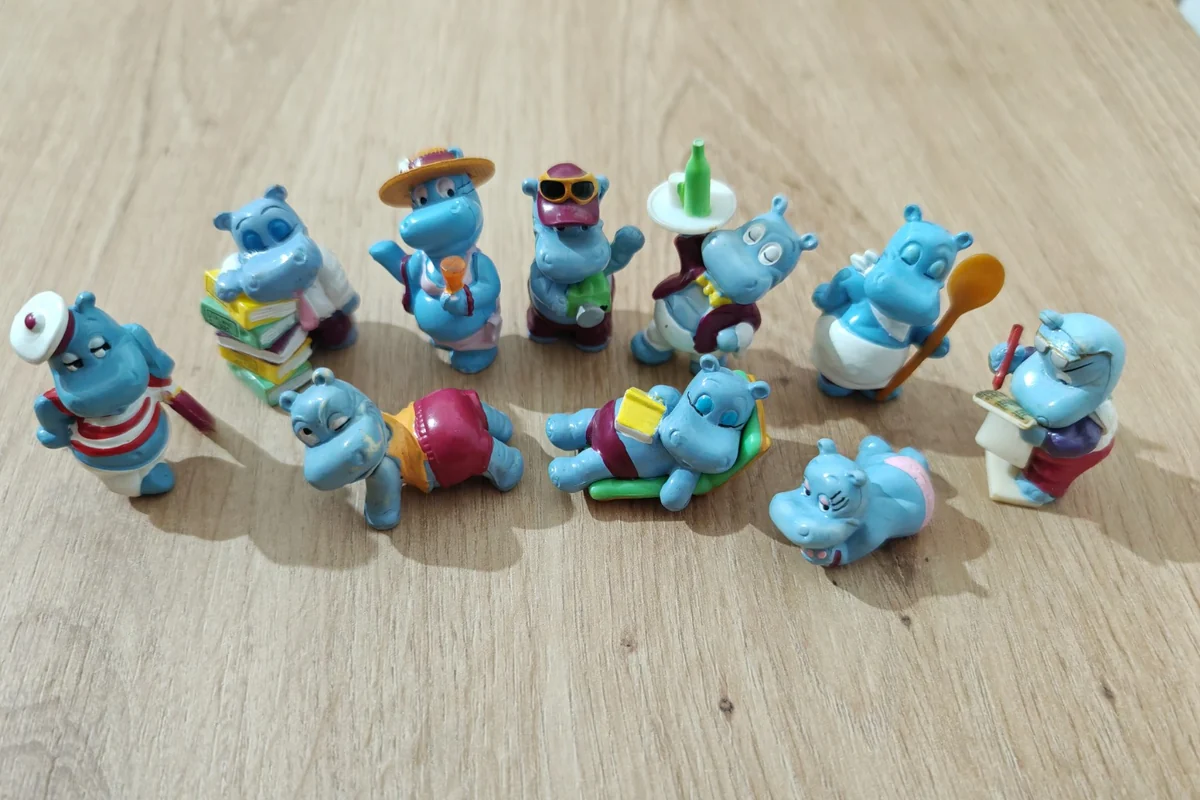
They include the cook Emil Eintopf, the sleepy Träumer Tommy in a deckchair, and other characters equipped for work or relaxation on board. The oversized spoon, the tray with a bottle and the hat are memorable even if you never learned the figures' original names.
The hippo with the books reveals the difference
There are ten hippos in the photograph, but that does not necessarily make this one complete set. The figure dozing against a pile of books matches Träumer Tommi from the separate Die Happy Hippo Company series of 1994.
Comparing the figures with catalogue images suggests nine members of the cruise ship group and one from the office series. If that identification is correct, the captain, Käpt'n Happy Hippo, is missing from the photographed group. This comparison is based on visible details; confirming the precise production variants would also require examining the markings underneath.
Happy Hippos also have a known creator. Illustrator André Roche states in his professional portfolio that he created the characters for Ferrero in 1987. The year the characters were designed is therefore different from the release years of the cruise ship and office collections.
Peppy Pingo Party: penguins dressed for a 1994 celebration
The six penguins in the photograph belong to Die Peppy Pingo Party, a series from 1994. A complete set has ten characters. Their outfits, presents, flowers and other party accessories help identify this particular group.
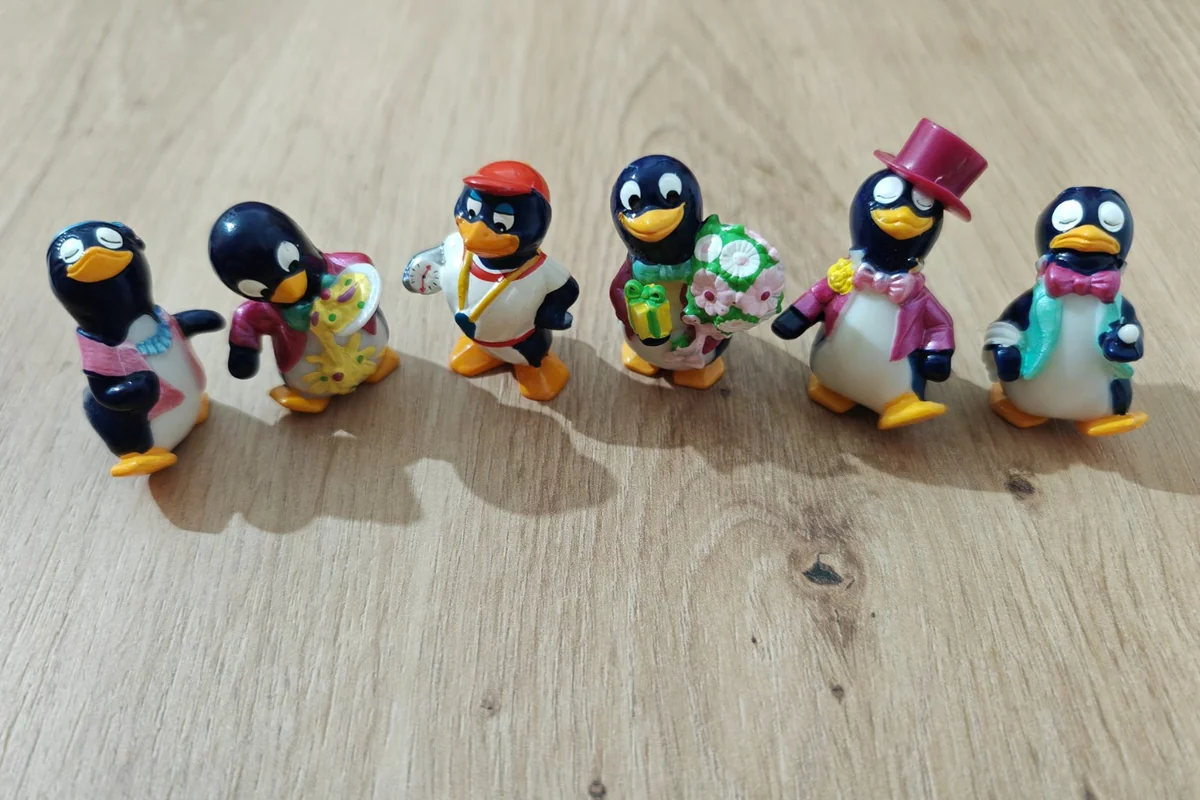
The penguin in the top hat is Zacharias Zaster, while the one with the flowers is Sascha Süssholz. Each outfit gives its character a different personality, despite their similar shapes and basic colours.
When identifying these figures, the full series name matters. Peppy Pingos from 1992 and Peppy Pingo Party from 1994 are different collections. The earlier group features winter activities such as sledging and hockey, while the penguins photographed here belong to the party series. Searching only for “Kinder penguins” can easily lead to the wrong set.
Ranoplà: green frogs on winter adventures
The green figures in the next photograph can be misleading at first glance. Although they may look a little like small crocodiles, they are frogs from the 1993 Le simpatiche Ranoplà series. Their accessories represent winter activities: snowshoeing, skating, skiing and snowball fights.
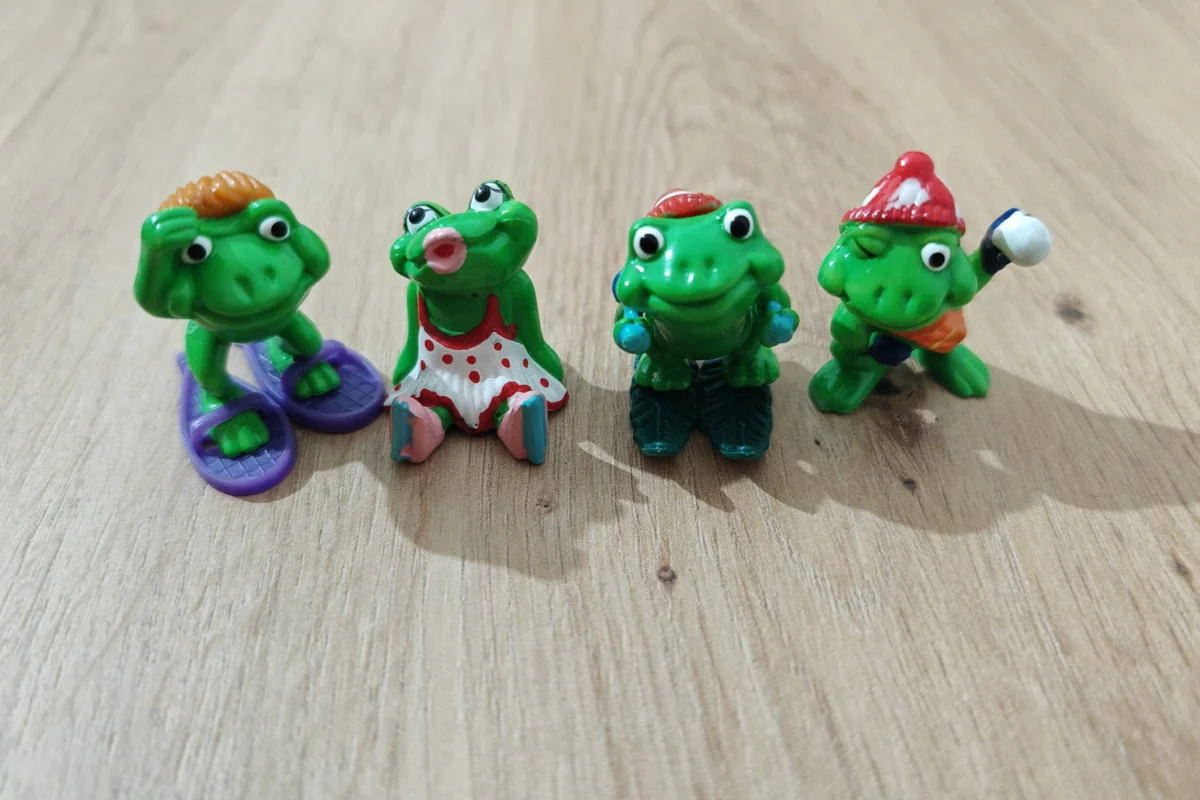
The four frogs shown here can be matched to the following characters:
- Battista Fuoripista: the frog wearing purple snowshoes.
- Patty Ruzzolona: the figure in a white dress with red spots, wearing skates.
- Gigi Spazzaneve: the frog skiing on green leaves.
- Gianni Tormenta: the character in a red hat, holding a snowball.
This series also shows why names from different countries can confuse collectors. It appeared under names including Froggy Friends, Mini Splash and Frosty Froggz. Surviving paper inserts document a Froggy Friends release for a group of markets that included Croatia and Slovenia.
The full Italian or European catalogue list contains twelve characters, but there were also regional releases with ten. Before deciding whether your own collection is complete, it helps to establish which version you are comparing it with.
Squalibabà: blue sharks with a flying carpet
The blue shark Kinder figures belong to Squalibabà, which collector catalogues list as a 1995 series. Turbans, cushions, a basket and a flying carpet give the group its fairy-tale setting.
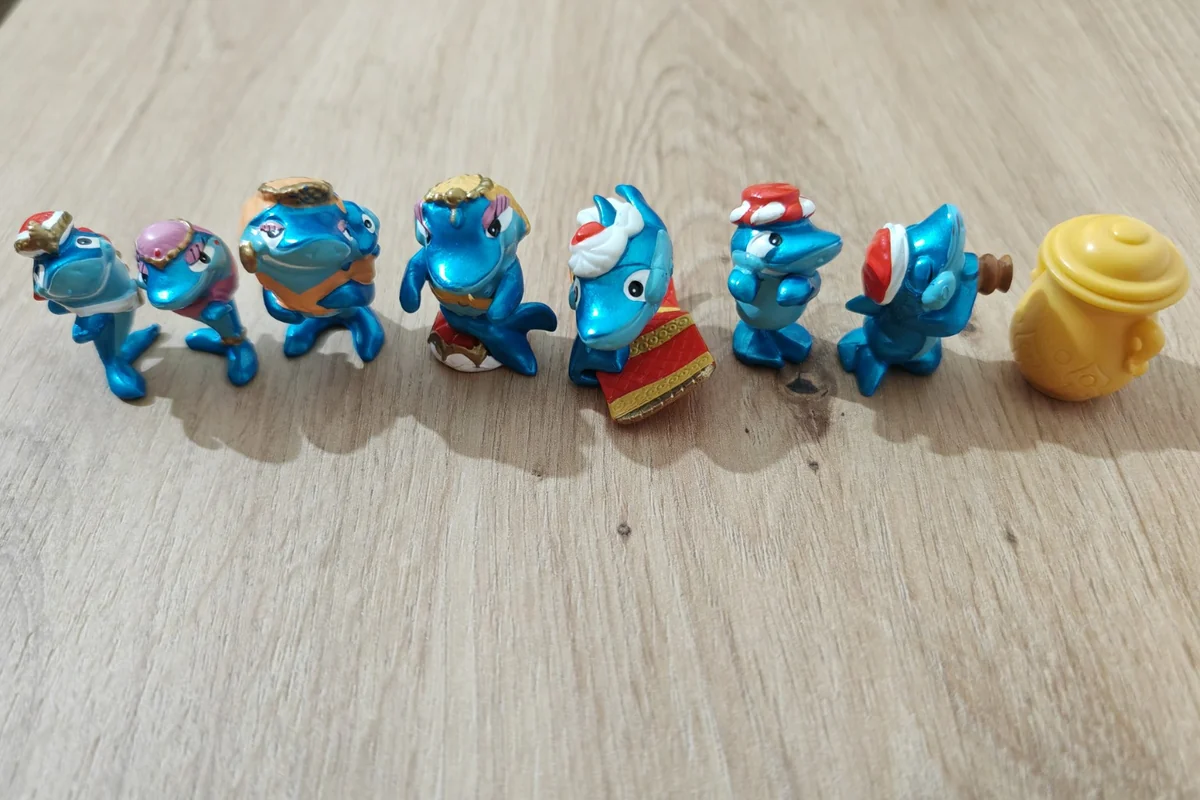
Some of the easiest characters to recognise are the mother with her young shark and Kebel Volar, riding a red flying carpet. The catalogue has ten entries, including one pair of sharks. The photograph shows seven assembled figures and a separate yellow piece, so I am not presenting this group as a complete set.
The yellow piece resembles the basket associated with Nahas Kondin, but that accessory alone is not enough to count the character as complete. With toys this small, a separate piece can make the difference between a recognisable figure and a complete example.
CollectingKinder lists Squalibabà as a 1995 release, while also recording the marking © Ferrero 1996. A series date, a copyright marking and the period when a figure was sold in a particular country need to be considered together.
How to identify old Kinder figures
If you still have a few old figures, you can start with a closer look. A photograph of a similar animal is useful, but small details often determine the correct match. Here are a few things to check:
- Look at the markings underneath. Note the Ferrero marking, any year and other numbers or letters. These provide clues to compare with a catalogue.
- Compare the outfit, pose and accessories. A hippo in a deckchair and a hippo resting against books may look similar, but they belong to different series.
- Look for the original paper insert. Collectors often call it a BPZ, short for the German word Beipackzettel. It can show the other characters, the collection name and the regional version.
- Check for missing pieces. A parasol, spoon, hat, net or another detachable accessory may be important to the figure's completeness.
- Compare more than one source. A seller's listing title may be inaccurate. Catalogue photographs and surviving original inserts are more useful than a description such as “rare toy from the 1980s”.
Having ten figures of the same animal does not necessarily mean you have a complete collection. The Happy Hippos in these photographs show how characters from different series can end up in one group.
Are old Kinder figures worth anything today?
Collectors still buy and swap old Kinder figures, but age alone does not determine their value. Original accessories and well-preserved paint matter, particularly when comparing examples from the same series.
Useful points of comparison include paint condition, completeness, the original paper insert, the exact variant and interest in the series. A different shade or marking may be interesting, but it first needs to be checked against documented variants.
An asking price is also different from a confirmed sale price. One expensive listing does not prove that every similar figure is worth that amount. When assessing your own collection, completed sales of matching examples in comparable condition are more useful.
Which figure would you recognise immediately?
When I look at these Kinder figures, it is the little details that catch my eye first: a spoon almost as large as the hippo, a guitar in a lion's paws and enormous purple snowshoes on a tiny frog. Those accessories gave the characters personality and made them easy to remember.
Some children displayed them on shelves, some used them in games, and others tried to collect every character on the paper insert. If these photographs also bring back the room you grew up in, you might recognise another part of that setting in our story about watching cartoons on a CRT television.
Do you still have any Kinder figures? Share the group you remember and the character you were hoping to find in the comments. Were they known by a different name where you grew up? You might spot a familiar little toy in these photographs and finally discover what it was called.
Sources and photographs
The identifications are based on comparisons between the photographs, collector catalogues and documented paper inserts. The dates refer to the series releases described here; the photographs alone cannot establish when a figure was bought or confirm every production variant.
- Ferrero: the history of Kinder and Kinder Surprise.
- CollectingKinder: the cruise ship Happy Hippos and the 1992 Peppy Pingos.
- CollectingKinder: Leo Venturas and Ranoplà from 1993.
- CollectingKinder: Peppy Pingo Party and Happy Hippo Company from 1994.
- CollectingKinder: Squalibabà and the markings on the figures.
- EierWiki: Ranoplà, regional names and releases.
- André Roche: the portfolio of the Happy Hippos creator.
All photographs in this article show Kinder figures from my own collection.