
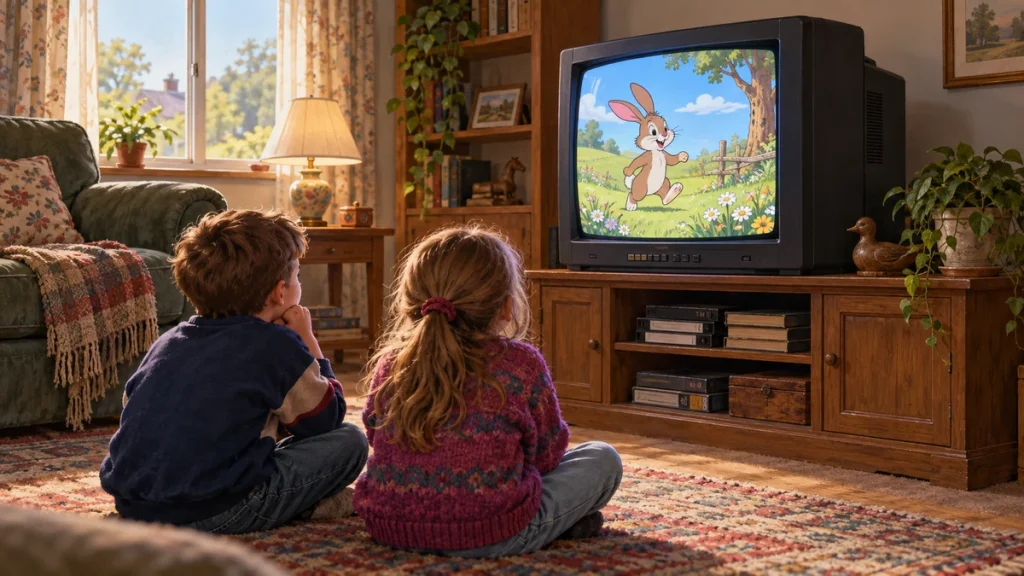
Before streaming apps and endless recommendations, watching cartoons on a CRT TV often meant being in the right room at the right time. A familiar theme tune could bring children to the television before anyone had announced that the programme was starting. The set itself was hard to overlook: a deep cabinet, a heavy glass screen and, on older models, a row of buttons you could actually feel clicking into place.
The cartoons mattered, but so did everything around them. The television had its place in the room, the programmes had their place in the schedule, and whoever was watching shared the same episode. Those details help explain why an ordinary household appliance still brings back such clear memories.
The Television at the Centre of the Room
A CRT television needed somewhere substantial to stand. Unlike a slim screen mounted on a wall, it occupied space on a cabinet or a sturdy stand, with its bulky rear housing extending behind the screen. Books, photographs or a video recorder might surround it. The arrangement differed from home to home, but the television often became a fixed point around which the furniture was placed.
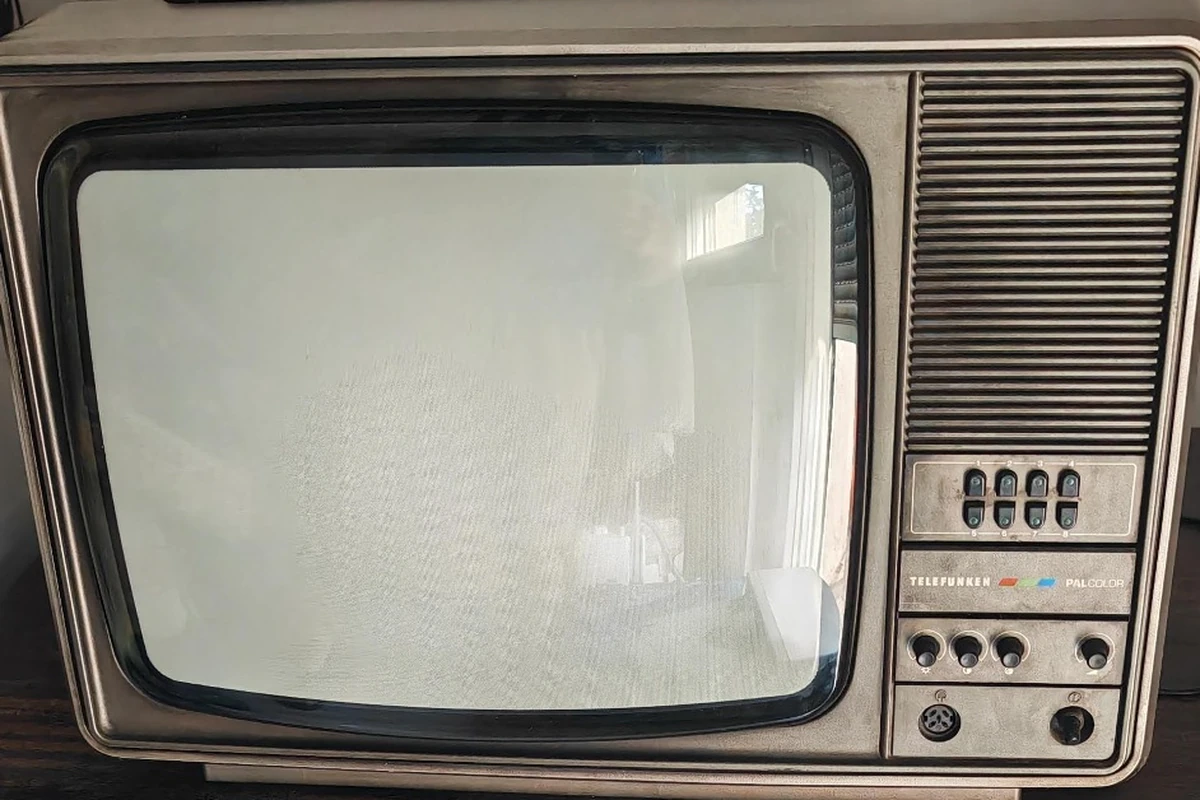
The Telefunken in the photograph shows how much of the television could be operated directly from the front. Channel buttons, rotary controls and a large speaker grille formed part of its appearance. On sets like this, changing the channel could mean getting up and walking across the room. Later CRT models brought different layouts, remote controls and on-screen menus; there was no single design shared by every generation.
Some families kept the same set for years, having it repaired when necessary. Others remember the change from a black-and-white television to a colour one. For households making that switch, familiar cartoons suddenly gained another dimension. Yet the timing varied by country and family: many children of the 1980s and 1990s grew up with colour television already in the home.
Cartoons Had a Place in the TV Schedule
The most important difference from streaming was the schedule. Depending on the broadcaster, cartoons might appear before school, during the afternoon, at weekends or between other programmes. You could choose a channel, but you could not simply summon any episode whenever you wanted.
That gave the opening music a practical purpose as well as an emotional one. It was the signal that the cartoon had begun. If you were in another room, the first few notes could be enough to make you hurry back. Characters such as the Smurfs, Tom and Jerry and the Pink Panther became associated with those recurring slots, although the programmes and broadcast times differed around the world.
Watching a live broadcast also meant keeping pace with everyone else in the room. A conversation could cover a joke; leaving for a drink could mean missing a scene. Where siblings or friends watched together, even deciding which channel to choose became part of the experience.
Video recorders offered a way around the schedule. If a household had a VCR, a blank tape and someone who remembered to start the recording, an episode could be saved and watched again. Bought or rented tapes offered another choice. The same television could show an afternoon cartoon and later become the centre of a weekend evening with a rented VHS tape.
Why Cartoons Looked Different on a CRT
CRT stands for cathode-ray tube. Inside the television, electron beams strike a phosphor coating on the inner surface of the screen, causing it to glow. In a colour tube, red, green and blue phosphors produce the colours of the picture. Canon’s explanation of CRT technology describes this process and why the tube needs depth behind the screen.
The familiar television picture came from more than the tube alone. The broadcast, aerial reception, video connection, picture settings and condition of the set all affected what viewers saw. A good CRT with a clean signal could produce a detailed picture; a weak broadcast or worn VHS recording could look much softer. It would be misleading to describe every CRT image as blurry.
For some viewers, that softer presentation remains part of the appeal. Outlines and painted backgrounds can seem to blend together more gently than in a sharp digital version. That is a viewing preference rather than proof that the animation was better on an older screen. A restored copy may reveal artwork that an old broadcast never showed clearly, as we discuss in our article about remastered Tom and Jerry cartoons from the 1940s.
The shape of the picture matters too. Many household CRT sets had a 4:3 screen, matching the shape of much traditional television programming. When revisiting an old cartoon on a widescreen display, preserving its original proportions helps avoid stretched characters or missing parts of the frame. A wider picture is not always a more complete one.
Adjusting the Aerial and Moving Back from the Screen
In homes using an indoor aerial, getting a watchable picture could take a little experimentation. Moving or turning the aerial might improve one channel while making another worse. With weak analogue reception, snow, ghost images or noisy sound could interrupt a programme. These were reception problems, rather than something every CRT screen produced.
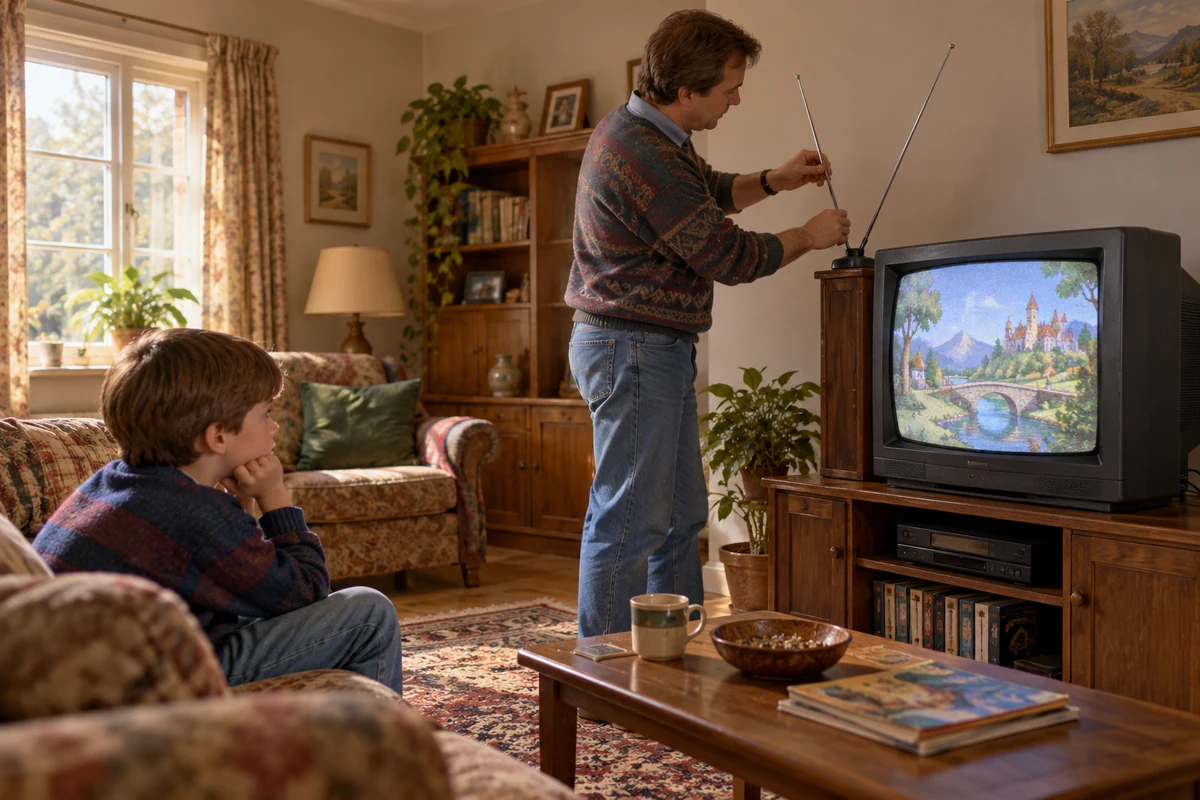
Adjusting the aerial could briefly become a two-person job: one person moved it while another watched for a clearer picture. The instruction to stop moving made sense when a small change in position was enough to affect reception. It is an easily recognised detail of analogue television, though households with a good outdoor aerial or cable connection could have a very different experience.
Another familiar instruction was to move back from the screen. The warning that sitting close would “ruin your eyes” deserves a little clarification. Montreal Children’s Hospital explains that sitting close to a television has not been shown to damage children’s eyes, although prolonged viewing can cause temporary eye strain. A child who regularly moves very close may also have an existing difficulty seeing clearly. The remembered warning should not be treated as a technical fact about CRTs.
What We Miss About Watching Cartoons Together
CRT televisions still interest collectors and people who enjoy older games and video equipment. For someone returning to childhood cartoons, however, the attraction may be less about the hardware specifications and more about the setting it recalls. A familiar screen can bring to mind a particular room, a programme’s theme tune or the person who always wanted to change the channel.
Streaming makes revisiting those cartoons much easier. We can find a favourite episode, pause a scene and share something we once struggled to catch on television. There is plenty to appreciate in that convenience. What has changed is the need to gather around one set at a particular time and watch whatever was being broadcast together.
That shared routine gives the old television its place in the memory. The picture did not need to be flawless for a joke to make everyone laugh, and the cabinet did not need to be stylish to become a familiar part of the home. Sometimes the most memorable detail was simply knowing that, for the next few minutes, everyone in the room was watching the same thing.
Which cartoon makes you think of your old television, and do you remember changing its channels with buttons, a dial or a remote? Share your memories in the comments.