
I sold Bitcoin for $30 because I thought I had caught the top. When I started Bitcoin mining in 2013, the price was around $15, so a doubling looked like an excellent reason to sell. When I later saw how much further it went, I was, to put it politely, pissed off.
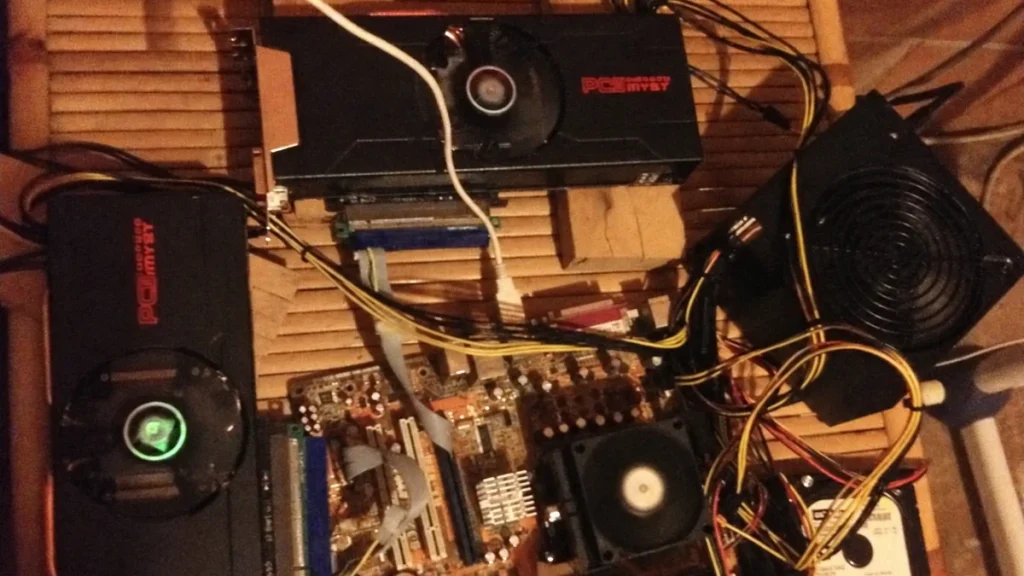
Around the start of that year, I put two graphics cards to work in an improvised rig on a little table. There were electricity bills to cover and people on a hardware forum comparing results. We kept changing settings, chasing a little more speed and selling coins to keep the whole thing going. A future in which one BTC would trade above $120,000 was beyond anything I was planning for.
Later, we also followed prices on BitcoinWisdom and watched the charts while deciding when to sell. There was always another move to worry about, another setting to try and another electricity bill on the way.
Two MYST Cards on a Woven Reed Table
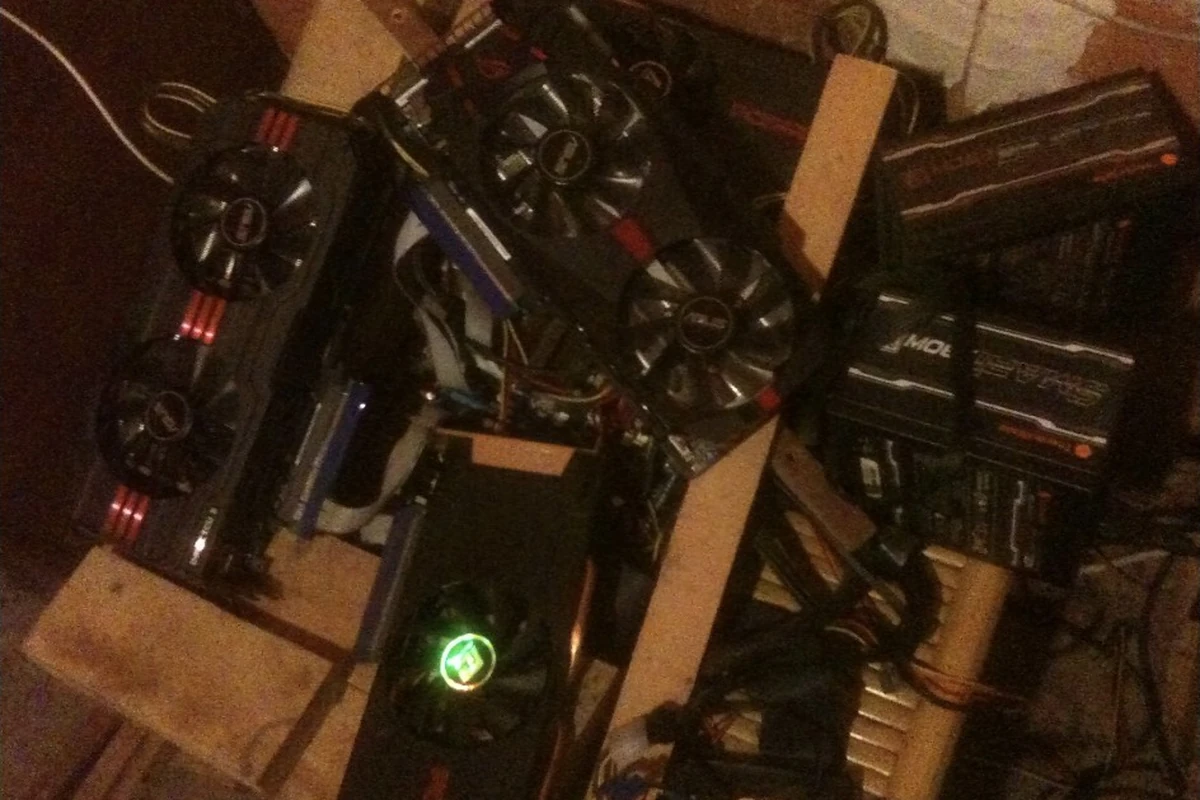
My first cards were two PowerColor PCS+ Radeon HD 7870 MYST Editions. I laid out the motherboard, power supply and hard drive on a small table made from reeds, with cables running between the parts. I arranged the cards so the warm air could escape upwards. That was the best arrangement I could come up with at the time.
Getting it running was exciting in a very practical way. These were computer parts I could buy and put together myself. Once the software started working, they earned something I could exchange for money. Watching the figures change made it difficult to leave the settings alone. There was always the possibility that another adjustment would improve the result.
Graphics cards already had a way of consuming a PC enthusiast's attention. Anyone who remembers the hardware discussions around running Crysis on a gaming PC will recognise the urge to compare one card with another. Mining gave that habit a financial calculation to go with it.
Bitcoin Mining in 2013: Getting the Settings Right
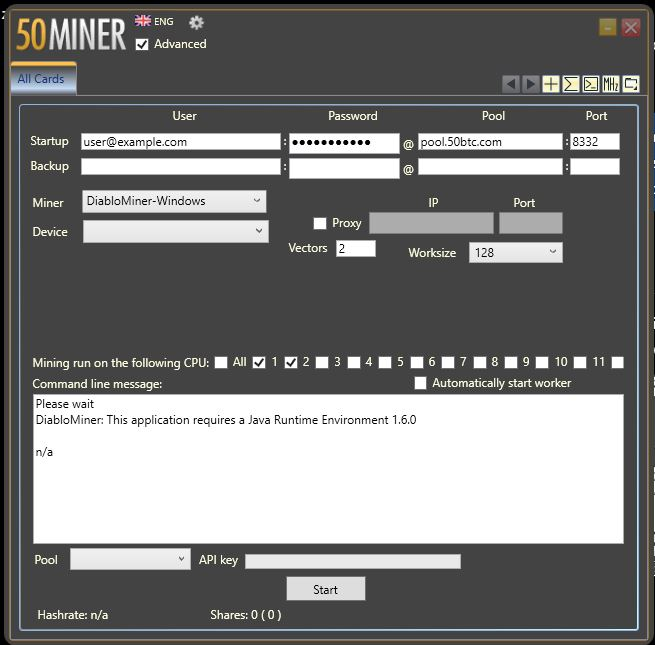
I started with BitMinter and later used 50Miner. Their windows gave me somewhere to watch what the cards were doing, but getting useful performance involved considerably more than opening a program and pressing Start.
You needed a miner that worked well with your card, a suitable graphics driver and settings that suited the particular machine. With command-line miners, a batch file could hold the pool address, worker credentials and startup options. Clock speeds, workload and cooling also had to be managed. Saving a working configuration meant you could run the same combination again instead of rebuilding it from memory.
Then came the testing. Change a value, start the miner and watch the speed and errors. A faster number was encouraging until the card became unstable or started producing hardware errors. A configuration copied from a forum was useful, but it still needed testing on your own hardware. Two apparently similar setups could behave differently.
I remember seeing figures of around one BTC, then half a BTC, on those early screens. I can no longer say for certain what period those figures covered. What I clearly remember is seeing the same equipment bring in less as time went on.
Selling Bitcoin for $30 Seemed Sensible
At the time, moving from roughly $15 to $30 looked like a substantial rise. I sold at around thirty dollars and felt that I had made a good decision. The later chart was unavailable to me, which remains an annoying limitation of every financial decision I have ever made.
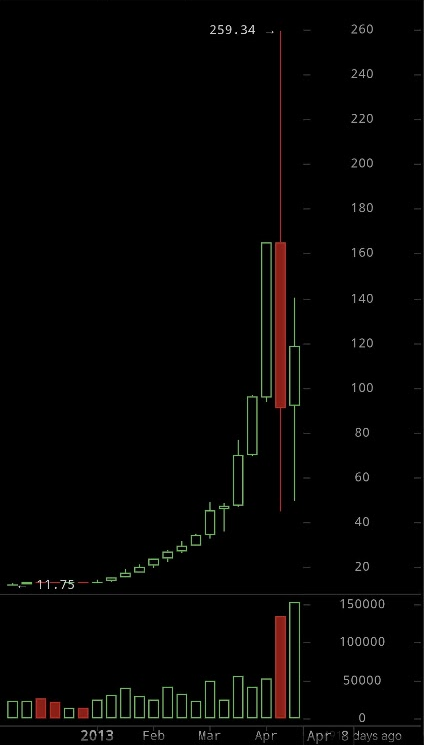
Electricity had to be paid for. The cards had cost money, and a balance on a screen would not settle a household bill until I sold it. We went to exchanges to turn the coins into something we could spend, often when we needed the money. The prices look painfully low now. Back then, covering the cost of running the rig mattered.
I kept a note titled “PRODATO COINA”, meaning “Coins Sold”, with quantities and amounts in euros. I also remember sending 0.55878038 BTC to BTC-e on 3 April 2013 at 18:45. These were the amounts I was tracking while trying to work out whether the rig was paying its way.

Moving to Litecoin Meant More Tuning
The Benchmark forum, a Serbian hardware community, was where we compared experiences and discussed what was worth mining. Those old Bitcoin mining discussions preserve the sort of information we were looking for: pools, results, software and somebody else's attempt to make a card work better.
As direct Bitcoin mining became less rewarding for my setup, I moved to Litecoin. I spent some time mining through ltcmine.ru, a pool I remember fondly. I then sent the LTC to BTC-e and exchanged it for Bitcoin. The rig was still working towards BTC, but it was earning a different coin first. Bitcoin was what I wanted to keep, because its price seemed steadier to me than those of other coins during panic selling.
Bitcoin used SHA-256 mining, and specialised ASIC hardware was increasingly taking over that work in 2013. Litecoin used Scrypt. Our graphics cards could mine it, though the settings that worked for Bitcoin were no guarantee of good results on Litecoin.
The Scrypt instructions for the old cgminer show how much tuning mattered. Driver versions were important. Parameters such as intensity and thread-concurrency affected the workload and memory use. Increasing a setting too far could make performance worse or produce hardware errors.
Even increasing the GPU core clock did not automatically mean a better hashrate. The relationship between the core and memory clocks mattered. You could move away from a good combination while believing you were making the card faster. That helps explain why we saved instructions for Reaper and cgminer and kept returning to configuration files.
I was less happy with my MYST cards' Litecoin results than I had hoped to be. A promising forum post usually meant another round of adjustments.

An ASUS Upgrade and a Diablo III Mouse Mat
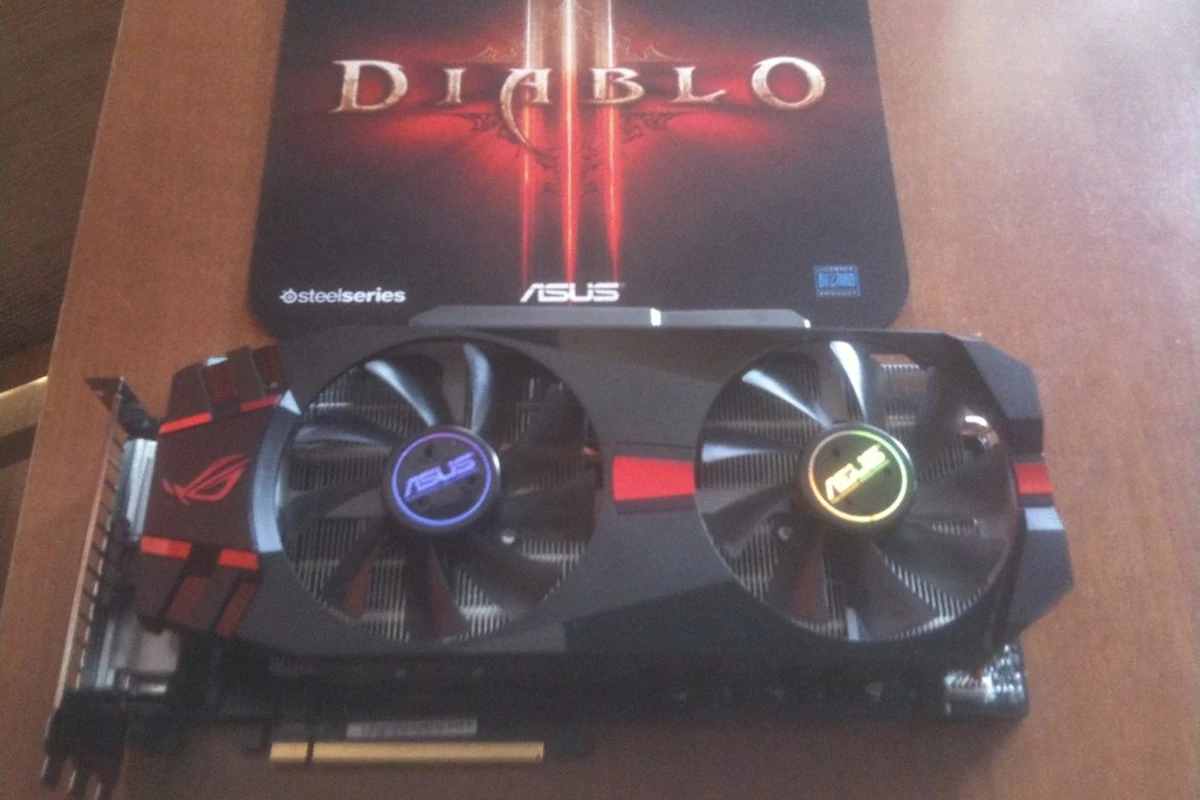
After the two MYST cards, I bought an ASUS Radeon HD 7950. A 7970 came considerably later, along with a SteelSeries Diablo III mouse mat. That is one of the details I remember most clearly from buying the later card.
The accessory fits the period perfectly. ASUS's own MATRIX HD 7970 unboxing from 2012 lists a Diablo III mouse mat among the contents. It is a useful clue to the bundle, although I would not claim an exact model number from the mat alone.
Each extra card meant another opportunity to increase the rig's output and another setup to get right. The equipment grew out of the gaming hardware world I was already interested in, the same world preserved in my collection of Svet Kompjutera magazines. A graphics card and a Diablo mouse mat belonged together quite naturally.
Then There Was Dogecoin
Dogecoin launched on 6 December 2013. I later mined it because the calculation looked better to me than mining Bitcoin directly. DOGE also used Scrypt, so the graphics cards I had used for Litecoin could be put to work on it.
The routine became familiar: check the price, look at the network difficulty and see what other miners were reporting. Then decide whether to stay with the same coin or switch. I also tried BlackCoin, Monero and other currencies later, as well as mining with a processor.
For Bitcoin, we had talked about GPU speed in MH/s. With Litecoin and Dogecoin on those cards, we usually watched figures in kH/s. Those were different algorithms doing different work, so the numbers were not directly comparable. The figure I ultimately cared about was what remained after the electricity bill.
When Mt. Gox Went Down
Exchanges were part of this routine. They were where we sold mining earnings, swapped coins and left balances while deciding what to do next. Mt. Gox was one of the names we used back then. In February 2014, it collapsed.
Its announcement from 28 February 2014 recorded that the website had closed on 25 February and that the company had applied for civil rehabilitation in Tokyo three days later. Customers who had expected to trade or withdraw their money instead faced a long legal process.
Some creditors eventually received repayments. The trustee announced Bitcoin and Bitcoin Cash repayments to some creditors on 5 July 2024, more than ten years after the collapse. The wait stretched across more than a decade of changing prices, while creditors had no access to those funds.
BTC-e and My Roughly 500 LTC
My own exchange trouble came with BTC-e, where I had around 500 LTC trapped. It had been the place where I exchanged mined Litecoin for Bitcoin. Losing access turned an ordinary part of the mining routine into a problem I could do very little to solve.
BTC-e was shut down by law enforcement in July 2017. The attempt to continue the service under the WEX name followed later that year. WEX then developed its own problems, with withdrawals frozen in July 2018.
After some time, I received about 55% of my LTC back, with the remainder represented by tokens. That matches the basic structure of BTC-e's recovery proposal from August 2017: access to part of the funds, with tokens representing the outstanding debt.
I remember having to sell those tokens quickly as their price fell. I was trying to recover whatever I could. After losing access to the original coins, even getting part of the balance back involved another pressured decision about when to sell.
I had spent so much time worrying about what a coin would be worth that losing access to the coins themselves was a particularly bitter lesson.
From $30 to $124,000 and a wallet.dat File
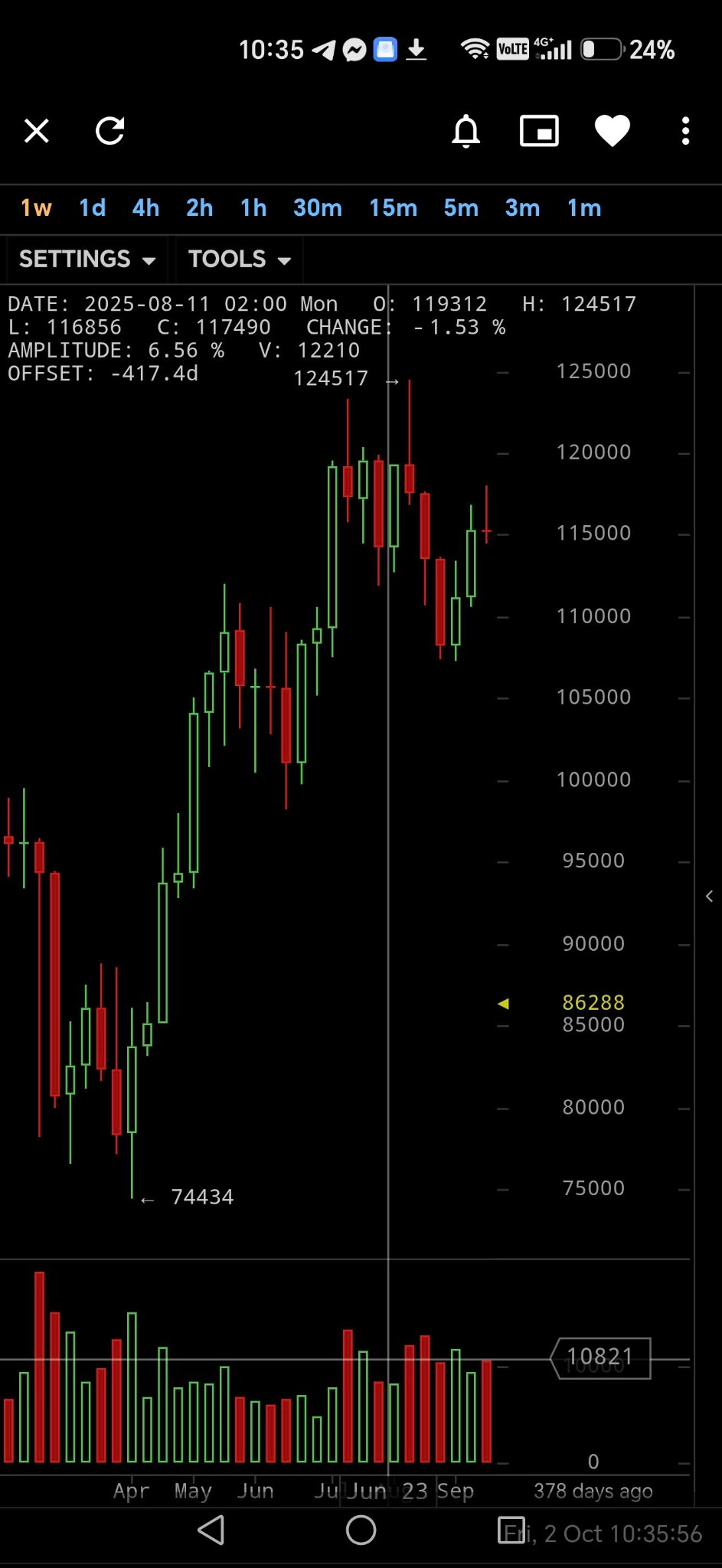
On 14 August 2025, Bitcoin traded above $124,000. Naturally, I thought again about my thirty-dollar sale. The gap between those two prices was difficult to look at without doing some very unpleasant mental arithmetic.
With hindsight, the instruction I would most like to give myself in 2013 is to take at least some coins off the exchange and keep the wallet safe. For a Bitcoin-Qt wallet of that period, the important file was wallet.dat, which held the private keys needed to spend the coins. Proper offline backups and the password mattered. Litecoin and other currencies needed their own corresponding wallets and keys.
Keeping the file would only have been part of it. I would also have had to resist selling through years of price swings and ordinary bills arriving. Once you know the later price, twelve years of waiting sounds much easier than it would have felt.
Looking at the old cards, I still remember the excitement of getting the rig working and finding another setting worth trying. There was always a new lead on the forum. It felt like a treasure hunt, and it was easy to believe the next improvement would be the important one.
Meanwhile, I was selling the treasure for $30 and congratulating myself on catching the top. At least the electricity bill got paid.
Photographs, saved notes and personal experiences are from my own archive. Further context: BitcoinWisdom's original 2013 announcement · 50Miner's original announcement.
Did you mine Bitcoin or other coins back then? Tell me in the comments when you started, what hardware you used and what you remember most.