
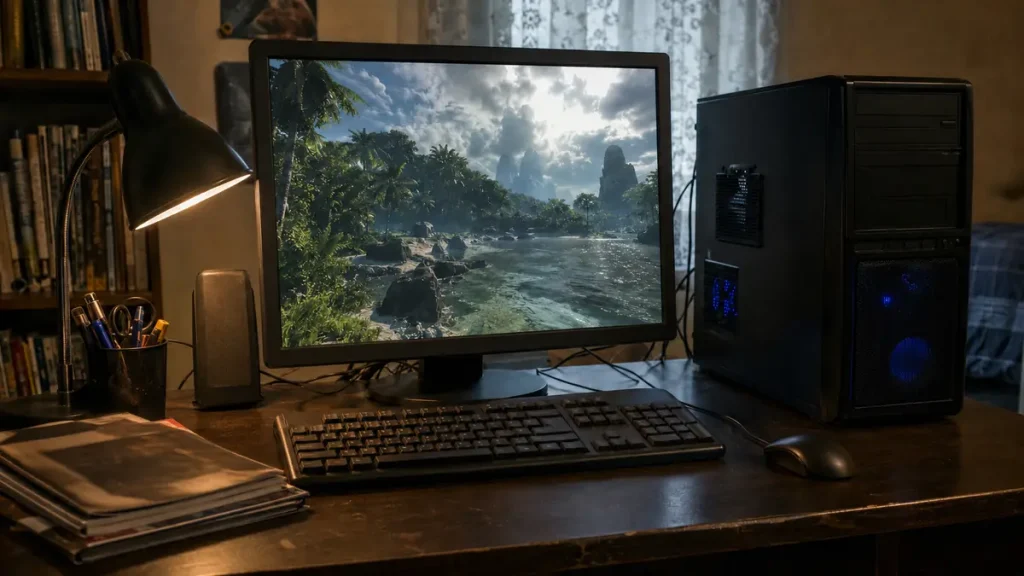
When Crysis arrived in 2007, the question was not simply whether you wanted to play it. The more important question was: could your computer run it?
The game quickly became a test of PC power. A new processor or graphics card did not seem particularly impressive until someone checked how it handled Crysis. But how much did a computer capable of running one of the most demanding games of its time actually cost?
A December 2007 issue of the Serbian computer magazine Svet kompjutera, together with a period Gigatron catalogue, gives us a rare local answer. By comparing the original review, its hardware recommendations and two complete retail PCs, we can see why Crysis became both a gaming landmark and an expensive challenge for players in Serbia.
Crysis on the Cover of Svet Kompjutera
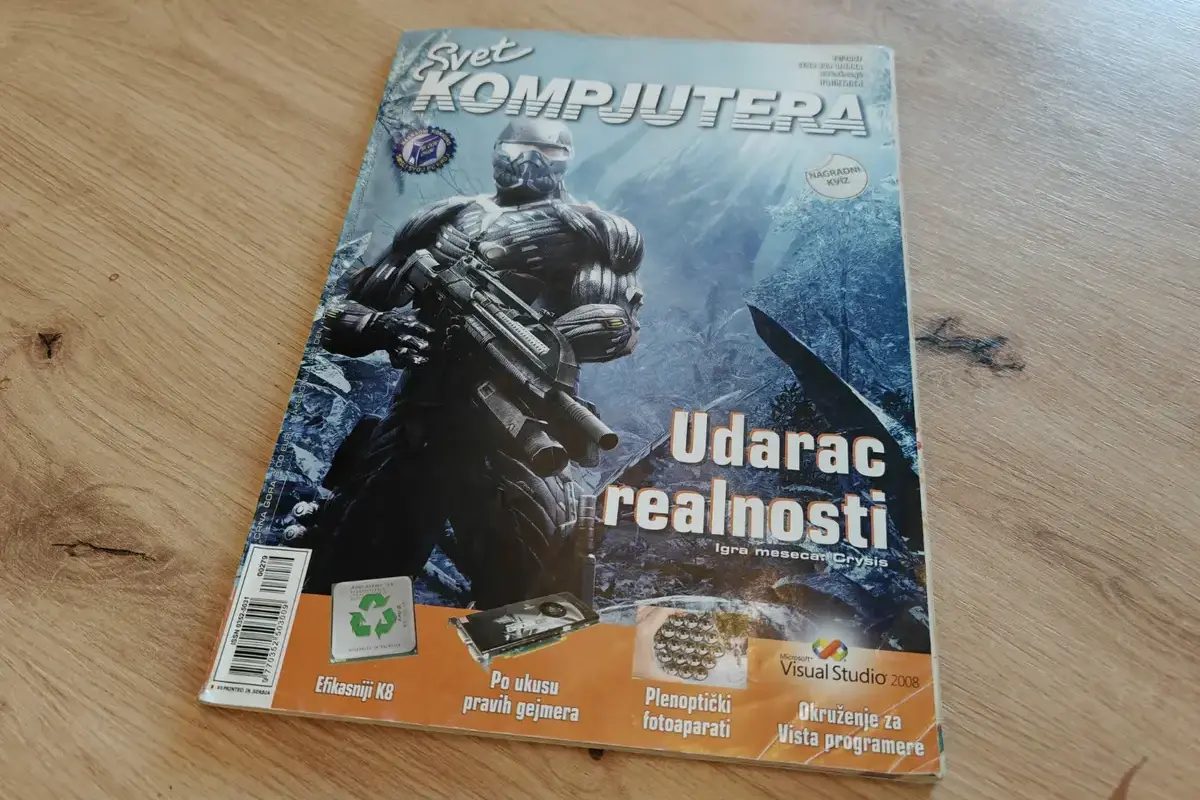
The oldest issue in my collection of Svet kompjutera magazines is issue 12/2007. Its cover features Crysis beneath the Serbian headline “Udarac realnosti”, which can be translated as “A Strike of Reality”.
That headline now feels remarkably appropriate. Crysis offered a glimpse of where PC graphics were heading, but it also delivered a harsh reality check to anyone who believed their recently purchased computer was powerful enough for every new game.
Developed by Crytek and published by Electronic Arts, the original game was released for PC in November 2007. It used Crytek’s CryEngine 2 and placed players on a tropical island filled with dense vegetation, wide landscapes, dynamic lighting and destructible objects.
Its Nanosuit allowed players to switch between armour, speed, strength and camouflage abilities. This made it possible to approach the same encounter in several ways instead of following one narrow route. The technology was impressive, but every layer of detail placed more pressure on the hardware.
Why Was Crysis So Demanding?
The jungle was not merely a painted background. Trees, bushes and smaller objects reacted to movement and combat. Large sections of the island remained visible in the distance, while water, shadows, particles and changing light made the world feel unusually alive for 2007.
The game was also designed for the new DirectX 10 features available through Windows Vista, although it could run on Windows XP with DirectX 9. Players could adjust many individual graphics options, but that often turned the first hours of playing into a long search for the right balance between image quality and performance.
Running the game and running it with maximum visual settings were two very different achievements. Even expensive graphics cards could struggle at high resolutions, especially when the “Very High” preset was selected.
A contemporary GameSpot hardware test from November 2007 found that even a GeForce 8800 GTX barely reached a playable result at 1600 × 1200 with high-quality settings. Players with high-resolution monitors were advised to reduce either the resolution or the graphics quality.
What Did the Original 2007 Review Say?
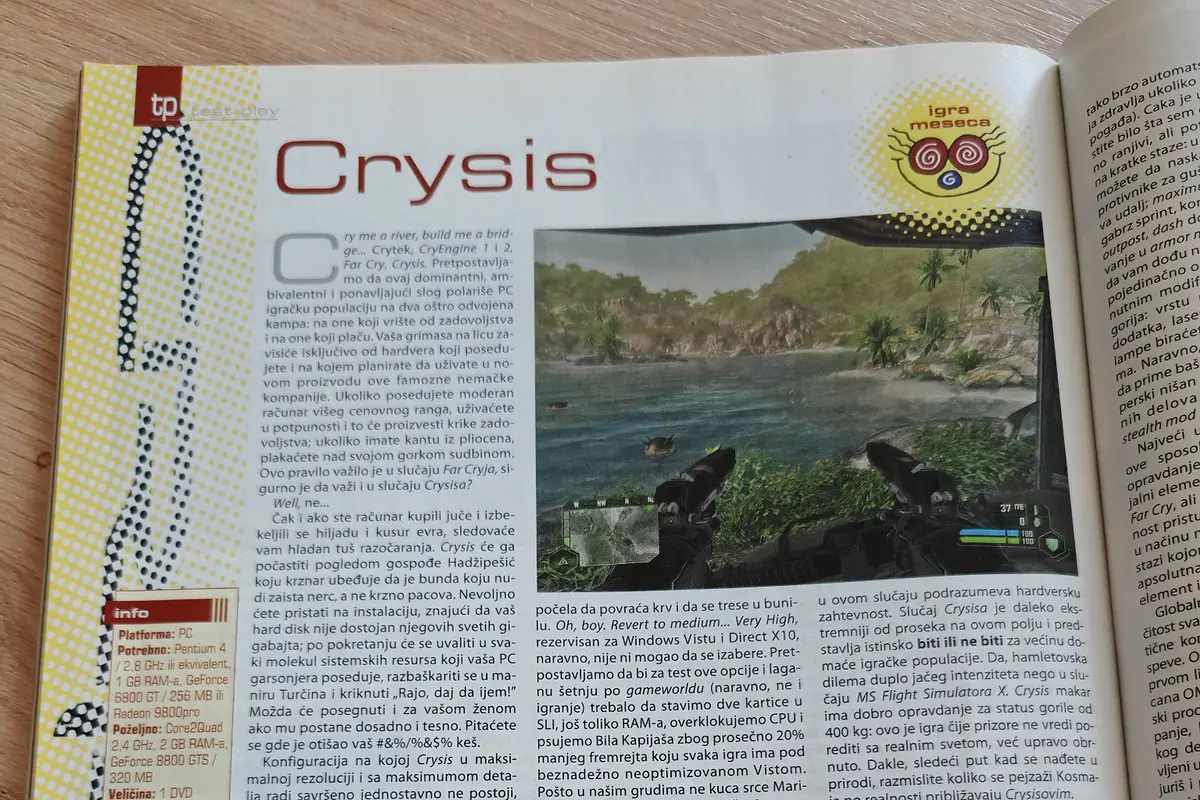
The review in Svet kompjutera did not hide the game’s hardware demands. Its test computer was powerful for the period, yet compromises were still needed when playing at a high resolution with advanced effects enabled.
For steadier performance, players were expected to lower the resolution, reduce some details or disable the most demanding visual options. This was not only a problem for ordinary family computers. Systems considered powerful in late 2007 also had to make careful adjustments.
Hardware Listed in the Magazine
The Serbian review presented both a required and a desirable configuration:
| Component | Required configuration | Desirable configuration |
|---|---|---|
| Processor | Pentium 4 at 2.8 GHz or equivalent | Core 2 Quad at 2.4 GHz |
| Memory | 1 GB RAM | 2 GB RAM |
| Graphics card | GeForce 6800 GT with 256 MB or Radeon 9800 Pro | GeForce 8800 GTS with 320 MB |
| Media | One DVD | One DVD |
These figures reflect what a reader in Serbia saw in December 2007. The game itself was listed at a price of 2,999 Serbian dinars.
The minimum specification meant that the game could start and be played with reduced settings. It did not mean that it would look like the promotional screenshots that had made so many players want it. Achieving that experience required a much more powerful and expensive system.
The minimum requirements currently preserved on the official Electronic Arts page for the original Crysis are similar, although the memory requirement differed between Windows XP and Windows Vista. EA lists 1 GB for Windows XP, 1.5 GB for Vista and a graphics card with 256 MB of memory.
A Score of 93 Despite the Hardware Demands
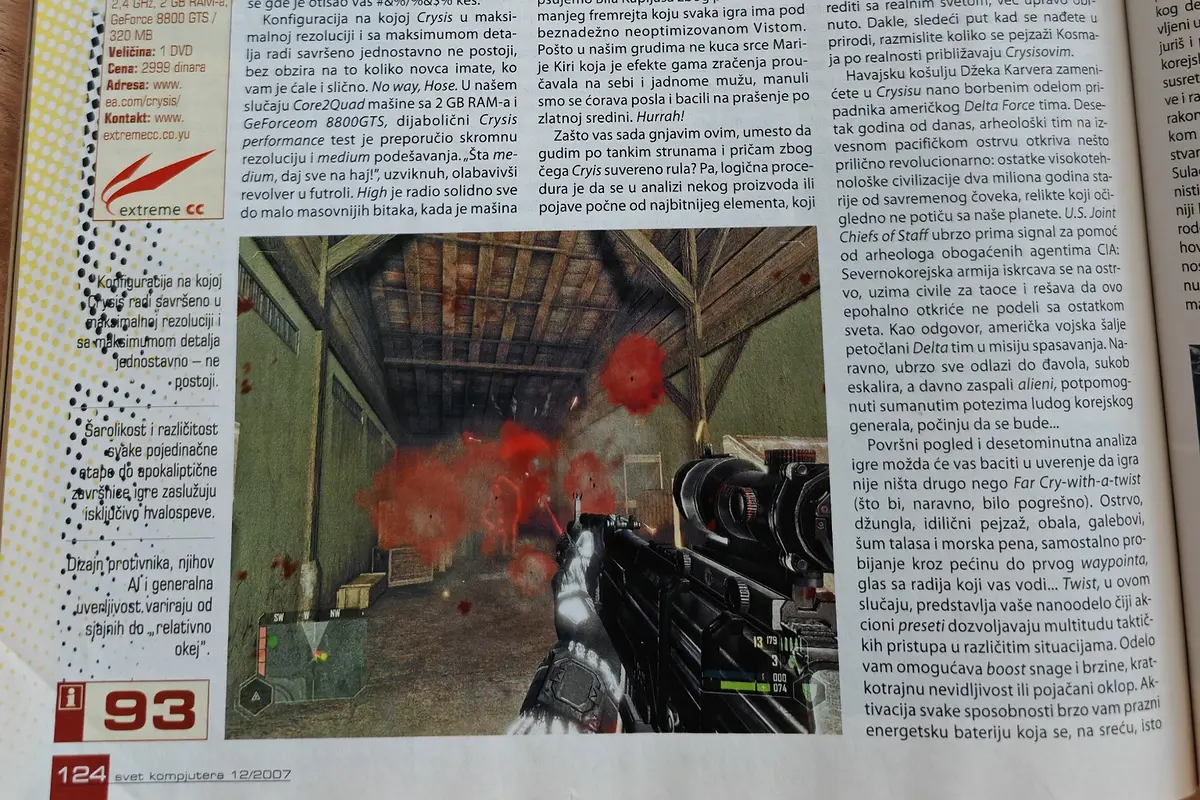
Despite its enormous appetite for hardware, Crysis received a score of 93 and was selected as the magazine’s game of the month.
The high score reflected more than attractive graphics. The large environments, flexible Nanosuit abilities and freedom to approach encounters in different ways made the game feel unusually ambitious. It was possible to attack directly, move quietly through the vegetation or use the environment to find another route.
The review also left room for criticism, particularly when discussing enemy behaviour and the demanding system requirements. Even so, the overall experience was considered strong enough to place Crysis among the most important PC releases of its generation.
Its reputation came from a rare combination: it was a real game rather than a simple technology demonstration, but its technology was so advanced that contemporary hardware could not comfortably display everything it offered.
How Much Did a Gaming PC Cost in Serbia in 2007?
A Gigatron catalogue from the same period helps place those requirements into a real shopping context. It advertised two complete desktop systems with 2 GB of RAM, a GeForce 8600 GT graphics card and a 19-inch monitor. One used an Intel processor, while the other was built around an AMD processor.
These were not bare computer towers. Both packages included a monitor and basic peripherals, making them closer to the kind of complete system a family might have purchased for work, school, internet access and gaming.
Intel Energy – 52,370 Dinars
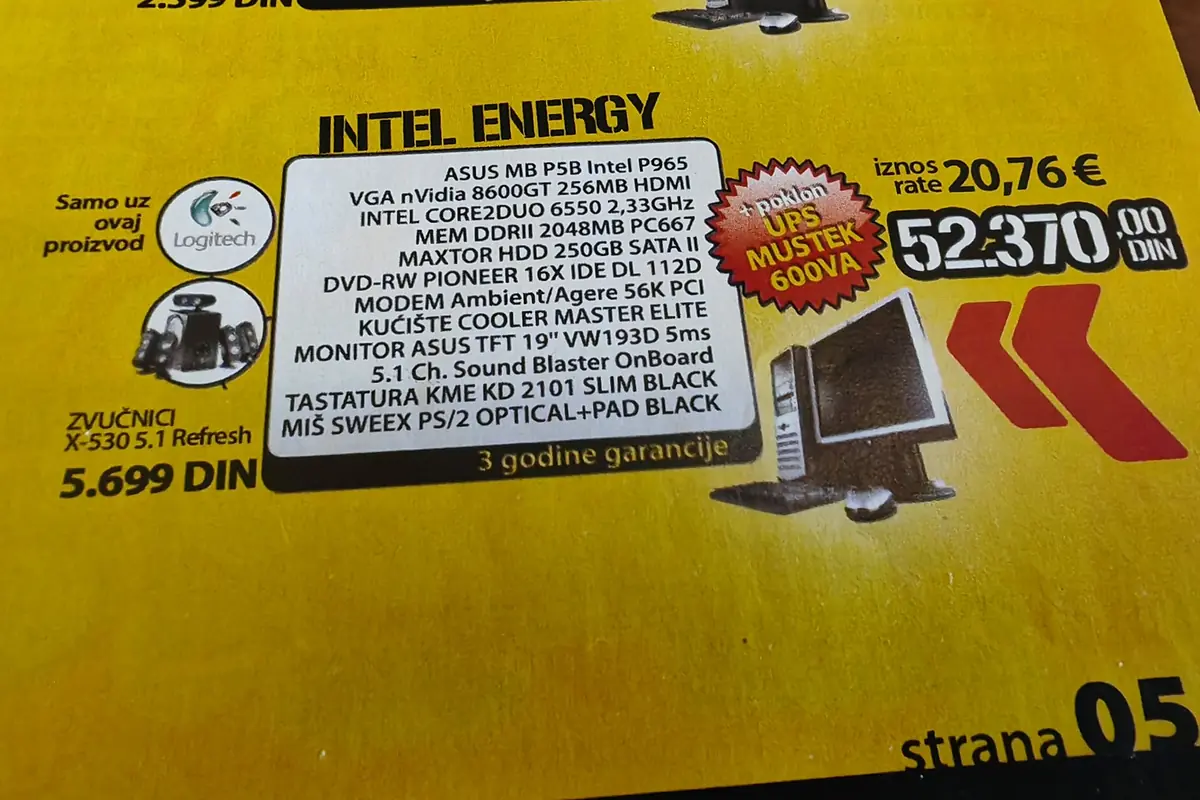
The more expensive system was called Intel Energy. It included an Intel Core 2 Duo E6550 processor running at 2.33 GHz, 2 GB of DDR2 memory, a GeForce 8600 GT graphics card with 256 MB and a 250 GB hard drive.
The advertised price of 52,370 dinars also covered a 19-inch Asus TFT monitor, a Cooler Master Elite case, a DVD writer, keyboard, mouse and mouse pad. The catalogue listed a three-year warranty and a 600 VA Mustek UPS as a gift.
For late 2007, this was a capable and modern home computer. The dual-core processor and 2 GB of memory were useful well beyond gaming, but the GeForce 8600 GT prevented it from becoming a true high-end Crysis machine.
AMD Energy – 46,790 Dinars
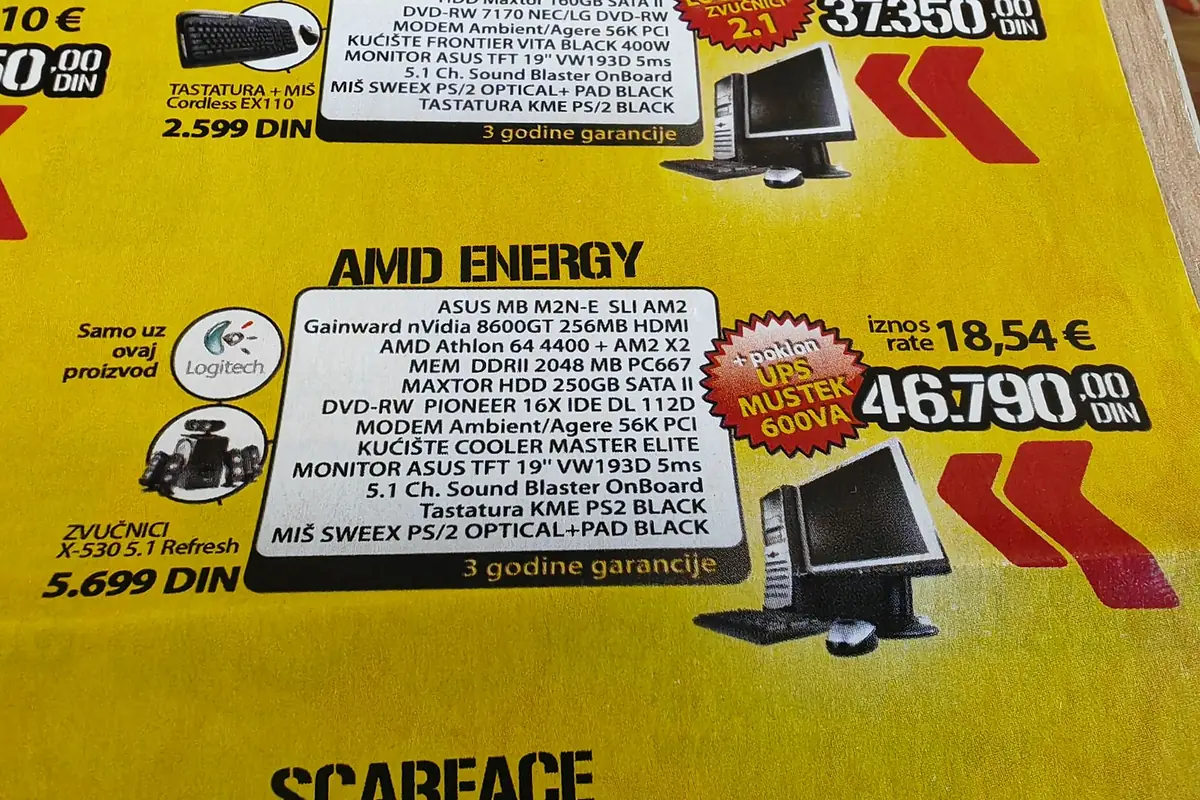
The less expensive AMD Energy system used an AMD Athlon 64 X2 4400+ processor. It also came with 2 GB of DDR2 RAM, a GeForce 8600 GT with 256 MB and a 250 GB hard drive.
With the same 19-inch monitor, DVD writer, case, keyboard and mouse, the complete package cost 46,790 dinars. A three-year warranty and the UPS gift were also included.
The AMD model therefore offered a similar gaming experience for 5,580 dinars less. However, both systems shared the same graphics card, which was the component most likely to limit performance in Crysis.
Could These Computers Actually Run Crysis?
The short answer is: yes, but only with compromises.
Both computers had dual-core processors and 2 GB of memory, giving them a reasonable foundation for the game. The main limitation was the GeForce 8600 GT. It was newer than the GeForce 6800 GT listed among the minimum options, but far weaker than the GeForce 8800 GTS shown as the desirable card in the magazine.
Players using either Gigatron system would therefore have needed to reduce the resolution and adjust several visual settings. Low or medium settings, with carefully selected higher details, would have been more realistic than attempting to use the maximum preset.
The 19-inch monitors included with the systems probably used a native resolution of 1280 × 1024, which was common for that size at the time. Running the game below the monitor’s native resolution could improve performance, although the image would not appear as sharp.
This difference between “able to run the game” and “able to run it well” is central to the history of Crysis. A computer could satisfy the minimum requirements and still produce an experience far removed from the game’s most impressive screenshots.
The Price Was Higher Than an Average Monthly Salary
The catalogue prices become more meaningful when compared with income in Serbia at the time. According to a January 2008 report based on data from the Serbian Statistical Office, the average net salary paid in December 2007 was 34,471 dinars.
| Item | Price in 2007 | Share of the average net salary |
|---|---|---|
| AMD Energy PC package | 46,790 RSD | Approximately 1.36 salaries |
| Intel Energy PC package | 52,370 RSD | Approximately 1.52 salaries |
| Crysis | 2,999 RSD | Approximately 8.7% of one salary |
This comparison is only a broad guide. An average salary does not represent every household, and the computers included monitors and peripherals rather than only the tower. Even so, the figures show that buying a new PC was a serious family expense.
Spending more than one average monthly salary did not guarantee maximum graphics settings. A buyer could bring home a modern computer, install one of the most talked-about games of the year and still discover that the first task was to lower the visual quality.
“Can It Run Crysis?” Became Part of PC Culture
Over time, the question “Can it run Crysis?” became more famous than any individual hardware recommendation. It appeared whenever a new graphics card, processor or unusually powerful computer was discussed.
The phrase worked because so many players had shared the same experience. They installed the game, opened the graphics menu, selected ambitious settings and watched their expensive machine struggle. Then came the familiar routine of lowering the resolution, changing shadows, reducing effects and testing the result again.
Crysis remained in hardware benchmarks long after 2007 because newer computers also needed time to catch up with everything the engine could display. The game became a symbol of software designed with future hardware in mind.
Not everyone had a suitable gaming computer at home. Throughout the 2000s, many players experienced demanding games on the best machines available in internet cafés and LAN centres. Regular visitors often knew exactly which computers had the strongest graphics cards and which seats were worth waiting for.
A Magazine and Catalogue as a Time Capsule
It is easy to find old system requirements online today, but the physical magazine and retail catalogue reveal something more personal. They show what a customer in Serbia could read, compare and realistically purchase at the end of 2007.
On one page is a game rated 93, accompanied by the warning that even powerful hardware must make compromises. On another are complete computers with 2 GB of RAM, 250 GB hard drives, 19-inch monitors and graphics cards that looked modern but were still humbled by Crysis.
This was a period when people studied computer catalogues carefully. Processor and graphics card names were written down, prices were compared and possible upgrades were planned one component at a time. A computer was not used only for games. It was also a place for schoolwork, music, early social networks, internet browsing and personal collections of files.
The rituals of older PC use had already begun to change. The era of installing software from floppy disks was fading, DVD drives had become standard and larger hard drives allowed people to keep more games, photographs, music and videos than before.
Why Do We Still Remember Crysis?
Crysis is not remembered only because it was difficult to run. If it had offered nothing beyond impressive graphics, it would probably be remembered as an interesting technical demonstration rather than a gaming landmark.
Its lasting appeal came from the combination of open environments, flexible combat, Nanosuit abilities and a world that felt several years ahead of the average home computer. The hardware demands became part of the story, but they were not the whole story.
The magazine review and the two catalogue systems return us to a time when it could not be assumed that a new game would work well on the computer we already owned. Sometimes a trailer or magazine screenshot was enough to start dreaming about a new graphics card, more memory or an entirely new PC.
Today, these systems belong to retro computing history. Their specifications show how quickly technology has changed, while their prices reveal how significant such a purchase once was. Most importantly, they preserve the moment when one game became the measuring stick for an entire generation of PC hardware.
If you enjoy bringing old computers, magazines, controllers and gaming memories together, you may also like this guide to building a retro gaming corner at home.
Did you try to run Crysis in 2007? What hardware did you have, and how far did you need to lower the graphics settings?
Sources
- Electronic Arts – Original Crysis release information and system requirements
- Crytek – Original Crysis announcement and CryEngine 2 information
- GameSpot – Crysis Hardware Performance Guide, November 2007
- Government of Serbia – Average net salary for December 2007
- Svet kompjutera 12/2007 and a Gigatron catalogue from 2007, photographed from the author’s private collection.