

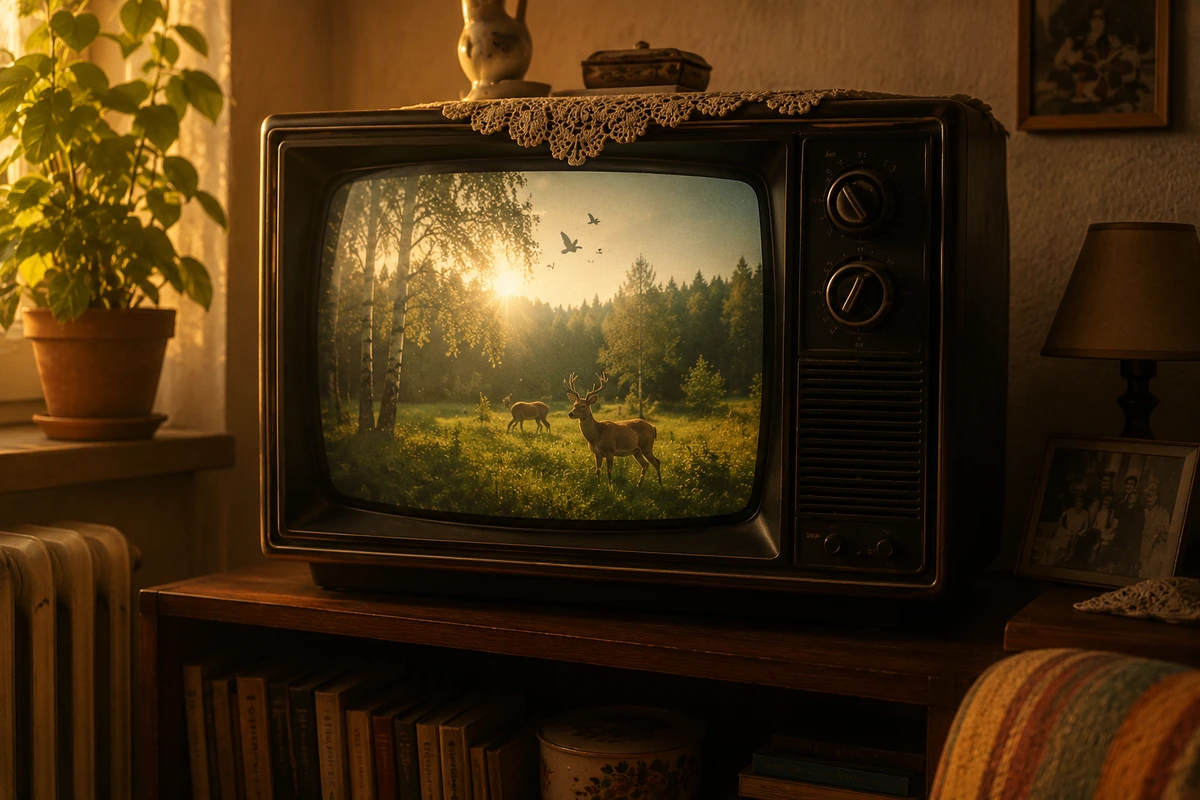
Before streaming platforms, smartphones and endless recommendations, television had a very different place in everyday life. One programme that defined that experience was the Survival wildlife series, known to generations of viewers across the former Yugoslavia as Opstanak. A bulky CRT set stood in the corner, coffee was being prepared, and a calm voice introduced us to animals and landscapes that seemed impossibly far away.
The Survival wildlife series was originally produced by Anglia Television in Britain and became an important part of television history. You can read more about Anglia Television’s pioneering Survival documentaries on ITV News.
For those who remember it from childhood, it was never only a programme about animals. It became part of the atmosphere at home — quiet Sundays, the smell of coffee, the sound of dishes from the kitchen and the gentle glow of an old television.

A programme we did not have to search for
Today, we search for almost everything we watch. We type a title, open a video, skip the introduction and move on after a few seconds if it does not immediately catch our attention.
Survival entered our lives differently.
It simply appeared on television. You might have been waiting for lunch, passing through the room or sitting at the table while the adults talked. Then the pictures of forests, oceans, deserts or distant grasslands appeared, and somehow you stayed to watch.
It did not matter whether the episode followed lions, elephants, birds, insects or animals whose names we could barely remember. The natural world looked enormous, mysterious and real. For a while, the television became a small window into places we had never visited.
How the Survival wildlife series brought nature into our homes
Children growing up before smartphones could not instantly search for every animal they saw. There were no short clips waiting on a phone and no algorithm offering another wildlife video every few seconds.
We learned through schoolbooks, illustrated encyclopaedias, magazines and television documentaries. Because information was not always available immediately, discovering something new felt more important.
The Survival wildlife series could introduce an entire family to an unfamiliar habitat. One moment you were sitting at home in slippers, and the next you were watching deer move through a misty forest or birds circle above a distant landscape.
It was slow, but it held our attention
Older wildlife programmes were not edited like modern online videos. Shots lasted longer. The camera observed instead of constantly jumping from one subject to another. The narration was calm, and there was no need to promise something surprising every few seconds.
That slower rhythm gave the programme a sense of importance. It felt as though someone knowledgeable was patiently explaining how the natural world worked.
There was also no simple way to pause, rewind or watch the same scene again. When something appeared on screen, you paid attention because the moment would soon be gone.
Perhaps that is one reason those images stayed in our memories for so long.
Sunday coffee and the television in the background
Some childhood memories return through pictures. Others return through smells and sounds.
The smell of coffee. Lunch being prepared. The quiet movement of adults around the house. A newspaper resting on the table. The gentle hum of an old television that was rarely completely silent.
The Survival wildlife series belonged naturally to that world.
Not everyone watched every episode from beginning to end. Sometimes the programme was simply playing in the background. We might remember only one animal, one landscape or the familiar voice of the narrator. Yet all those small details became part of a much larger memory of home.

Food was also part of those family weekends. Many of the simple dishes we remember from that period were not prepared for photographs or social media. They were everyday meals served while the television played in the next room. You can revisit some of those memories in our article about foods we made in the 90s.
When television was a shared experience
Today, everyone in a household can watch something different on a separate screen. One person uses the television, another a tablet, while someone else scrolls through a phone with headphones on.
Older television often brought people into the same room.
Even when nobody had deliberately chosen the programme, everyone could see and hear it. A child might ask a question about an animal. A parent might remember seeing a similar documentary before. Someone would turn up the volume, and for a few minutes the whole family watched the same thing.
There were fewer choices, but the things we watched often became shared memories.
Nature was beautiful, but it was not always gentle
Survival also showed children that nature was not a perfectly safe storybook world.
Animals searched for food, protected their young, defended their territory and adapted to difficult conditions. Every creature appeared to have a place within a much larger system.
We may not have understood every explanation, but we understood that we were watching something real. Nature could be peaceful, unpredictable, strange and powerful at the same time.
For many children, programmes like this created an early interest in animals, geography and distant parts of the world. They made the planet feel much larger than our street, school or neighbourhood.
We also listened differently
The same period had its own rituals around music. We carried albums on CDs, wrote track lists by hand and carefully protected our favourite discs from scratches. Later, portable players allowed us to take large MP3 collections wherever we went.
Those memories live on in our story about portable CD players and MP3 CDs.
On computers, another familiar name defined an era. Before music libraries moved to streaming services, many of us organised our songs, created playlists and customised our players with colourful skins. Read more about the time when Winamp was the king of music.
Television and music were different experiences, but they created similar memories. We had less content available at any moment, yet we often formed a stronger connection with what we had.
Why the Survival wildlife series still affects us
Modern wildlife documentaries offer spectacular detail, high-resolution images and scenes that old television technology could never show. Yet technical quality is not the only thing that creates a lasting memory.
When people remember Survival or Opstanak, they often remember the room around the screen as clearly as the programme itself.
They remember the furniture, the curtains, the cup on the table and the sound of the television warming up. They remember the feeling that Sunday moved more slowly than the rest of the week.
The programme became connected to a particular period of life — one without notifications, endless scrolling or another screen constantly competing for attention.
One programme, two familiar names
The Survival wildlife series connected wildlife stories with the everyday experience of watching television at home.
English-speaking viewers knew the series by its original title, Survival. Across the former Yugoslavia, many viewers remembered it as Opstanak, a local title that became inseparable from the experience of watching it.
The language and narration may have been different, but the images of wildlife connected viewers across countries and generations.
For people from the Balkans and members of the diaspora, mentioning Opstanak can still open an entire collection of memories. It is not only the memory of animals on television. It is the memory of being at home.
The feeling cannot be streamed
Today, we can watch nature documentaries whenever we choose. We can pause them, replay them and find information about almost any animal within seconds.
What we cannot recreate so easily is the world in which we first watched them.
The Survival wildlife series was more than a programme shown on the screen. It was the quiet house, the smell of coffee, the approaching family lunch and the old television glowing in the corner.
Perhaps that is why the programme still means so much.
We do not only remember what we watched.
We remember what home felt like while we were watching it.