
Portable CD Players and MP3 CDs
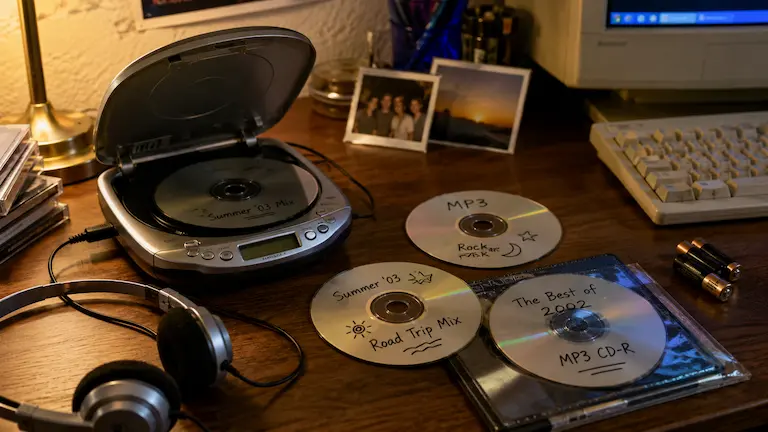
Before phones became our music players, before Spotify, YouTube Music, Bluetooth earbuds, and endless playlists in the cloud, there was one little device that meant freedom to a lot of people: portable CD players and MP3 CDs.
For those who grew up in the late 90s and early 2000s, a portable CD player was not just something you used to listen to music. You carried it in your backpack, protected it in your jacket, tried not to shake it too much, and treated it like a small piece of personal technology that actually mattered.
Back then, music did not live in the cloud. It lived on discs, in plastic cases, often with handwritten labels. If you had a good CD, fresh batteries, and headphones that worked in both ears, you were ready for school, the bus, a road trip, or just a walk around the neighborhood.
Before music lived inside our phones, we carried it inside a portable CD player.
Today it may seem inconvenient, but back then it had a special kind of charm. Every disc felt like a small collection of memories.
A Regular Audio CD Could Only Hold So Many Songs
At first, many people used regular audio CDs. Those discs worked in older CD players, home stereo systems, car stereos, and portable CD players that did not support MP3 playback.
A regular audio CD usually held around 70 to 80 minutes of music. That meant maybe 15, 18, or 20 songs, depending on how long they were. Because of that, every song choice mattered.
There was no room for everything. You had to decide which songs really deserved to be on the disc. If you were making a CD for a road trip, for school, for friends, or just for yourself, the order of the songs mattered too.
The opening track had to set the mood. After that, the middle of the disc had to keep the energy going. By the end, the final song needed to close everything in the right way.
That is why regular audio CDs often felt more personal than today’s playlists. They were not endless. They had a beginning, a middle, and an ending.
Portable CD Players and MP3 CDs Changed How We Listened to Music
When more people started using portable CD players that could read MP3 CDs, everything suddenly felt more serious. You no longer had to carry just one album or a disc with twenty songs. You could fit much more music onto one CD.
For many of us, that felt like a huge upgrade. One MP3 CD could hold dozens, sometimes even hundreds of songs, depending on the quality and file size. Instead of one album, you carried a small personal music library.
The disc could have folders like “Rock,” “Rap,” “Pop,” “Techno,” “New Songs,” “Road Trip,” “Favorites,” or “Mix.” Some folders looked carefully organized. Others looked like complete chaos.
But that chaos was part of the charm. You put the disc in, waited for the player to read it, jumped from folder to folder, skipped tracks, and hoped everything would work the way it was supposed to.
Portable CD players and MP3 CDs gave us the feeling that we could take our music anywhere, even when the process was not exactly simple.
Burning MP3 CDs Was Its Own Ritual
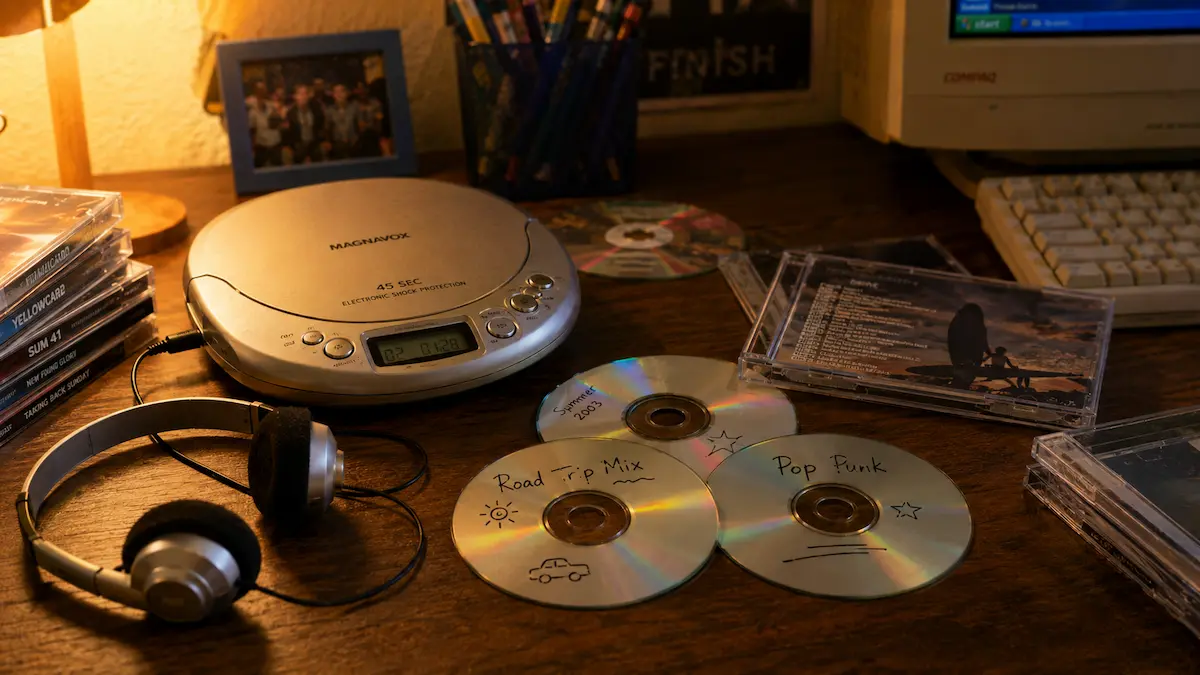
Before the music ended up in your portable CD player, you first had to make the disc. That is where Winamp, Nero Burning ROM, blank CD-R discs, a marker, and that familiar waiting screen all became part of the experience.
First, you built the playlist. You listened to songs, changed the order, deleted a few, added a few more, and checked if everything could fit on the disc. Only then did you open Nero or another CD burning program.
A successful burn felt like a small victory. But if the process failed at 87%, that CD often ended up ruined. It was a small tragedy, especially if you did not have many blank discs left.
The handwritten labels had their own personality: “Mix 2003,” “Road Trip,” “Best Songs,” “Rock,” “Rap,” “New Music,” “Summer Mix,” or simply “MP3.” Some people wrote neatly. Others just scribbled something with a marker. Either way, every disc had its own character.
If you enjoy this kind of early 2000s nostalgia, you may also like our story about burning music CDs and how personal music collections were made before streaming took over.
Batteries, Skipping, and Protecting the Portable CD Player
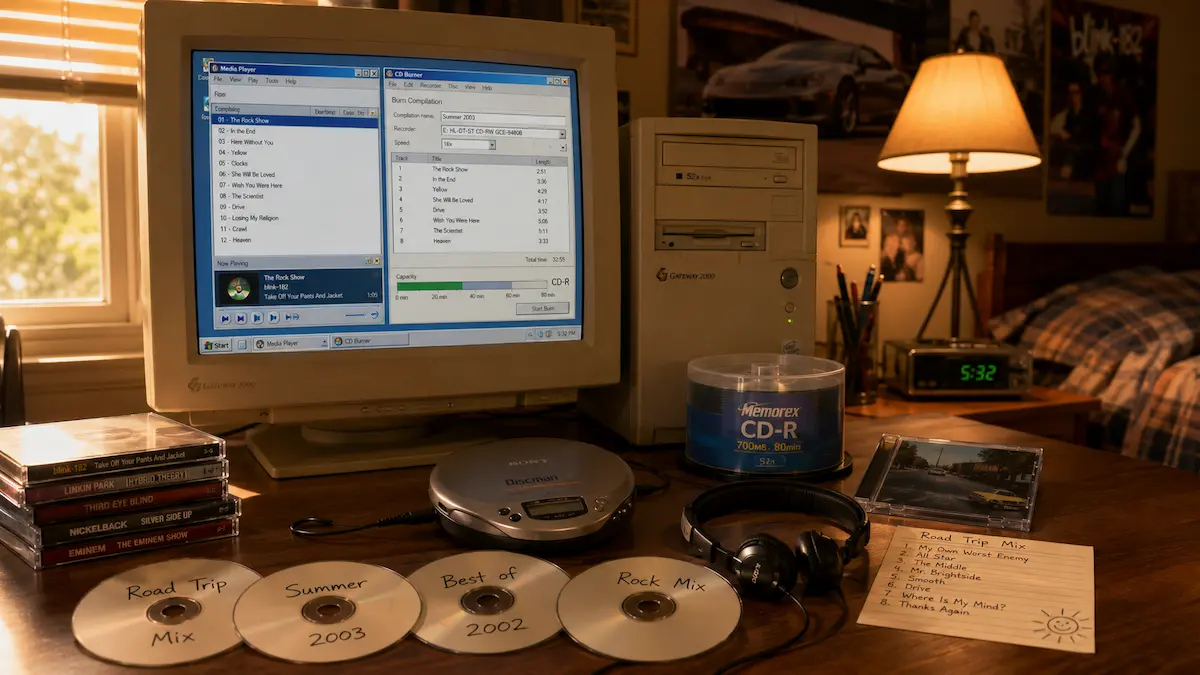
A portable CD player had one big problem: you had to be careful with it. If you shook it too much, the song could skip. Later models had better anti-skip protection, but everyone who used one remembers the feeling of walking carefully so the music would not cut out.
Unlike a phone, you could not just throw it into your pocket and forget about it. It was bigger, more sensitive, and needed its own safe place. People carried it in backpacks, in their hands, in jacket pockets, or in little soft cases made for portable players.
Batteries were another big part of the experience. Most players used AA batteries, so you had to think ahead before leaving the house. Some people used regular batteries, some used rechargeable ones, and some always kept an extra pair in a drawer, backpack, or glove compartment.
Weak batteries could ruin the whole mood. The music might start cutting out, the player might shut off, or the disc might refuse to load. Today, our phones show us an exact battery percentage. Back then, you often knew it was over only when the player stopped cooperating.
People still loved these devices. They gave you the feeling that your music was truly yours and that you could take it with you.
Portable CD Players on the School Bus, in Backpacks, and on Road Trips
For many people, portable CD players are strongly connected to travel. The school bus, family road trips, summer vacations, rides across town, or just sitting in the back seat staring out the window — everything felt different when your own songs were playing in your headphones.
The headphones were not always great. Sometimes only one side worked. Sometimes the cable cut out if you moved it the wrong way. But when your favorite song started and you looked out the window, the whole ride suddenly had a different feeling.
At school, a portable CD player was often something someone pulled out during a break. Then came the questions: “What are you listening to?” or “What’s on that disc?” If someone had a good MP3 CD, people noticed.
Friends traded discs, borrowed them, copied them, and sometimes never gave them back. A few came back scratched. Others disappeared completely. Some stayed in a drawer for years, quietly holding a little piece of that time.
When an MP3 CD Was Better Than a Whole Album
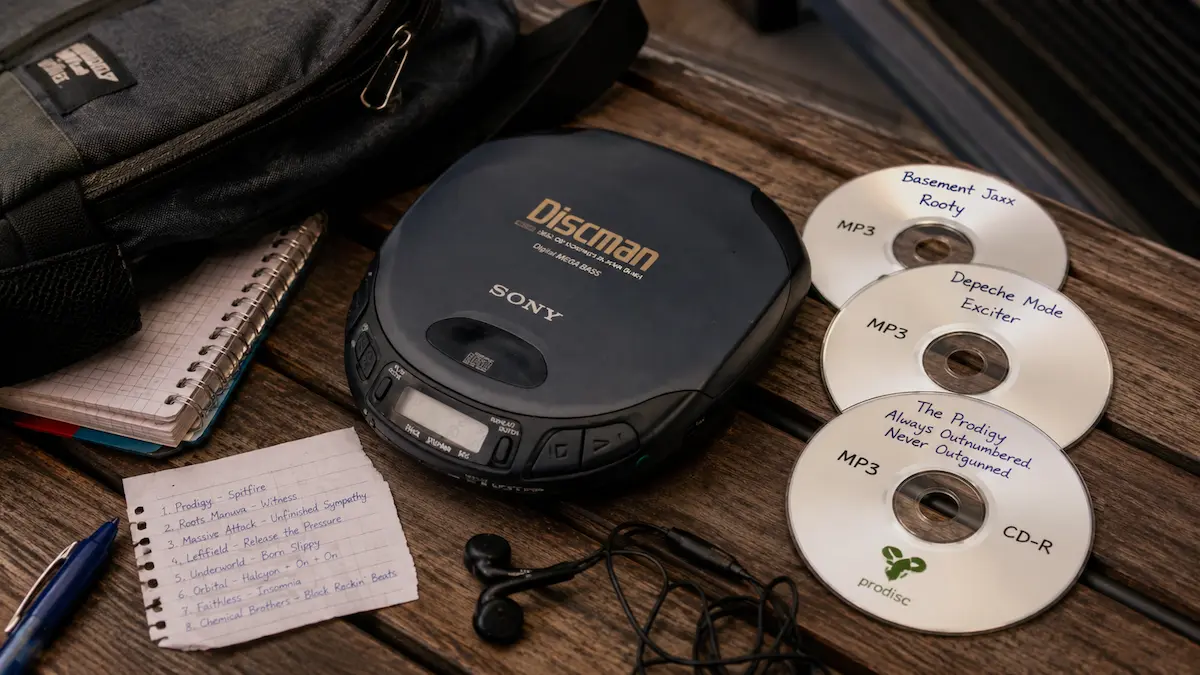
One of the best things about MP3 CDs was the freedom to make your own selection. You did not have to listen to just one album from beginning to end. You could put everything you liked at that moment onto one disc.
A single MP3 CD could have a little rock, a little rap, some pop, a few dance tracks, movie themes, cartoon intro songs, and a couple of random songs that only made sense to you.
It was a personal collection. It was not perfect, but it was yours. An algorithm did not make it. An app did not suggest it. You built it yourself, song by song.
That was the biggest difference. Today, we have more music than ever, but back then every song on a disc had passed through some kind of personal choice.
From Winamp to the Portable CD Player
The whole computer culture of that time connected portable CD players and MP3 CDs. First, you listened to music on Winamp. Then you made a playlist. After that, you burned it onto a CD. Finally, that disc went into your portable CD player.
The full chain had its own rhythm: the computer, MP3 folders, Winamp, Nero, a CD-R disc, a marker, a portable CD player, and wired headphones. Every part had its role.
This nostalgia is not only about one device. It is about the whole way we listened to, saved, organized, and shared music.
That same early computer feeling also lives in memories of floppy disk installation, old folders, CRT monitors, and programs we used for years.
Why Do We Still Remember Portable CD Players?
Today, everything is easier. Music is on our phones, headphones are wireless, playlists live inside apps, and nobody has to burn songs onto discs just to take them outside.
But that is exactly why portable CD players feel different in our memories. You had to prepare the music. You had to choose the disc. You had to think about batteries. You had to protect the CD from scratches.
The ritual made the music feel personal. Every disc had a story. Every plastic case had scratches. Every handwritten label could bring back a memory.
For many of us, portable CD players and MP3 CDs were not just old technology.
They were a way to carry a small musical world with us.