
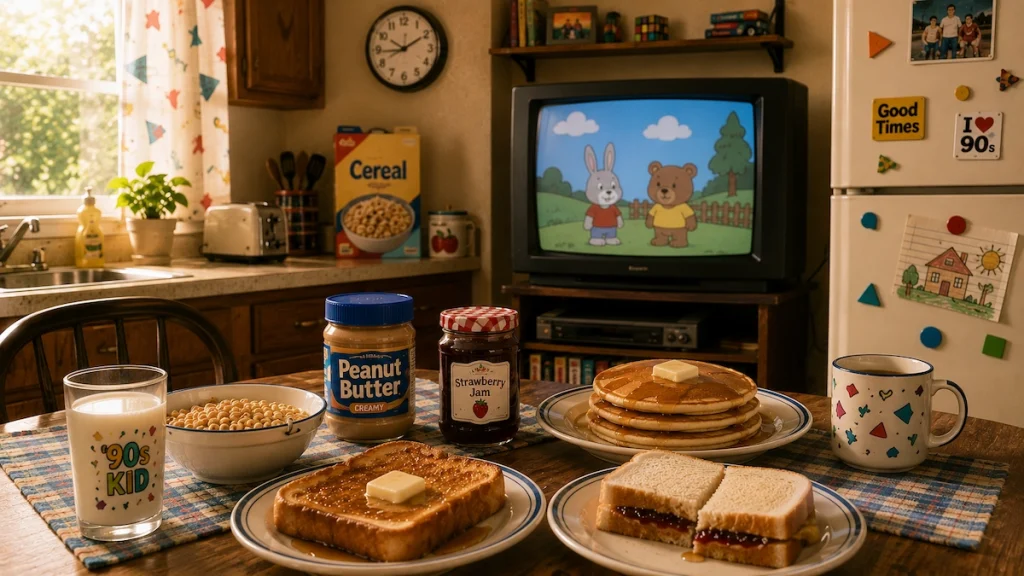
When I think of the foods we made in the 90s, I remember bread broken into milk with sugar, a slice spread with margarine and sprinkled with sugar, and spaghetti with ketchup. I also remember waiting beside the stove and watching cartoons during a meal.
Someone else might start with a cereal bowl, pancakes or a sandwich packed for school. The details depend on where we grew up and what our families cooked. These are meals we associate with the decade, rather than recipes invented in it.
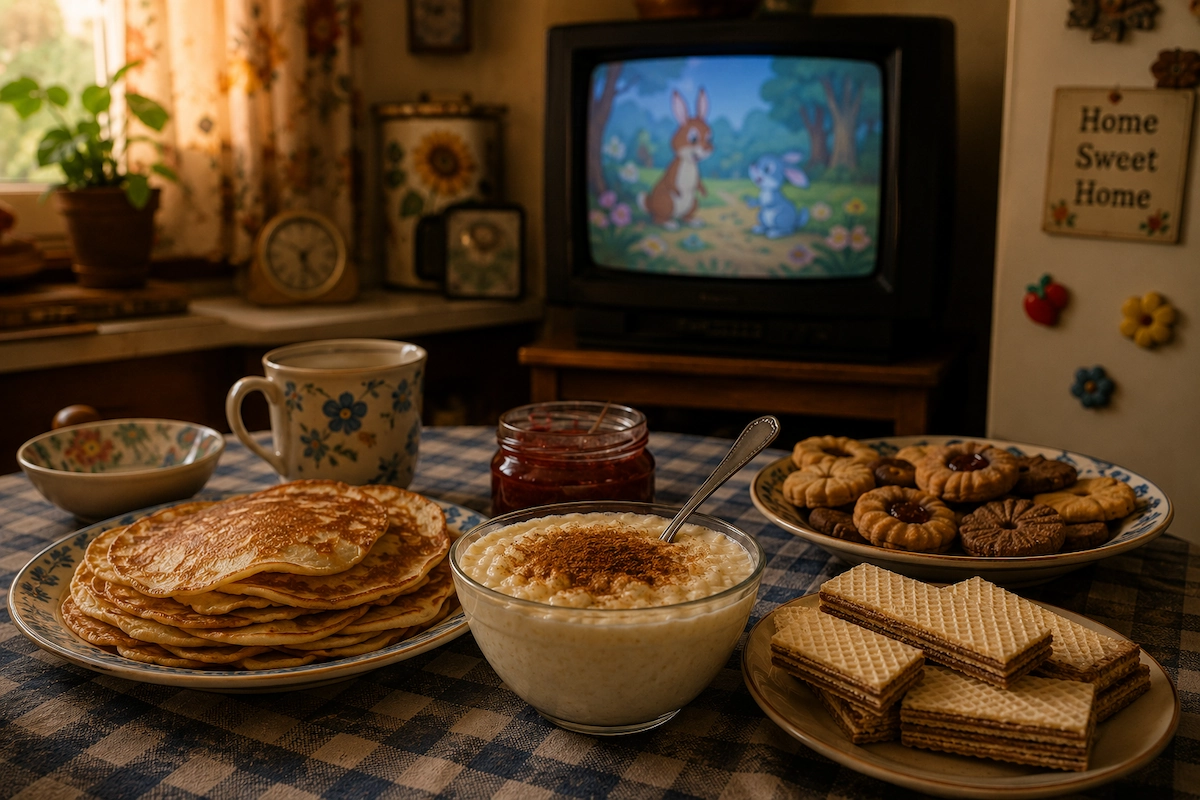
The images in this article are AI-generated illustrations inspired by 1990s kitchens.
Bread, milk and a spoon
Bread in milk with a little sugar is one of my own childhood memories. The preparation was almost as short as the ingredient list: break the bread into a bowl, pour over the milk and add sugar. The bread softens, the crust gives a little more resistance, and everything can be eaten with a spoon.
I remember bread with margarine and sugar too. The sugar stayed on the surface and crunched between my teeth. It was a quick snack with no cooking involved, quite different from the soft bread in the bowl.
Toast and bread dipped in eggs
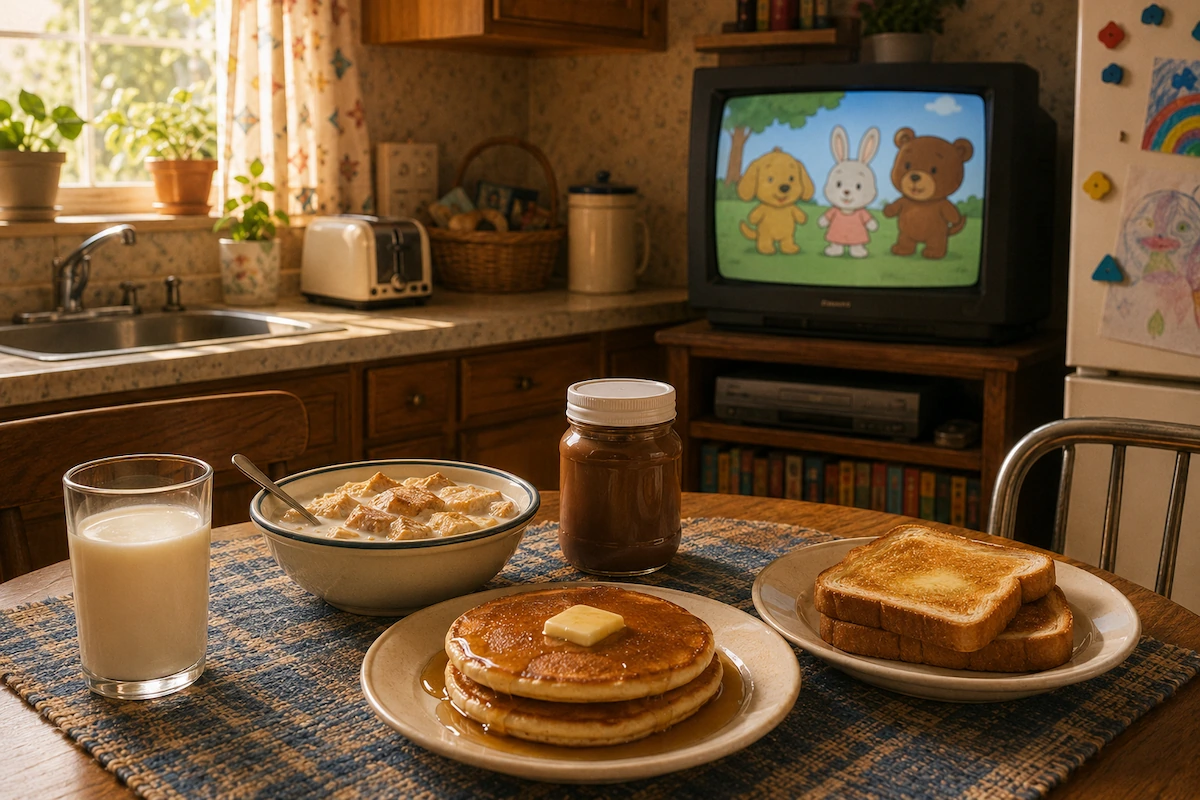
A loaf could produce several different breakfasts. Toasting gave a slice a dry, crisp surface, ready for butter or jam. Dipping bread in beaten eggs, sometimes with milk, before frying produced a browned outside and a softer middle.
French toast and British eggy bread belong to this family of preparations, with different recipes and toppings. A sweet version might have sugar, jam or syrup; a savoury one could be eaten with cheese or another accompaniment. The bread and eggs provide the starting point, while the additions change the meal.
Older bread was useful here because a firmer slice was easier to handle after dipping. Using what remained of yesterday’s loaf could also save the trouble of planning a separate breakfast.
Cereal bowls and different kinds of pancake
A cereal bowl beside a television is a recognisable image of American childhood, particularly in stories about Saturday morning cartoons. It is one regional version of breakfast, alongside the many other ways families started the day.
Cereal had its own texture and timing. Eat quickly and it still crunched; leave it in the milk and the last spoonful could be much softer. Even a small change in that familiar breakfast was noticeable.
Pancakes need a little more explanation when memories cross borders. A stack of thick pancakes with butter and syrup looks different from thin pancakes spread with jam and rolled or folded. Both may appear in a conversation about childhood food, but they bring different textures and ways of serving.
A peanut butter and jelly sandwich in the lunchbox
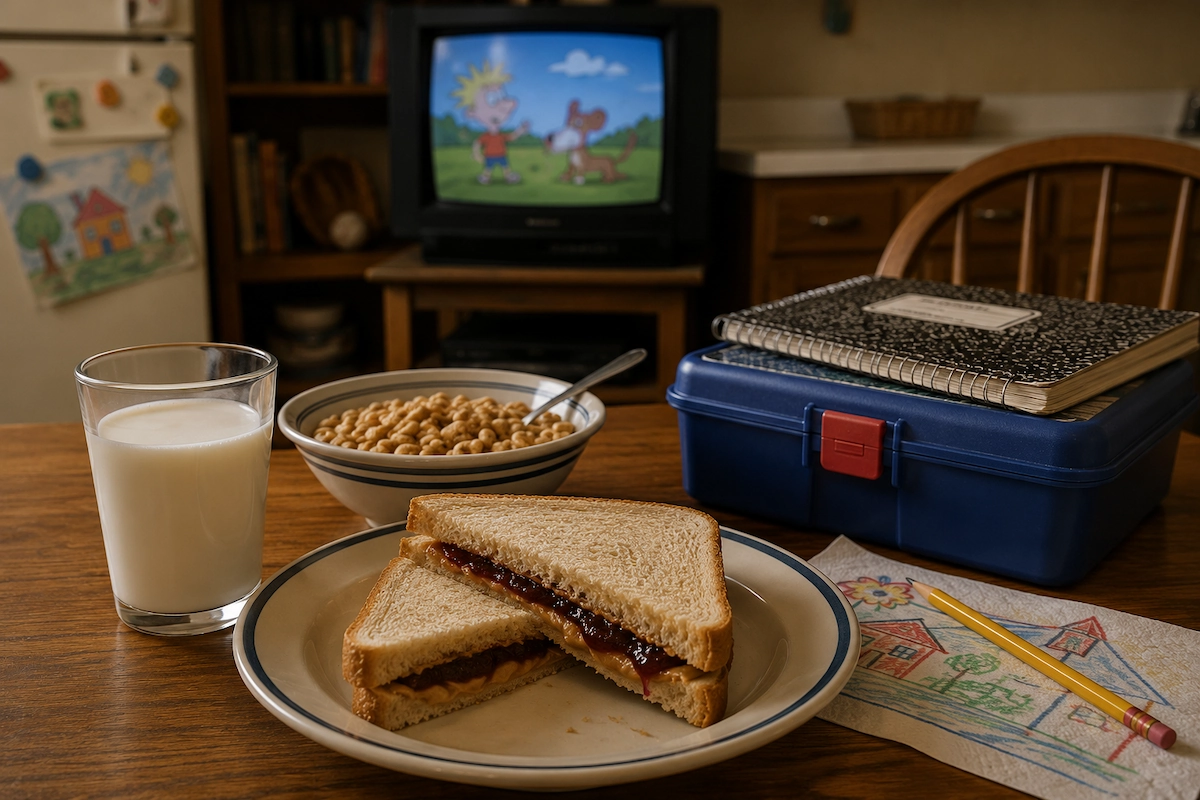
For an American lunchbox example, there is the peanut butter and jelly sandwich, usually shortened to PB&J. Peanut butter and a fruit preserve sit between two slices of bread. A sandwich made with jam follows the same basic idea, although jam and jelly are different kinds of preserve.
A packed sandwich had a different job from a hot breakfast. It had to be made ahead, carried and opened later, perhaps with a piece of fruit or another snack.
The lunchbox itself could carry a piece of television culture. The Smithsonian’s National Museum of American History records a Pinky and the Brain lunchbox made by Aladdin in 1996. It was an insulated fabric bag with red handles and a zip. Cartoon characters could travel to school even when the television stayed at home.
Beans, soup and pasta for family meals
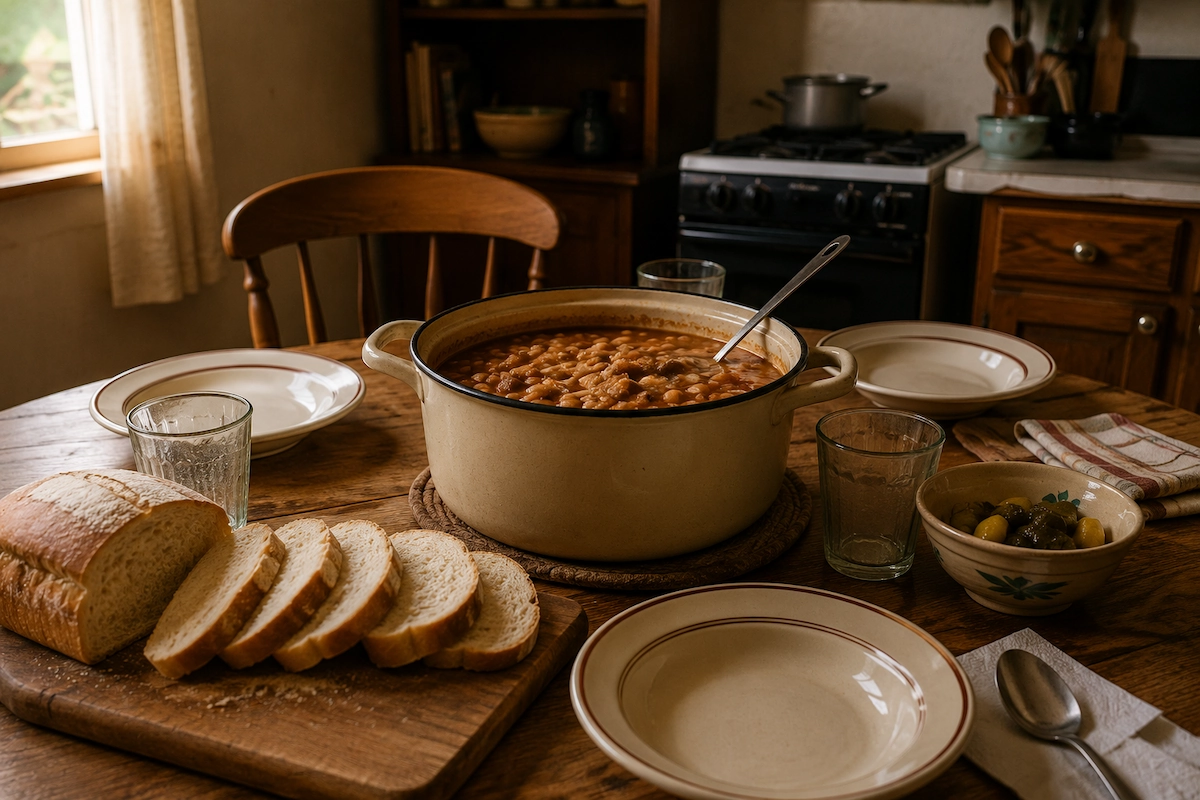
Beans and stews needed time on the stove. As the liquid thickened, the smell of onions and vegetables could reach the next room. Cooking a larger pot also made it possible to plan another meal for the following day.
The contents depended on the recipe and the household. Potatoes, beans, vegetables, rice or pasta could form the main part of a meal, with meat added where the recipe and the budget allowed. Bread on the table helped with the last spoonfuls of soup or sauce.
Pasta could be much quicker. Cheese stirred through hot macaroni gave a different result from a baked macaroni dish with a cheese sauce, but either could be served as the main meal.
Spaghetti with ketchup belongs to my own childhood memories. The ketchup went straight over the cooked pasta. It is a very specific combination, and one I still associate with that period.
What stretching a meal meant in different places
Household budgets, working hours and access to ingredients shaped these meals. For some families, using a short list of ingredients was convenient. For others, there were much harder limits on what could be bought.
Serbia in the early 1990s provides one specific example. In research published in 2014, anthropologist Ivana Bajić-Hajduković describes food shortages during sanctions and hyperinflation. Her work, based mainly on experiences in Belgrade, records home bread-making, support from relatives in the countryside and recipes adapted to scarce ingredients.
Rice pudding, pancakes and wafer biscuits
Something sweet could be as simple as a pancake spread with jam or a bowl of rice pudding dusted with cinnamon. Rice pudding keeps the texture of the grains, while semolina cooked in milk gives a smoother result. Milk-based puddings poured into bowls or glasses brought a familiar wait while they cooled and a skin formed on top.
Wafer biscuits need a little distinction too. Individual cream-filled wafers are ready to eat from the packet. A homemade layered wafer cake is assembled from larger sheets and filling, then left to set before cutting. They may look related on a table, but the preparation is different.
For pancakes, jam, sugar, ground nuts and chocolate spread offer several ways to finish the same batch. While one pancake cooks, the previous one can already be filled and eaten warm.
The meal and the programme on television
In my memories, the food and the cartoons often come together. I remember waiting by the stove and eating with a cartoon on television. The bowl or plate belongs to the same scene as the programme playing nearby.
The screen also connects these food memories with the 1990s living room before streaming: a television on its stand, a programme already in progress and a meal being eaten nearby.
Bread in milk, margarine and sugar, spaghetti with ketchup — that is where I would start my list. Someone else might name a school sandwich, a particular stew or pancakes prepared a certain way. The rest depends on whose kitchen we are talking about.
What was the simplest meal you enjoyed as a child? Tell us what you called it, how it was served and where you grew up.