
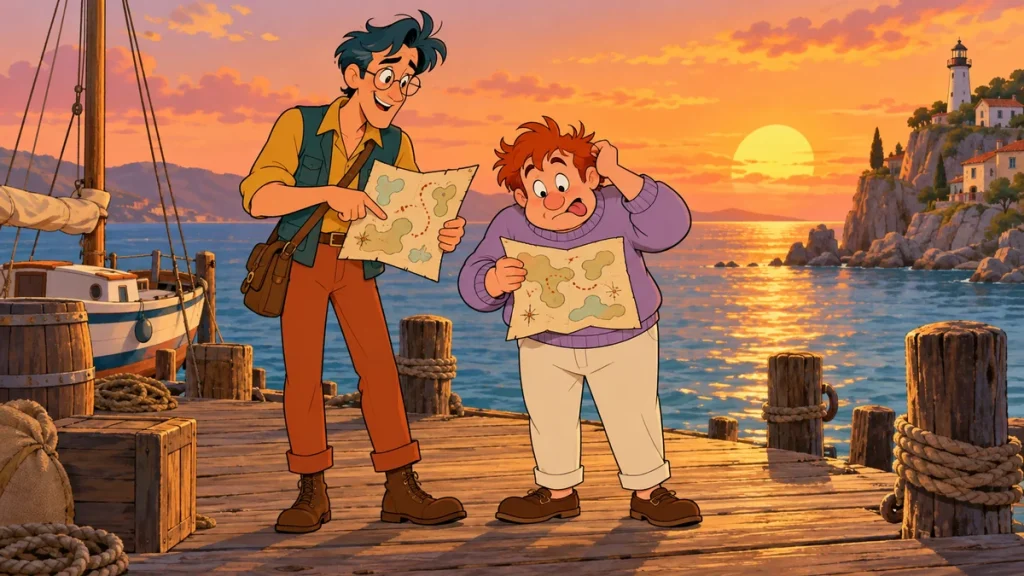
Supporting cartoon characters often get the moment we remember long after the adventure itself: a puzzled look, a badly timed question or an attempt to help that creates an even bigger problem. One character may lead the story, while a friend gets the best laugh.
Scrappy-Doo, Pinky, Patrick, Stimpy and Toad do this in different ways. This selection includes companions and friends of leading characters, as well as members of equal partnerships. Pinky and Stimpy belong to that second group. Their names are in their shows’ titles, and removing either of them would change the whole story.
Why do supporting cartoon characters steal the scene?
A comic companion gives the leading character someone to argue with, explain a plan to or lose patience with. When one takes everything seriously and the other thinks very differently, an ordinary conversation can become a gag. The contrast appears in their delivery, body language and reactions to the same problem.
The best supporting cartoon characters can also set the story in motion. They rush ahead before hearing the explanation, misunderstand an instruction or accidentally find the way out. A distinctive personality makes the reaction enjoyable, even when we have a fairly good idea of what is coming.
1. Scrappy-Doo: the little dog who would rush towards danger
Scrappy-Doo is Scooby’s nephew, introduced in the 1979 series Scooby-Doo and Scrappy-Doo. His confidence creates a clear contrast with Scooby’s fear. While Scooby and Shaggy would happily find somewhere safe, Scrappy is ready to confront the problem.
That contrast is his comic contribution. The smallest member of the group behaves as though he is the best prepared for a confrontation. His enthusiasm can quickly change the pace of a scene, leaving the others to respond to his determination when they would rather stop and think.
Scrappy is an interesting example of a new character changing an established group. You might enjoy his energy, or prefer the slower build-up of a mystery with the original gang. Either way, his presence shows how much one personality can alter the rhythm of a cartoon.
For more about the wider series, visit our article on Scooby-Doo facts and memories.
2. Pinky: Brain makes a plan, but the conversation takes a detour
Pinky and the Brain began in segments of Animaniacs before receiving their own series in 1995. Their basic premise is easy to remember: two laboratory mice try to take over the world, with very different ideas about how to think and act.
Brain concentrates on his goal and develops elaborate plans. Pinky approaches the conversation much more casually, so a serious question can receive an entirely unexpected answer. The humour grows out of that mismatch. They are taking part in the same adventure, but sometimes seem to be following different conversations.
Pinky is more than an extra standing beside Brain. He is the partner who makes Brain’s ambitions even funnier. A grand scheme sounds rather different when you have to explain it to a friend whose attention keeps drifting elsewhere.
The opening theme already makes their relationship clear. If cartoon music brings familiar characters straight back to mind, explore our selection of cartoon songs from childhood.
3. Patrick Star: the friend who turns an ordinary idea into confusion
Patrick is SpongeBob’s best friend and a neighbour who lives under a rock. Their friendship leaves plenty of room for jokes. SpongeBob approaches something with enormous enthusiasm, while Patrick may reach a conclusion that leaves everyone else struggling to respond.
A useful example is Big Pink Loser, in which Patrick takes SpongeBob as a role model and goes too far. A familiar friendship develops a new problem: how far can you go when trying to be like someone you admire?
Patrick’s humour works particularly well when he treats an absurd idea with complete seriousness and confidence. From his perspective, it may seem perfectly reasonable. We can see the misunderstanding, while Patrick carries on as though he has found a simple solution.
There is also warmth in the time they spend playing and doing things together. Patrick is someone SpongeBob wants to be around. He later received his own series, The Patrick Star Show, becoming another example of a leading character’s friend who can carry a separate story.
4. Stimpy: good spirits opposite Ren’s temper
Stimpy is the cat in The Ren & Stimpy Show, while Ren is a Chihuahua. They are the show’s central pair. Stimpy’s disposition and Ren’s short temper provide the basis for comedy that often becomes grotesque, with exaggerated expressions and very strange situations.
In Stimpy’s Invention, Stimpy creates a helmet intended to make Ren happy, and its effect on the normally angry dog goes to extremes. It is a concrete example of Stimpy taking the initiative and setting the whole story in motion through his invention.
Their relationship is interesting to follow through their reactions. Stimpy does not always need a long speech to draw attention. His expression and the way he experiences an event can be enough. Ren’s anger then intensifies the scene, building the comedy between them.
The show’s humour can be crude and deliberately uncomfortable, which is part of the experience of revisiting it. Within this selection, it offers a clear example of a partnership in which different temperaments carry much of the comedy.
5. Toad: Mario and Luigi’s travelling companion
Toad belongs to the group in The Super Mario Bros. Super Show!. Alongside Mario, Luigi and the Princess, he takes part in adventures that turn the world of the video games into a television cartoon.
In the first episode, The Bird! The Bird!, Toad is already at the centre of the problem. A giant Birdo kidnaps him, believing he is her missing baby. That misunderstanding shows how a companion can become the reason the rest of the group needs to act.
In a group adventure, a character like Toad expands the relationships between the others. Mario and Luigi have someone to help, talk to and follow into an unexpected situation. His presence gives the story another direction.
If you mainly remember Toad from the games, it is interesting to look at his television role. His familiar appearance still matters, but the cartoon also gives him room for conversation, reactions and shared adventures.
Supporting cartoon characters: what to notice when watching again
When revisiting these cartoons, follow the way a joke develops. Notice the moment before the final gag: who misunderstands something, who pauses and whose reaction gets the laugh. Sometimes a leading character’s friend takes over the scene with the smallest movement.
These five characters offer different examples. Scrappy brings determination into a situation built around fear. Pinky interrupts Brain’s seriousness. Patrick keeps a misunderstanding going, Stimpy prompts Ren’s explosive response, and Toad can place the whole group in a new predicament. Those differences make the selection more interesting than simply declaring one character the best.
If you first encountered them on television, the memory may also include the room, the theme tune or someone watching beside you. We explored that part of the experience in our article about watching cartoons on a CRT television.
Which cartoon character stole the scene most often for you? Share the name and, if you remember it, a particular episode or gag. Those little details make conversations about old cartoons worth having.
Sources
- Apple TV — Scooby-Doo and Scrappy-Doo.
- Amblin — the origins and premise of Pinky and the Brain.
- Nickelodeon — Patrick Star and his friendship with SpongeBob.
- Paramount+ — Big Pink Loser episode description.
- Paramount+ — Stimpy’s Invention episode description.
- Apple TV — The Bird! The Bird! episode description.