
Enjoy our retro stories?
★ Click the star to add Good Old Cartoons to your Google favouritesWhen you add us to your preferred sources, Google may show our articles more often when you search for retro topics. This makes it easier to keep up with new stories from Good Old Cartoons.
A potato police officer turns an ear of corn into popcorn during an interrogation. In another cartoon, robots give two visitors a beauty treatment that leaves them looking years younger. These strange details in classic cartoons are often central to the story or the joke.
All five films below belong to Fleischer Studios’ Color Classics series and were released between 1936 and 1939. Their worlds range from a welcoming fair full of inventions to a railway where a child’s fascination with trains becomes dangerous.
All’s Fair at the Fair: let the robots do it
In All’s Fair at the Fair (1938), an old-fashioned couple visit a fair full of futuristic inventions. Their clothes and manner make them look rather out of place among the modern pavilions. They have plenty to try before they go home.
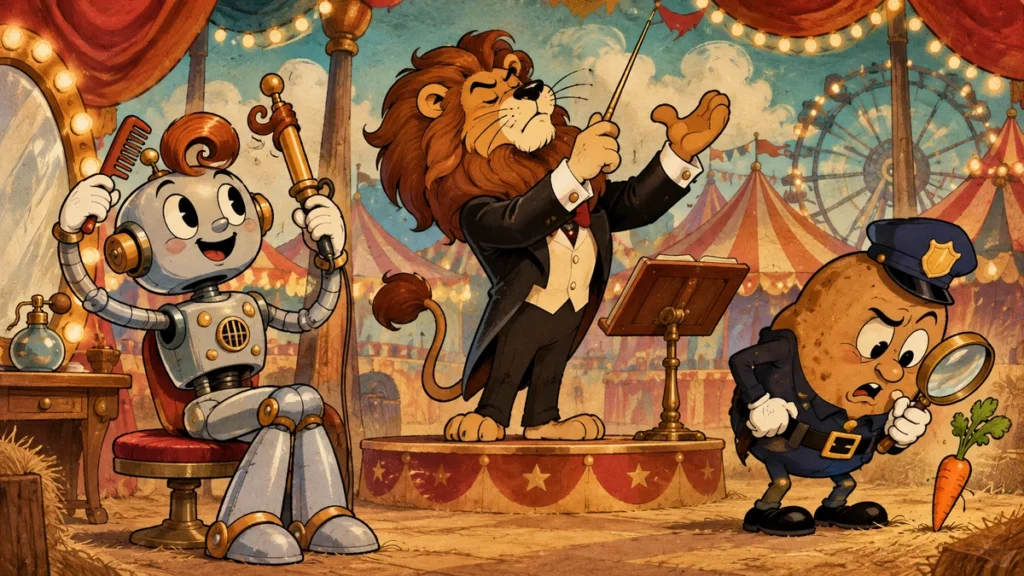
Robots give them beauty treatments that leave them looking younger and more fashionable. Later, the visitors dance with robots and leave in a new car. Machines can take care of entertainment as easily as practical tasks.
The fair makes automation look pleasant and easy to accept. The visitors trust the machines, enjoy the results and move on to the next attraction. By the end, a day out has changed their appearance and given them a new way to travel. The cartoon’s optimism is quite cheerful: there seems to be an invention for almost anything they might want.
A Car-Tune Portrait: a lion asks for a little dignity
Before the concert begins in A Car-Tune Portrait (1937), we see an artist’s hand creating the characters and their stage. The film lets us watch its performers being made before asking us to believe in their performance.
The lion conductor wants the audience to take his animal orchestra seriously. Franz Liszt’s Hungarian Rhapsody No. 2 provides the music, but maintaining a respectable concert proves difficult. When the lion notices a sleeping musician, he wakes him with a roar. His manners are less refined than his introduction suggests.
There is a small production detail worth knowing, too. The surviving animation draft, published by Cartoon Research, uses the working title Animal Orchestra. It does not list the opening sequence with the artist’s hand that appears in the finished film.
For more examples of music, timing and character behaviour working together, read why classic cartoons still make us laugh.
Play Safe: the train is still coming
The boy in Play Safe (1936) lies across his toy railway, reading a book about trains. When the little engine comes along, he lifts himself to let it pass underneath him. A real railway runs near the house, and his dog tries to keep him away from it. The boy gets past him, leaving the dog tied to a tree.
He tries to climb onto a railway wagon, falls and hits his head. A dream begins in which he takes control of a locomotive. Two engines heading towards each other develop faces and rear up like animals preparing to fight.
Then the film returns to the boy lying on the tracks. A real train is approaching, and the dog has to break free to rescue him. The scene is frightening because the dream has ended, yet the boy is still in danger.
Somewhere in Dreamland: what happens after the children wake up
Two children pull a wagon through snowy streets, collecting wood, in Somewhere in Dreamland (1936). They pause at a shop window filled with food. At home, supper is hard bread and water. When the boy says he is still hungry, his mother begins to cry.
In the dream, food is everywhere: ice cream, popcorn and other treats are there for the taking. There are toys to play with, and new clothes grow on trees. For once, the children can help themselves to as much as they like.
It is worth watching beyond the dream. When the children wake up, they find a feast, clothes and toys supplied by the town’s shopkeepers. The adults noticed them earlier in the film and began planning to help. The children return to their own home, where somebody has made sure they will have enough to eat.
Some of the dream’s visual depth comes from a physical set. Fleischer’s Stereo-Optical process photographed characters on transparent sheets in front of miniature scenery. Drawn characters could appear within a small, three-dimensional landscape. Our history of animation looks at other techniques used to bring images to life.
The Fresh Vegetable Mystery: a kitchen with a police force
In The Fresh Vegetable Mystery (1939), disappearing carrots bring a squad of potato police officers into action. A mysterious figure in a cloak moves through the kitchen. Soon, the investigation involves arrests and interrogations of the other inhabitants.
The questioning turns ordinary food preparation into something unpleasant. An ear of corn becomes popcorn; an orange is squeezed. The suspects have faces and can show fear, so the familiar kitchen routines become threats. These scenes can feel surprisingly harsh for a cartoon with such colourful characters.
The culprit eventually turns out to be a group of mice hidden beneath one cloak. By then, the police may have made a stronger impression than the crime. They round up innocent suspects and treat them roughly.
Sources and further reading
- Dr. Grob’s Animation Review: All’s Fair at the Fair and its inventions.
- Cartoon Research: the original animation draft for A Car-Tune Portrait.
- Cartoon Research: the music, characters and animators of A Car-Tune Portrait.
- Cartoon Research: the story of Play Safe.
- Somewhere in Dreamland: film details and plot summary.
- Cartoon Research: the sets, filming process and restoration of Somewhere in Dreamland.
- Dr. Grob’s Animation Review: the plot and interrogation scenes in The Fresh Vegetable Mystery.