
Enjoy our retro stories?
★ Click the star to add Good Old Cartoons to your Google favouritesWhen you add us to your preferred sources, Google may show our articles more often when you search for retro topics. This makes it easier to keep up with new stories from Good Old Cartoons.
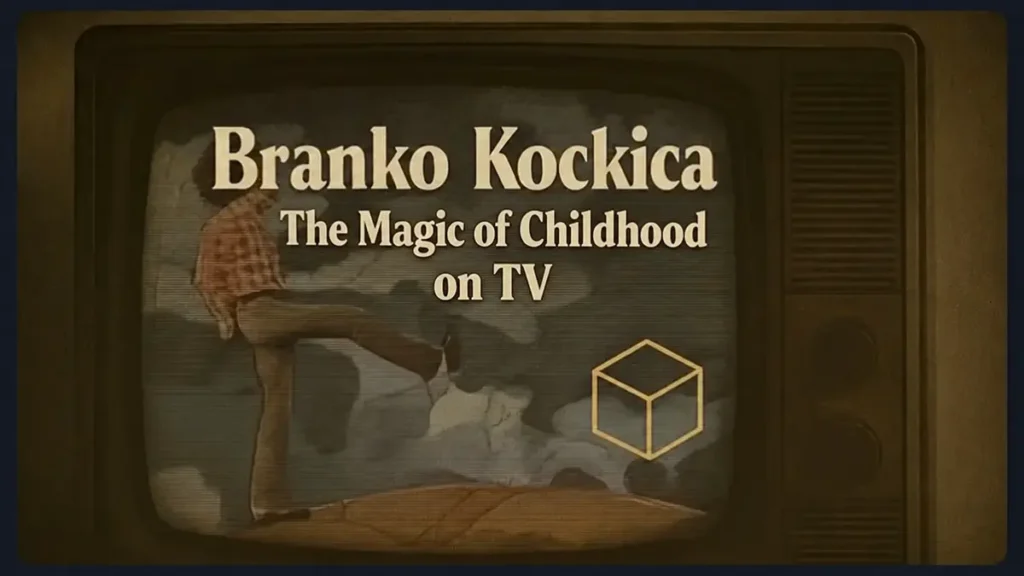
Branko Kockica was one of the familiar faces on television when we were children in Serbia. If you grew up elsewhere, his name may be new to you. He was the presenter who would take a group of children to a glass factory, a building site or a studio where cartoons were made.
His programme was called Kocka, kocka, kockica. It mixed conversations, visits, games and songs, with Branko and the children exploring a different subject in each episode. A broken window could lead to a lesson about glass, and that lesson could take everyone to the factory where glass was made.
A children's programme from Television Belgrade
Kocka, kocka, kockica first aired on 27 November 1974 on Television Belgrade, in what was then Yugoslavia. It was made for preschool children, and viewers in other parts of Yugoslavia grew up with it too.
The presenter was the actor Branislav Milićević, usually credited as Branko Milićević. His nickname, Kockica, came from the programme. The title plays on the Serbian word kocka, meaning a cube, and its diminutive, kockica. He called the children drugari, meaning friends or pals.
Why Branko Kockica kept our attention
What kept us watching was seeing where an ordinary question could lead. The subjects were close to a child's everyday life: a window, a street, an animal, a job someone did. There were people to meet and places to visit, with Branko and the children finding things out together.
We were being introduced to the world around us through children like us and a familiar presenter. You could see a city being built, meet the people keeping its streets clean or find out who made the cartoons on television.
How a broken window led to a glass factory
The archive of Serbia's public broadcaster, RTS, describes a 1978 episode called Staklo, or “Glass”. It begins with a window broken by a ball at a preschool in Belgrade. Branko and the children discuss what happened, then move on to how glass is made and what people use it for. Magnifying glasses, spectacles, marbles and the work of an optician become part of the conversation. The group also visits a glass factory in Paraćin, where children from a local preschool join them.
Trips through the world around us
In the 1977 episode Kako raste grad, roughly “How a City Grows”, Branko and a group of children explore how a city works. They visit the Beograđanka tower in Belgrade and a construction site, learn why building requires plans and permission, and find out about chimney sweeping and street cleaning.
Another outing took Branko and a group of children to the Resavica coal mine to learn where coal comes from and how miners work. In an episode set around Kalemegdan, Belgrade's fortress and park, they looked at the meeting of the Sava and Danube rivers, visited the zoo and rode a carousel.
Going to see how a cartoon was made
In the 1979 episode Crtani film, or “Cartoon”, Branko and the children watch the animated short Ludi brod and then visit its creator, Zoran Jovanović. RTS's synopsis mentions a practical explanation of animation using a shoelace.
The children were being shown the work behind something they already enjoyed watching. We look more closely at that process in our article on how cartoons were made in the 1990s.
The song and “tatatatira”
Music was part of the programme's identity too. The song U svetu postoji jedno carstvo, with its emphasis on friendship, became closely associated with Branko Kockica. In his 2011 interview with Novosti, he recalled initially wanting a different opening song, one that included the programme's name and the expression “tatatatira”. The replacement never displaced the song audiences had come to associate with the series.
In a 2024 interview, Branko linked “tatatatira” to the feeling of happily running around with the children. He compared explaining it to explaining laughter. It became a recognisable part of the programme alongside his greeting to the drugari.
The children returned 28 years later
In 2004, Predrag Marković contacted the RTS archive programme Trezor. He had appeared in Kako raste grad as a child and wanted the old episode to be shown again. While the archive team looked for the recording, he looked for the other former participants.
In 2005, they returned to the 23rd floor of the Beograđanka tower, where they had filmed 28 years earlier. The children from the old recording were now adults, meeting Branko again in the same place. Their reunion was shown in Trezor that December.
Watch an episode: “Prljave ruke”
The episode below is called Prljave ruke, meaning “Dirty Hands”, and comes from the official RTS educational and science YouTube channel. The original audio is in Serbian. It gives you a chance to hear Branko's voice and see the programme for yourself.
Video source: RTS Obrazovno-naučni program. More episodes are listed in the official RTS Planeta catalogue. Access to individual programmes can depend on location and viewing rights.
Sources and archive records
The following archive descriptions and interviews are in Serbian.
- RTS: the first broadcast date and the origin of Branko's nickname
- RTS archive: “Staklo” (Glass)
- RTS archive: “Kako raste grad” (How a City Grows)
- RTS Planeta: “Među rudarima” (Among the Miners)
- RTS: the visit to Kalemegdan
- RTS archive: “Crtani film” (Cartoon)
- RTS archive: the former participants' reunion in 2005
- Vukica Strugar's interview with Branko Milićević, Novosti, 2011
- Bojana Bačić's interview with Branko Milićević, 24sedam, 2024