
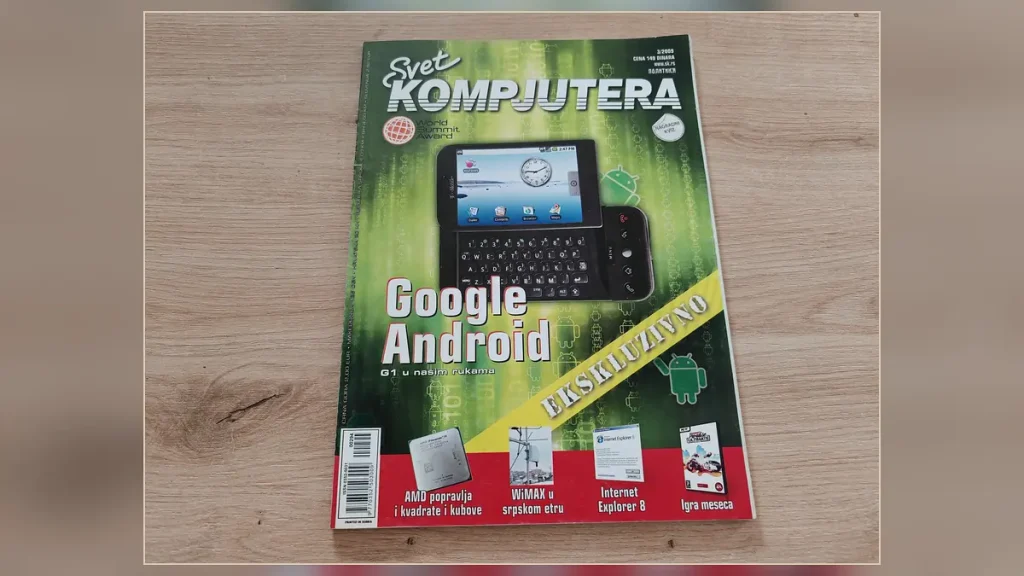
I bought this issue of Svet kompjutera in 2009, when the first Android phone, the G1, and Google’s new mobile operating system still looked like a glimpse of something completely new. I kept the magazine, and opening it again today feels like more than revisiting an old phone review. It is a small record of the moment when Android was still trying to show what it might one day become.
The cover of issue 3/2009 carries the large headline “Google Android”, with an open G1 beneath it and the Serbian line “G1 u našim rukama”, meaning “G1 in our hands”. The issue cost 149 dinars. Now that Android is part of everyday life, it feels strange to return to a time when an entire operating system was new enough to dominate the cover of a computer magazine.
A Serbian computer magazine captured the beginning of Android
For readers outside Serbia, Svet kompjutera is a long-running Serbian magazine devoted to computers, games and technology. In the article “Developerov san”, or “A Developer’s Dream”, published on pages 74–75, author Dejan Stefanović examined the G1 Developer Phone, a special development version of the first commercially released Android handset.
This was not a retrospective written years later, when the outcome of the story was already known. It was a hands-on review from a time when both the G1 and Android were unfamiliar to most readers in Serbia. That is what makes the article so interesting today: it shows which features appeared genuinely advanced, which limitations made everyday use difficult and how uncertain Android’s future still seemed.
This issue is part of my collection of Svet kompjutera magazines from 2007 to 2019. Together, those issues show how computers, games, mobile phones and our expectations of technology changed over more than a decade.
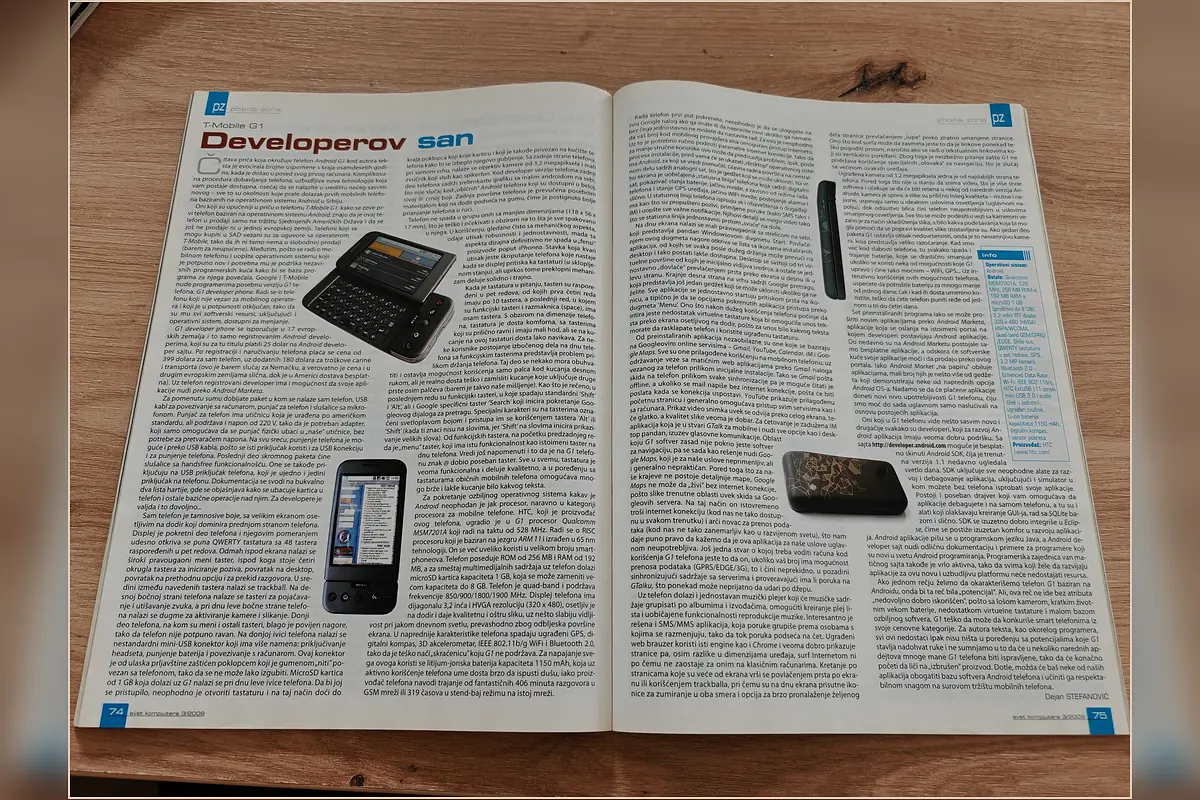
The G1 Developer Phone was not an ordinary retail model
The different names associated with this phone can be confusing. HTC Dream was the model name, T-Mobile G1 was the name used for the operator-branded retail version, and Android Dev Phone 1 was the unlocked development model intended for programmers. The magazine referred to the device as the G1 Developer Phone.
T-Mobile announced the first Android-powered phone on 23 September 2008, together with Google and the other companies involved in the platform. The G1 reached customers the following month, while the development version went on sale in December. Unlike a phone locked to one mobile operator, the developer model allowed far greater access to the software and gave programmers more freedom to test applications and modify the system.
The article also explained how complicated it could be to obtain this version. A buyer first needed to register as an Android developer and pay a fee of 25 US dollars. The phone itself cost 399 dollars. In the example described in the magazine, customs and delivery to Germany added about another 180 dollars. Buying a new phone now takes only a few steps, but acquiring this early developer model was an adventure of its own.
What the first Android phone looked like in 2009
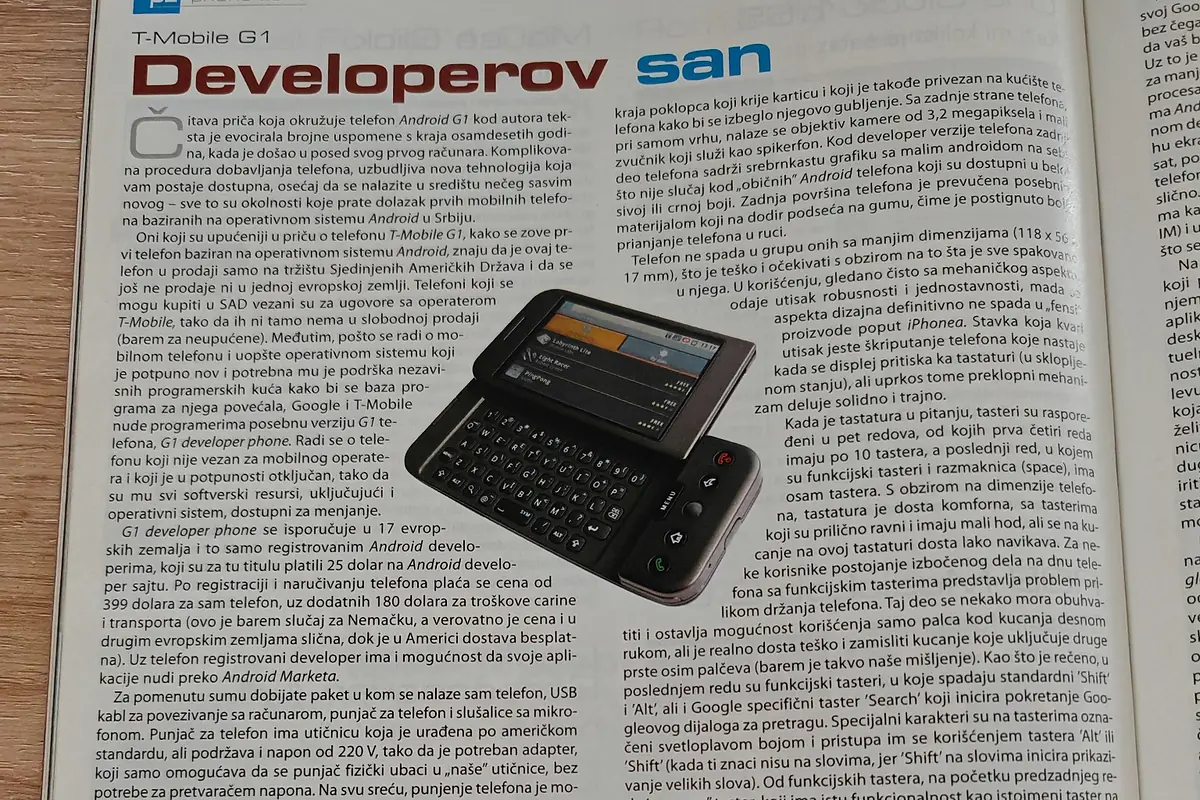
The first Android phone now looks like a device from a completely different era. Its touch-sensitive display measured 3.2 inches and had a resolution of 320 × 480 pixels. Sliding the screen aside revealed a full 48-key QWERTY keyboard. Below the display sat a small trackball for navigation, surrounded by physical buttons for calls, the home screen, the menu and returning to the previous option.
Inside the phone was a Qualcomm processor running at 528 MHz, along with 192 MB of RAM and 256 MB of ROM. A 1 GB microSD card came with the device, while cards of up to 8 GB were supported. The specification list also included GPS, a digital compass, a motion sensor, Wi-Fi, Bluetooth 2.0 and a 3.2-megapixel camera.
Those figures sound modest now, but the way the phone was used is even more revealing. The handset was heavy and robust, while its sliding mechanism exposed a keyboard covering almost the full width of the device. The reviewer did not consider its design as refined as some competing phones, but he praised the keyboard’s usefulness and the speed of typing compared with conventional mobile keypads.
There was a dedicated Google Search key and even a separate button for the @ symbol. These details made the intended audience clear. The G1 was built for people who would write messages, browse the web and work with applications rather than use their phone mainly for calls.
Android without an on-screen keyboard
One detail shows just how different early Android was from the operating system we know today: at the time of this review, the G1 did not have an on-screen keyboard. Whenever users needed to enter text, they had to slide the phone open and use the physical QWERTY keyboard.
The home screen consisted of three panels that could be changed with a swipe. The centre panel contained an analogue clock widget, while the status bar at the top displayed information about the signal, battery and notifications. Pulling that bar down opened a list of messages, missed calls and other events. An arrow at the bottom of the screen opened the list of installed applications.
All of this sounds ordinary today. In 2009, however, swiping between home screens, placing widgets on them and pulling notifications down from the top were not features people expected from every mobile phone.
Google services were at the centre of early Android
Google’s plans for Android were already easy to recognise. The phone came with Gmail, YouTube, Calendar, Google Maps and GTalk. Gmail synchronised messages with the user’s account, YouTube offered an interface adapted to the small display, and GTalk provided instant messaging similar to its desktop version.
However, features that appeared convenient in countries with more accessible mobile data could become a serious problem in Serbia in 2009. The phone relied heavily on an internet connection, while mobile data was neither as affordable nor as widely used as it is today. The reviewer warned that automatic synchronisation could quietly consume data and create an unexpected cost.
Google Maps illustrated the same gap. Maps for Serbia and the surrounding region lacked detail, and the application needed to download information from the internet as it was used. The phone had GPS, but without detailed local mapping and affordable data, its practical value was far more limited.
Android Market was only beginning
When the G1 reached the market, the service now known as Google Play was called Android Market. At its launch in October 2008, it offered just over 50 applications. The selection had grown by the time this article appeared, but the reviewer still found many small demonstrations and gadgets alongside relatively few substantial applications.
This may be the greatest difference between the Android shown in the magazine and the platform we know today. Modern phones are partly defined by the applications people use every day. With the G1, users still had to believe that developers would arrive, build enough useful software and gradually fill the gaps in the young operating system.
The title “A Developer’s Dream” was therefore well chosen. Google provided a software development kit, an emulator for testing applications without a phone, debugging tools, support for SQLite databases and integration with the Eclipse development environment. Applications were written in Java, documentation was available and a new community was beginning to form around the platform.
The camera, battery and unfinished software
The magazine did not hide the G1’s weaknesses. Its 3.2-megapixel camera was described as one of the poorest parts of the phone. It could not record video, offered very few settings and produced much weaker photographs in less favourable light.
Battery life was another disappointment. The 1,150 mAh battery struggled to support the large display, constant synchronisation, Wi-Fi, GPS and mobile internet. With intensive use, it could run out in less than a day. That may sound familiar to modern smartphone users, but it was a much greater disadvantage at a time when conventional mobile phones often worked for several days between charges.
Other signs of an unfinished first generation were equally clear. There was no on-screen keyboard, the supply of serious applications remained small, the camera was limited and some Google services were poorly suited to local conditions. The first Android phone contained many promising ideas, but it was not yet a complete product for every user.
Did the reviewer predict Android’s future?
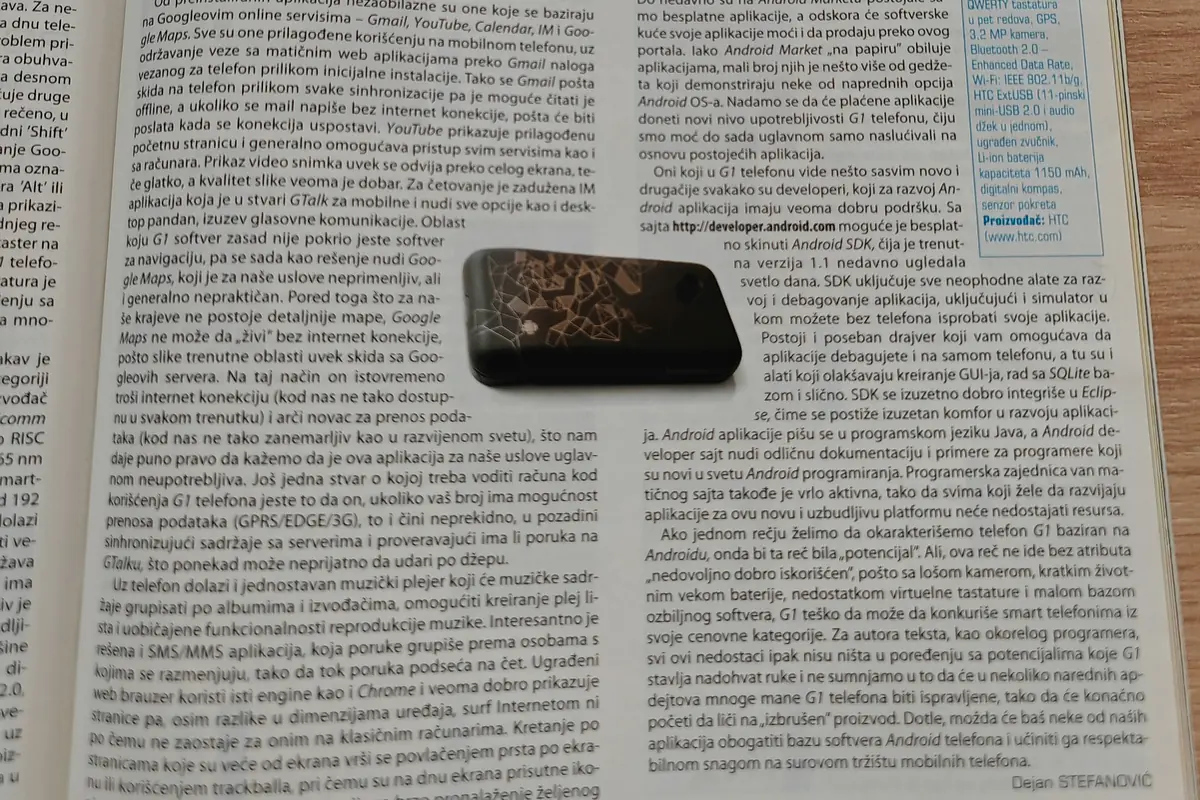
The most interesting part of the article comes at the end. When asked to describe the Android-based G1 in a single word, the author chose “potential”, but added an important qualification: it was potential that had not yet been used well enough.
From today’s perspective, that judgement was remarkably accurate. The poor camera, short battery life, lack of an on-screen keyboard and limited selection of serious applications prevented the first Android phone from feeling fully mature. At the same time, the openness of the platform, strong support for developers and the possibility of improving the device through new applications showed that the story was only beginning.
The author expected future applications to solve many of the phone’s weaknesses and help Android become a serious force in the mobile market. That is exactly what happened. Not every problem disappeared immediately, and not every later Android phone succeeded, but the platform quickly grew far beyond one unusual handset with a sliding keyboard.
Why this old magazine is even more interesting today
When I bought this issue in 2009, I was holding a magazine about new technology. Today, it feels like a historical record of the beginning of a major change. Across two printed pages, it preserves a 3.2-inch screen, a navigation trackball, a physical keyboard, an Android Market with a small selection of software and the unanswered question of whether the platform would succeed.
That is the special value of old technology magazines. The G1’s specifications can easily be found online, but a contemporary article reveals how the device appeared to people when it was genuinely new. It preserves their expectations, doubts and everyday problems, many of which were later forgotten.
A similar view of the past appears in my article about how much a computer capable of running Crysis cost in Serbia in 2007. That story also uses an original issue of Svet kompjutera from my collection to show what new technology meant at the time.
Do you remember when you first heard about Android? Which model was your first Android phone, and did it have a physical keyboard?
Sources
- Svet kompjutera issue 3/2009, “Developerov san” by Dejan Stefanović, pages 74–75; photographed from the website author’s private collection.
- Google Official Blog – The first Android-powered phone, 23 September 2008.
- Android Developers Blog – Android Market: Now available for users, 22 October 2008.
- Android Developers Blog – Software Update Available for the Android Developer Phone, 9 March 2009.