
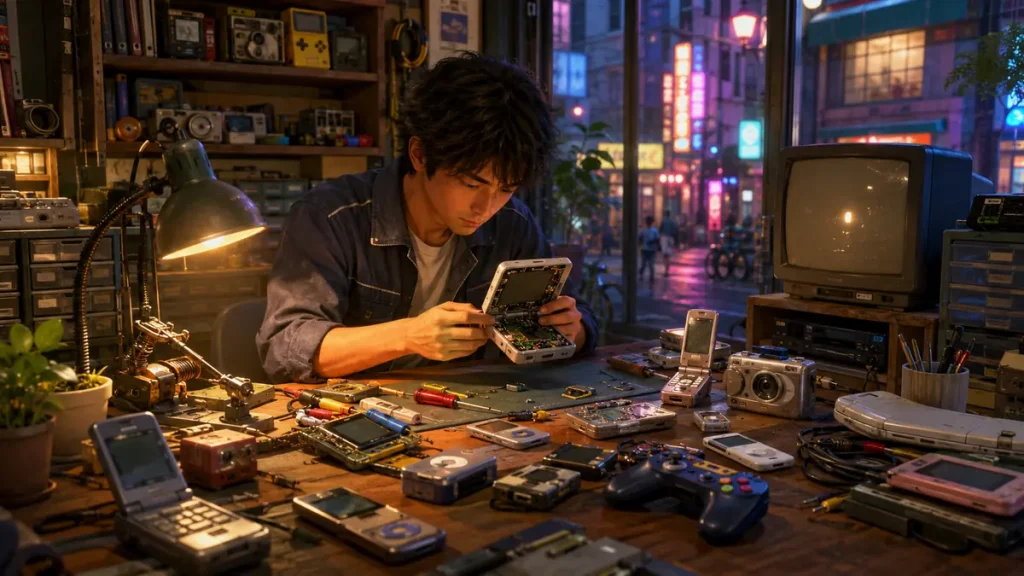
Before phones became almost identical glass rectangles, a drawer full of electronics could hold a flip phone, a pocket music player, a digital camera and a handheld console. Each had its own buttons, menus, charger and personality. ReStory: Chill Electronics Repairs builds an entire game around that lost variety.
Mandragora developed ReStory, and tinyBuild published it for Windows and macOS through Steam on 6 August 2026. This narrative shop-management simulation takes place in mid-2000s Tokyo. Customers bring well-used devices into the shop. The player takes them apart, cleans them, repairs them and returns them.
A repair shop from a different technological age
ReStory is not simply about collecting old gadgets. The player runs a small electronics repair shop, accepts jobs, manages money, orders spare parts and gradually changes the workshop. Even the online search for replacement components takes place through a browser designed to resemble the web of the Y2K era.
The Tokyo setting gives that idea a fitting home. The streets, signs and compact shop interior recall a period when electronics districts were filled with specialised stores, shelves of cables and devices that looked completely different from one another. The focus is not on modern efficiency, but on the small ritual of finding out what went wrong and giving an old object another chance.
The official launch trailer below shows the actual game, including its shop, repair tools, customers and range of devices.
Official ReStory launch trailer: tinyBuild / Mandragora.
What can you repair in ReStory: Chill Electronics Repairs?
Repair jobs cover the kinds of objects that once occupied pockets, school bags and living-room shelves. They include mobile phones, handheld game systems, cameras, music players, home appliances and video game consoles. Players disassemble devices, clean them, replace faulty parts and carefully reassemble them with different tools.
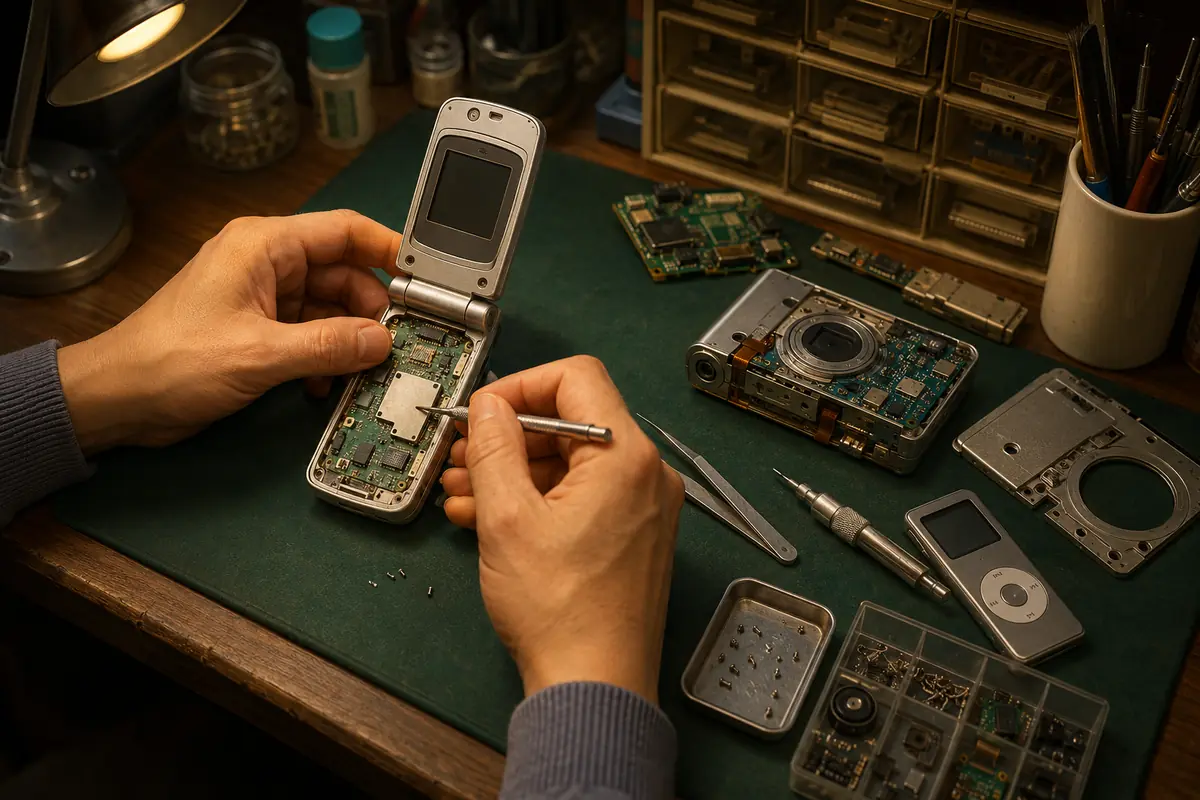
That hands-on approach is an important part of the nostalgia. A scratched plastic case, a removable battery cover or a row of physical buttons can instantly place a device in a particular period. Anyone interested in the wider story of retro technology and gadgets from the 1990s and 2000s will recognise why these ordinary objects can carry as many memories as an old television programme or song.
Real Atari hardware meets fictional retro brands
Most of the familiar-looking electronics in ReStory use fictional brand names. Devices such as the Pokia N-Joy, Patento BS and Nony PNP evoke the design language of the period without being presented as official products from those manufacturers.
Atari is the notable exception. ReStory includes officially licensed hardware such as the Atari 2600, Jaguar and Lynx, along with the classic CX40 joystick. Their appearance connects the game’s mid-2000s repair-shop setting with an even earlier generation of home gaming hardware—the kind of equipment that might already have needed careful restoration by then.
For readers who enjoy keeping real classic systems in use, our guide to creating a retro gaming corner at home explores the same pleasure from a practical, real-world angle.
More than an electronics repair simulator
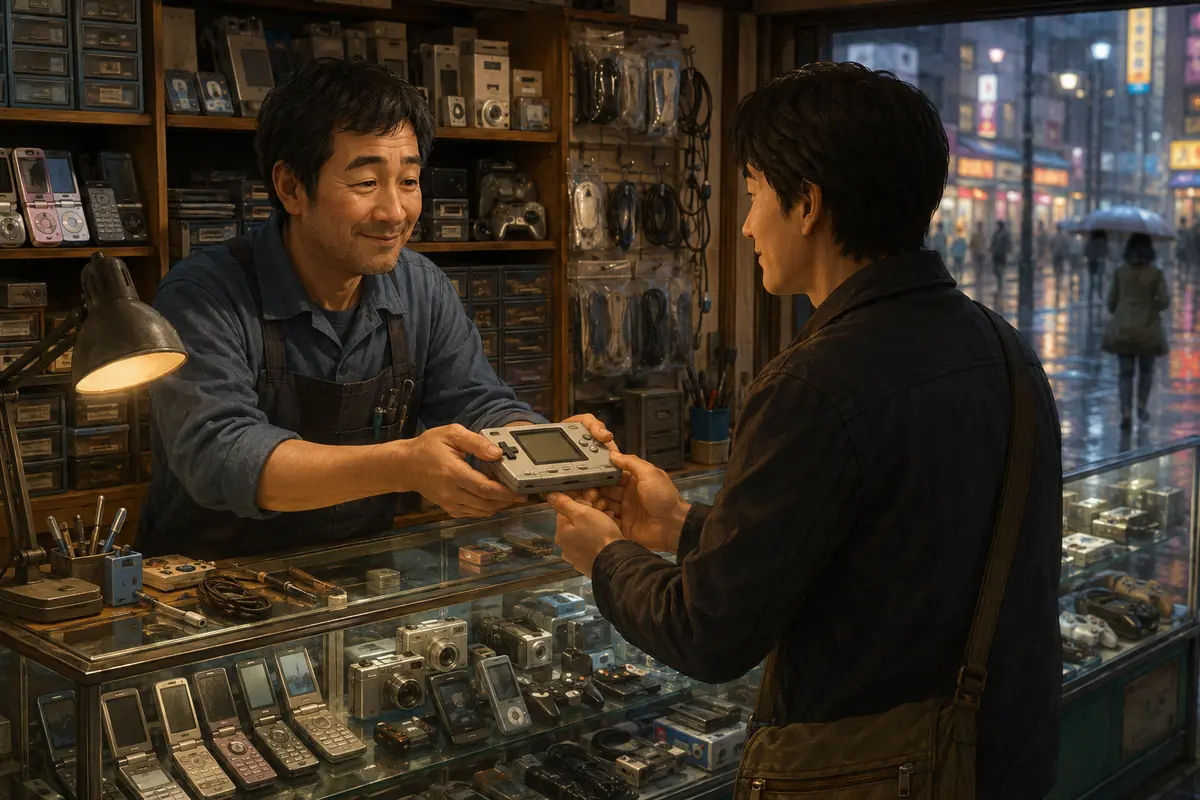
The devices may attract attention first, but ReStory also builds a story around the people who bring them into the shop. Customers have their own circumstances and conversations, while the player’s responses can affect branching storylines and lead to different endings.
The shop accepts orders both in person and online. Each repair connects the player with an owner and reveals why the object matters. The game treats an old phone or handheld as more than a collection of screws and components. It has already formed part of someone’s life.
Why 2000s electronics still feel so personal
The early and mid-2000s were a transitional period. Mobile phones were becoming everyday objects, digital cameras were replacing film for many families, portable music was moving from discs to files, and handheld gaming was changing rapidly. Yet a single universal device had not absorbed all those functions.
Choosing a phone meant choosing its shape, keypad, ringtone system and screen. A music player held a deliberately selected collection of songs. A digital camera travelled separately, often with its own memory card and cable. That era also lives on in memories of portable CD players and MP3 CDs, when carrying music required its own device, batteries and carefully chosen discs. The inconvenience was real, but so was the sense that every object had a distinct purpose.
ReStory uses repair to revisit that period rather than simply placing old gadgets on a virtual shelf. Cleaning a case, searching for a part and returning a working device to its owner turns nostalgia into an action. It is a fitting idea for a time when interest in Y2K design is growing, but many of the actual devices are becoming harder to preserve.
A new game built around old technology
ReStory: Chill Electronics Repairs is now available on Steam for Windows and macOS. Its full repair loop and branching narrative can only be judged through hands-on play, so this is not a review. As a new release, however, it stands out for treating the everyday electronics of the 2000s as objects worth remembering rather than disposable steps on the way to today’s devices.
For retro technology fans, that may be the most interesting part of the idea: the broken phone, worn handheld or old music player is not clutter waiting to be thrown away. It is the beginning of a story.
Official information: ReStory on Steam and the official tinyBuild launch trailer.