
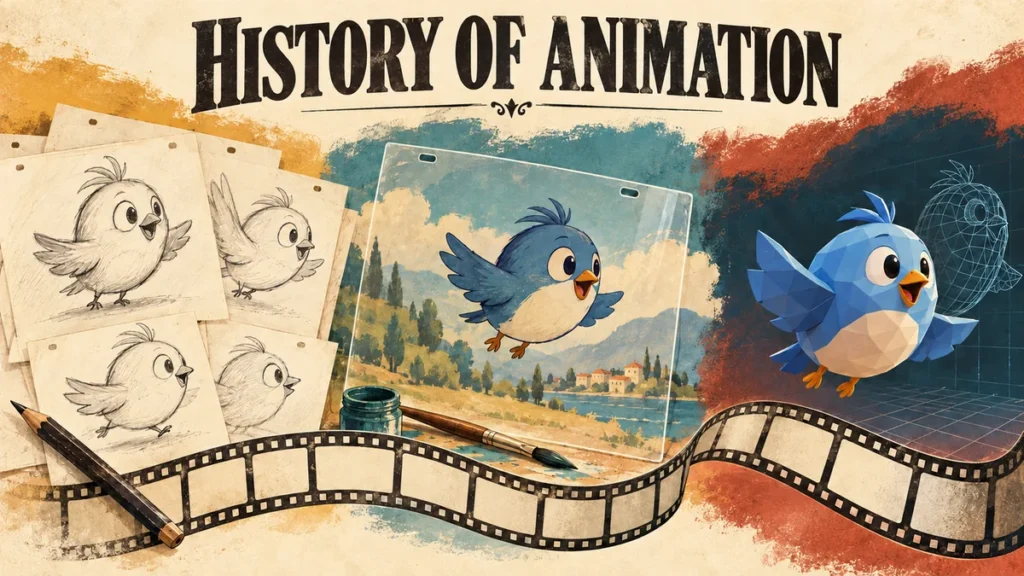
In 1892, audiences at the Musée Grévin in Paris watched painted figures move across a screen. Émile Reynaud operated his Théâtre Optique while live music and sound effects accompanied the pictures. This chapter in the history of animation began before conventional film screenings became widespread.
Animation has taken many forms, from rotating picture strips to digital characters. Changes in materials, sound and production methods gave artists new possibilities. They also left visible traces in the films: a transforming line, a character moving over a painted background, or a pose held while someone speaks.
Before cinema: the early history of animation
The thaumatrope, popular from around 1825, was a small disc with a different picture on each side. A bird might appear on one side and a cage on the other. When the disc spun quickly, the pictures seemed to merge, placing the bird inside the cage. It combined two images rather than showing a sequence of changing poses.
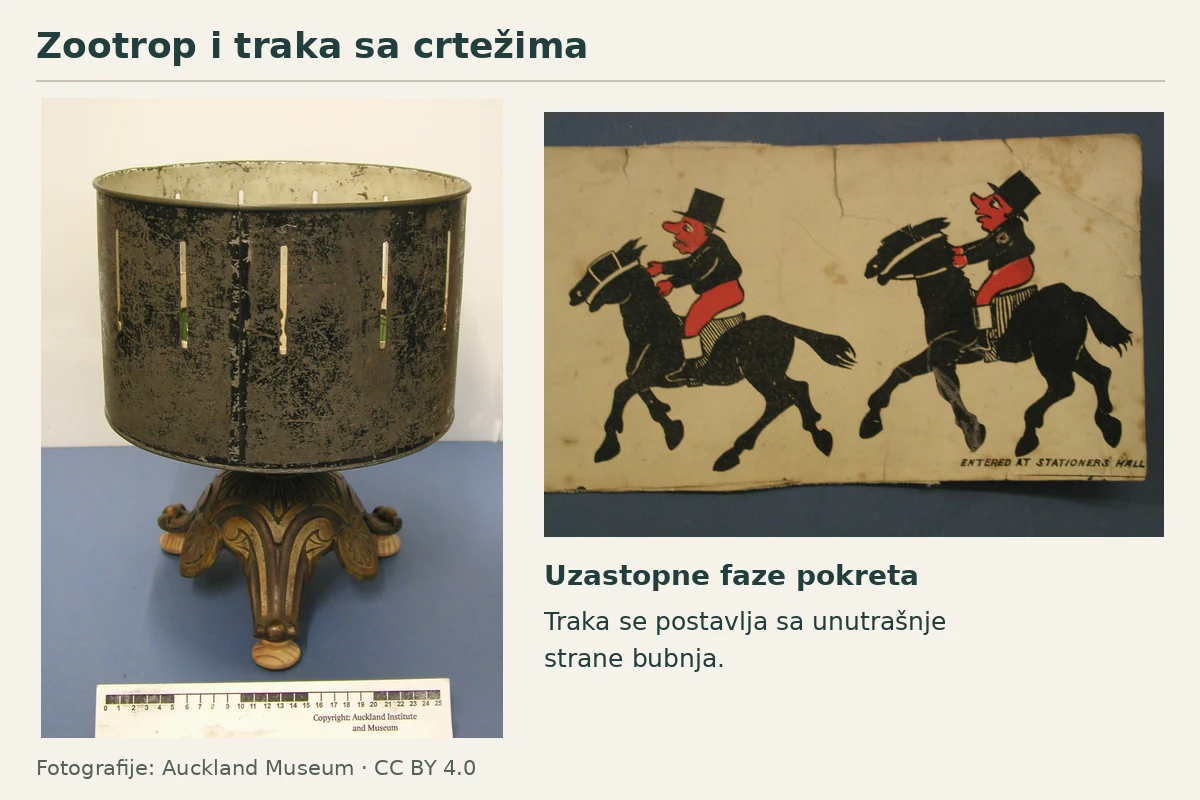
The phenakistoscope and zoetrope used sequences. Drawings showed successive stages of an action, viewed through slots as a disc or drum rotated. A figure could appear to run, jump or dance in a repeating loop. In a zoetrope, the picture strip sat inside the drum.


Reynaud patented his praxinoscope in 1877, using mirrors to view the pictures instead of the zoetrope’s slots. His later Théâtre Optique projected longer sequences of painted images over a separate background. The performances he began in 1892 helped turn the short loops of optical toys into stories presented to an audience.
Early animated films: drawings become performers
A film camera made it possible to photograph a drawing, change it and photograph it again. Projected in sequence, the individual images created movement. In Humorous Phases of Funny Faces (1906), J. Stuart Blackton used chalk drawings and cut-out elements to make faces move and change expression.
Émile Cohl’s Fantasmagorie followed in 1908. Its figures and objects constantly change shape, with one drawing developing into something unexpected. Transformation becomes the action itself. A line can become a character, then turn into something else before the viewer has settled into the scene.
Winsor McCay explored how movement could give a character personality. His Gertie the Dinosaur (1914) formed part of a stage act in which he appeared to give instructions to the dinosaur on screen. Gertie’s reactions were already animated; McCay timed his live performance to them. The apparent exchange helped make the drawn creature seem responsive and alive.
These filmmakers developed different aspects of animation: transformation, performance, timing and the relationship between the screen and a live audience. Their work makes more sense as a series of experiments than as a single moment when one person invented the medium.
Cels and the growth of animation studios
Redrawing an entire scene for each change in a character’s pose created an obvious problem: much of the work went into scenery that stayed still. The adoption of transparent sheets during the 1910s helped studios separate moving figures from their backgrounds.
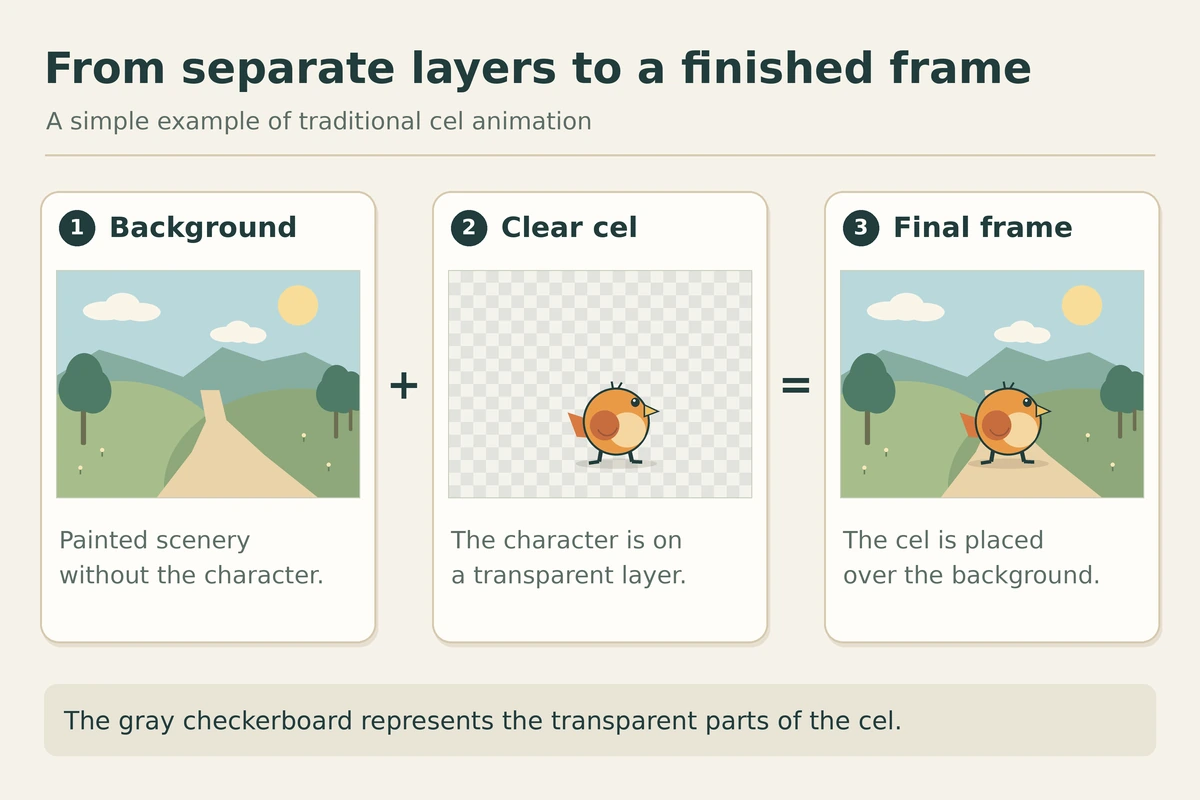
In a typical cel animation workflow, a character’s outlines were transferred onto a transparent sheet, or cel, and the figure was painted. The cel was placed over a separately painted background and photographed. For the next stage of movement, the appropriate cel could be changed while the background remained in place. Different moving parts could also occupy separate layers.
This approach supported a division of labor. Different artists handled animation, cleanup, backgrounds, inking and painting, while camera crews photographed the assembled artwork. Model sheets provided shared references for a character’s proportions and expressions, helping several animators draw a recognizable figure.
Character acting developed alongside these production methods. A movement could begin with a small preparation, build into an exaggerated action and finish with a carefully timed reaction. The story of how Bugs Bunny was created shows how a familiar character’s design and personality could develop through the work of several artists.
Sound and color in animation history
Silent films could have live musical accompaniment, and Reynaud’s performances had included music and effects in the nineteenth century. Recorded, synchronized sound made it possible to reproduce a precise relationship between picture and sound at each screening.
In Steamboat Willie (1928), musical rhythm shapes how the characters move and when the jokes land. The film helped popularize this use of synchronized sound, building on earlier experiments with matching recorded sound to moving pictures.
Color also developed through several different processes. Painted projection strips and hand-colored film prints existed before the widespread adoption of photographic color systems. Disney’s Flowers and Trees (1932) was a landmark in the use of three-color Technicolor for animation.
The change had practical consequences inside the studio. According to Disney’s D23 archive, Flowers and Trees was already halfway finished in black and white when production switched to color. Painters washed gray shades from the cels and repainted them, while background artists created new artwork. The color process used to record and reproduce the image still depended on artists preparing the painted elements.
Which was the first animated feature film?
A frequent point of confusion in animation history is the difference between the first completed feature and the oldest surviving one. The British Film Institute identifies Quirino Cristiani’s Argentine film El Apóstol (1917) as the first animated feature. The film is lost.
The oldest surviving animated feature is Lotte Reiniger’s The Adventures of Prince Achmed (1926). It was made with articulated cut-out silhouettes. Small adjustments to the figures were photographed frame by frame, creating movement through the positioning of their bodies and limbs.
Disney’s Snow White and the Seven Dwarfs (1937) took the studio’s character acting, songs and color work into a feature-length story. It was the studio’s first animated feature, giving its characters enough time for their different personalities to shape the action.
During the 1930s and 1940s, theatrical cartoons allowed American studios to refine character acting, visual comedy and the close timing of music and movement. That studio era is often called a “golden age,” although its boundaries vary and the term describes only part of animation history.
Other paths in animation history: Canada and Zagreb
Animation also offered ways to work directly with film itself. In the Canadian short Begone Dull Care (1949), Norman McLaren and Evelyn Lambart painted and engraved the film strip. Lines and colors move in response to jazz played by the Oscar Peterson Trio. Abstract shapes carry the performance without a conventional cartoon protagonist.
At Zagreb Film’s animation studio, established in 1956 in what was then Yugoslavia, filmmakers explored stylized drawing, selective movement, satire and visual metaphor. The name Zagreb School of Animated Film came to describe the work of different directors developing their own approaches within that shared environment.
Dušan Vukotić’s Surogat (1961) follows a holidaymaker who inflates objects to create an artificial world on a beach. Simple shapes and their transformations carry the humor and the film’s ideas. It won the Oscar for animated short film in 1962. Zagreb Film’s later work for television included Professor Balthazar, whose imaginative city and inventive solutions introduced the studio’s work to a wider audience.
Television brings new production demands
The expansion of television in the 1950s and 1960s created demand for regular episodes. Studios needed working methods that fitted recurring deadlines and budgets. They could hold a character in one pose, animate only selected parts of the body, or reuse a sequence of movement.
Hanna-Barbera became closely associated with this limited animation. During a conversation, a character’s body might remain still while the mouth, eyes or an arm moved. A walking cycle could be used again. The Flintstones, which began in 1960, also demonstrated the appeal of an animated family sitcom in American prime-time television.
In Japan, Osamu Tezuka’s original Astro Boy television series began in 1963. Held images, reused material and editing helped shape the language of television anime. Sound and changes of viewpoint could give a scene energy, while fuller movement was concentrated in selected moments.
The number of new drawings does not determine a story’s pace. A held pose can prepare a sudden reaction or accompany rapid dialogue. Cel-based production continued through the 1970s and 1980s, and many productions still used it during the transition to digital finishing in the 1990s.
The history of computer animation
Computer animation was being explored at Bell Labs during the 1960s. Programmers and artists used large computers and specialized equipment to generate images for film. The Computer History Museum documents experiments that connected programming, technical research and visual art.
Over the following decades, computer graphics became increasingly useful in production. Studios adopted different tools at different times, and digital processes could work alongside drawing, painted artwork and film cameras.
Hand-drawn films with digital finishing
Disney and Pixar began collaborating on the Computer Animation Production System, or CAPS, in 1986. It allowed hand-drawn artwork to be scanned, colored and combined with backgrounds digitally. The Rescuers Down Under (1990) used the system for its digital finishing.
A character could still begin as pencil drawings on paper. The computer took over stages that had previously involved transferring drawings to physical cels, painting them and photographing the layers. Our article on how cartoons were made in the 1990s follows these connected production stages in more detail.
Toy Story and 3D computer animation
Toy Story (1995) was the first fully computer-animated feature film. Its characters and environments were built as three-dimensional digital models. Animators used controls to pose the characters and shape their performances, while virtual cameras, lighting and materials contributed to the final image. Calculating those images is called rendering.
Digital 2D animation developed along its own paths. Artists could draw successive images directly on a screen or animate separate parts of a character. Stop-motion animation also continued, using physical puppets and objects moved between individual exposures. These methods can coexist, and a production can combine them.
When you revisit a familiar cartoon, watch one short action closely: the pause before a turn, the stretch in a startled reaction, or the way a sound effect lands on a movement. Those decisions make the animator’s work visible across very different periods and techniques.
Sources and further reading
- Science Museum Group: the thaumatrope and the combination of two images.
- CNC: Émile Reynaud, Émile Cohl and early animated projections (in French).
- Library of Congress: the origins of American animation and studio production.
- Daniel Eagan, Library of Congress: Gertie the Dinosaur (PDF).
- Academy of Motion Picture Arts and Sciences: silent and early sound animation.
- D23: Flowers and Trees and the transition to Technicolor.
- Walt Disney Animation Studios: Snow White and the Seven Dwarfs.
- Croatian Encyclopedia: the Zagreb School of Animated Film (in Croatian).
- Television Academy: The Flintstones and limited animation.
- Tezuka Osamu Official: the original Astro Boy television series.
- BFI: Tezuka’s experiments and limited animation.
- Computer History Museum: early computer-animated films, 1963–1972.
- D23: The Rescuers Down Under and digital production.
- Pixar: the studio timeline, CAPS and Toy Story.