
A poisoned apple, a talking mirror and a cottage with seven little beds. It only takes a few details to recognise Snow White, but we may be remembering different stories. A picture book, an animated film and an abridged collection can each give us a different version. Changing classic fairy tales began long before today's film remakes.
That makes the argument about tradition and inclusion difficult to settle with a simple yes or no. Before deciding what a change means, we need to know what has actually happened. A new film, a revised book and the removal of an older edition raise different questions.
Changing classic fairy tales: what the Grimms altered
Many familiar fairy tales have roots in oral storytelling. Turning those stories into books involved choices about language, characters and events. Jacob and Wilhelm Grimm collected and edited their tales, then continued to revise the collection over many years.
The first volume of their Children's and Household Tales appeared in 1812, followed by the second in 1815. The collection went through seven editions between 1812 and 1857. So even the phrase “the Grimm version” leaves an important question unanswered: which edition?
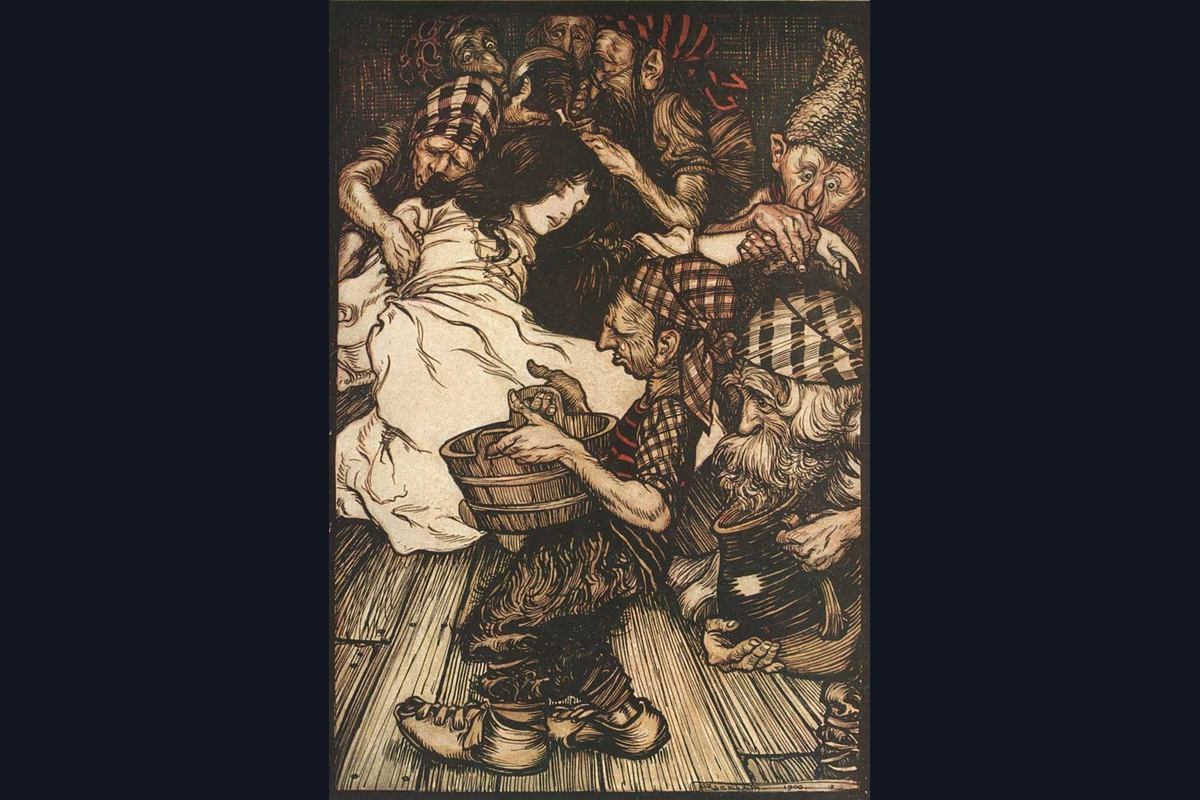
Snow White offers a clear example. In the 1812 text, the jealous queen is Snow White's own mother. In the 1819 edition, the opening explains that her mother has died and her father has remarried. The woman who wants her killed is now her stepmother.
Yet the story did not simply become gentler with every revision. The queen's punishment, in which she must dance in heated iron shoes until she dies, appears in both the 1812 and 1857 versions. One disturbing detail changed while another survived. That makes the familiar account of brutal old tales gradually becoming harmless children's stories rather too tidy.
Disney's Snow White changed the ending too
Disney's Snow White and the Seven Dwarfs, released in 1937, includes a change that became especially familiar: the prince wakes Snow White with a kiss.
There is no awakening kiss in the Grimms' 1857 text. As servants carry away her coffin, one of them stumbles. A piece of poisoned apple comes out of her throat, and she revives. The difference changes how a crucial moment in the story works.
If you know the animated film best, the kiss may feel like an essential part of the original tale. Comparing it with the book reveals that this familiar scene belongs to a particular adaptation. Sometimes the version that feels oldest to us is simply the one we know best.
What changed in The Little Mermaid
Before the release of the 2023 live-action The Little Mermaid, composer Alan Menken discussed changes to two songs in an interview with Vanity Fair.
He linked revisions to “Kiss the Girl” to questions of consent, and changes to “Poor Unfortunate Souls” to lines that could suggest girls should stay quiet. He also acknowledged that Ursula is manipulating Ariel into surrendering her voice.
That last point matters when judging a scene. A villain may give bad advice precisely because the story wants us to distrust it. Equally, an adaptation may choose to make its intentions clearer. We can consider whether the change works by looking at who is speaking, what they want and how the rest of the scene treats their words.
Changing classic fairy tales is easier to discuss when we examine an actual line, scene or character choice. Calling every alteration progress, or every alteration an attack on a classic, tells us very little about the result.
A remake, a revised text and a removed edition
Debates about tradition and inclusion often bring together three decisions with different consequences for readers and viewers:
- A new adaptation. A filmmaker, playwright or illustrator creates a retelling and chooses what to emphasise. Its existence does not, by itself, mean that an earlier version has disappeared.
- Changes to an existing author's text. A publisher alters words or events in a new edition. Readers should be told whether they are buying a complete text, an abridgement or an adaptation.
- The withdrawal of an older version. This concerns access to the work. We need to establish which edition or film has been removed, from whose catalogue and for what reason. A remake announcement alone cannot answer those questions.
These distinctions are useful whether you welcome a new version or prefer an older one. There is room to support a fresh interpretation while asking for previous versions to remain available and revisions to be clearly labelled.
Choosing an edition for a child
Wanting to avoid a demeaning portrayal of a group of people is a reasonable concern. The quality of the retelling still needs attention, though. If a character changes, their actions should continue to make sense. If a scene is cut, we should still understand the danger or the choice facing the hero.
The same care applies to reducing violence. A short picture book for a young child and an edition preserving an earlier text serve different purposes. Clear descriptions help readers choose between them. Terms such as “abridged”, “adapted” and “retold by” explain something that the word “classic” cannot.
An adult reading aloud can choose a different edition, skip a passage or talk about something unsettling in the story. Explaining historical context and adapting the material are both options; the choice can depend on the particular book, child and situation. Knowing what is in an edition is more useful than assuming its age makes it suitable for every reader.
Keep older versions within reach
You do not have to like every new Snow White, or consider every old edition the best one. An older work can have weaknesses, and a worthwhile modern message still needs a well-told story.
Changing classic fairy tales can give writers room for new ideas while earlier versions remain available and adaptations are clearly identified. Readers can then compare what has changed and decide what they think. Someone looking for the Grimms' text should be able to find it; someone choosing a modern retelling should know whose version they are reading.
A familiar voice, a song or a particular drawing can also be part of what you value in a story. That attachment is worth acknowledging. We explore a similar connection with music in our look at cartoon intros we never forget. You can keep enjoying a favourite version while giving another a chance, without having to like them equally.
When you read or watch a new version of a fairy tale, what do you most want it to keep: the plot, the characters or the atmosphere?
Sources
- Jack Zipes / National Endowment for the Humanities: the history of the Grimms' collection and its revisions.
- D. L. Ashliman / University of Pittsburgh: English translations of Snow White from 1812 and 1857, with notes on the differences.
- Disney: Snow White and the Seven Dwarfs — the 1937 film's release date and synopsis.
- Vanity Fair: interview with Alan Menken, 31 March 2023.