
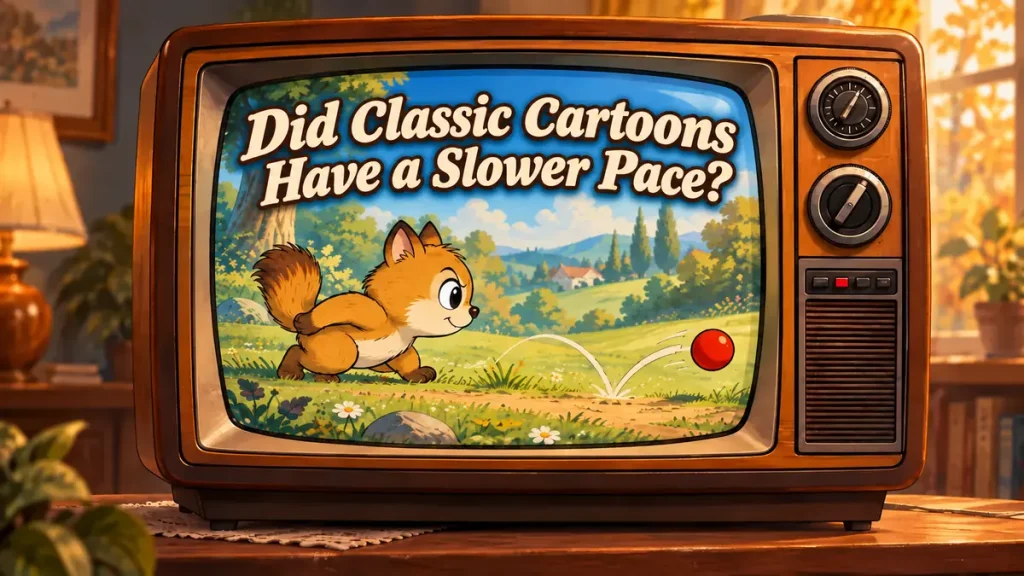
The Road Runner is an awkward mascot for the idea that classic cartoons had a slower pace. His films thrive on speed, with Wile E. Coyote supplying an apparently inexhaustible list of ways to get left behind.
Some older cartoons do feel unhurried, especially when a visual joke develops without much explanation. Others are crowded with movement, music and sudden reversals. The slower pace of classic cartoons makes more sense as a description of particular films, or of how they feel to us now, than as a rule about animation history.
Road Runner turns speed into comedy
Fast and Furry-ous, the first film featuring Wile E. Coyote and the Road Runner, reached cinemas in 1949. In a passage from his autobiography reproduced on the official Chuck Jones website, Jones recalled that he and writer Michael Maltese had wanted to make fun of animated chases. Those chases were already common enough to invite a parody.
The films leave little doubt about what Coyote wants. The interest lies in his next scheme and the gap between his confidence and the result. A pause can give the audience time to grasp an idea before it fails. That moment of preparation belongs to the rhythm of the chase.
Bugs Bunny's early history belongs to the same Warner Bros. theatrical tradition. His composure in the middle of trouble is another useful distinction: a character can keep his cool while the action around him becomes chaotic.
How pauses can create a slower pace
A single, uninterrupted shot can contain a frantic chase. Several cuts can show a character doing something quite ordinary. The length of a shot, the speed of a movement and the amount of action are separate things, even if we casually describe all three as pacing.
In The Pink Phink (1964), the Pink Panther objects to a painter's preference for blue and keeps introducing pink instead. The disagreement is visible in the paint itself. One character establishes a color, the other changes it, and the audience can wait for the painter to discover what has happened.
Once we understand the disagreement, a glance or a delayed reaction can carry the joke. There is time to notice the interference before the next response. A cartoon can feel spacious because it lets us follow one idea through, even when its characters are causing plenty of trouble.
Little dialogue does not mean a quiet soundtrack
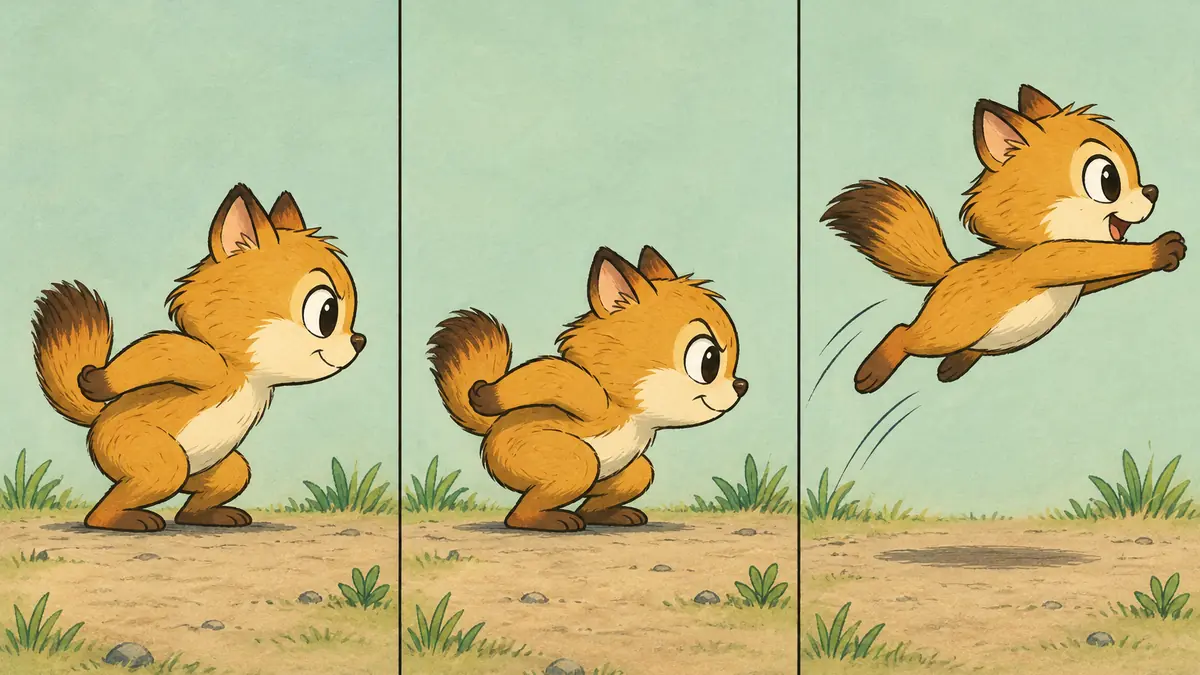
The absence of dialogue can make a cartoon easier to follow across languages. It says much less about the intensity of its soundtrack. An orchestral flourish, a crash or a change in musical tempo can communicate a reaction without anyone speaking.
In The Cat Concerto, Tom performs Franz Liszt's Hungarian Rhapsody No. 2 while Jerry disrupts the recital. The piano becomes both an instrument and the site of their argument. The musical performance and the physical comedy keep interfering with each other.
Here, “little dialogue” is a much more useful description than “quiet.” Listen to the accents, changes in volume and the way the action fits the music. That relationship is a major part of Tom and Jerry's comedy, and it can make a wordless cartoon very lively indeed.
From theatrical shorts to television cartoons
A cartoon you watched on TV in the 1980s or 1990s might date from decades earlier. MGM made the original Tom and Jerry shorts for cinemas. Warner Bros. also created many of its classic cartoons for theatrical release. Watching them on a smaller screen later did not change their origins.
Producing animation for television brought different schedules and budgets. In his 1997 interview for the Television Academy, Joseph Barbera discusses limited animation and the differences between film and television work. Reducing the number of new drawings could save production work without slowing the story down.
A held drawing can accompany a conversation full of new information. Only a character's mouth or arm might move while a voice carries the scene forward. Our look at how cartoons were made in the 1990s explains more about the practical work behind those choices.
Hanna-Barbera's The Smurfs also has room for conversations, plans and relationships within the village. Its stories develop differently from a short Coyote chase. Mushroom houses and woodland backgrounds can suggest a peaceful setting, even when the characters are having anything but a peaceful day.
How Bluey's Sleepytime lets music carry the story
A gentler passage does not require an old production date. In Sleepytime, an episode of Bluey, Bingo dreams of traveling through the Solar System while the family has a restless night of moving between beds. The space adventure and the ordinary business of getting a child back to sleep unfold alongside each other.
Composer Joff Bush described the episode's use of Holst's Jupiter, from The Planets, in an interview with ABC Classic. He explained how echoes of the melody suggested the parents' love, against synthesizer textures and swelling orchestral music. A scene can feel tender while still having a carefully developed soundtrack. This particular episode offers a modern example of how much the picture and music can communicate together.
Why a familiar chase can still be comforting
A familiar episode gives you a different kind of anticipation. You may already know that a plan will fail and be waiting for the delivery: the expression, the musical cue or the exact way a character reacts. The enjoyment of a joke does not have to depend entirely on being surprised by it.
A study of media that people find comforting consistently linked comfort with familiarity and a positive emotional tone across the contexts it examined. Nostalgia was relevant in some circumstances, but not equally in all of them. Familiarity may therefore help explain the appeal of returning to a cartoon, alongside its pacing, characters and soundtrack.
Research on children's attention also gives little support to the idea that a slower pace is always better. A meta-analysis published in 2025, whose analysis of media pace covered 19 studies, found no consistent overall short-term effect of pace on children's attention and executive functions, such as working memory and self-control. Those findings concern children's immediate test performance; adults' enjoyment of familiar cartoons is a separate question.
On another viewing, it is worth noticing exactly where a film pauses, what moves quickly and how much the soundtrack contributes. A cartoon can send Coyote hurtling into trouble and still be a familiar, comfortable thing to watch.