
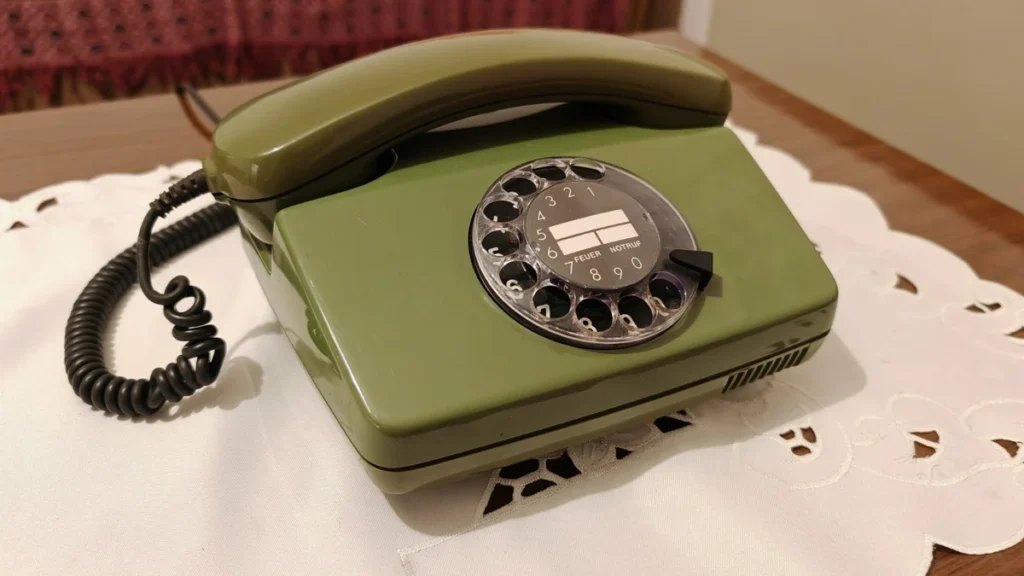
On a FeTAp 791, dialling a zero takes longer than dialling a one. You turn the clear dial until your finger reaches the black stop, release it and wait for the mechanism to return. Only then can you move on to the next digit.
The green phone in these photographs is a model from West Germany’s Deutsche Bundespost telephone range. Its rotary dial was a deliberate choice at a time when phones with keypads were already available.
Why the FeTAp 791 arrived in 1979
In West Germany, Deutsche Bundespost ran both the postal service and the public telephone network. Subscribers obtained their connection and standard telephone through the same organisation. FeTAp is short for Fernsprechtischapparat, meaning a desk telephone.
Bundespost introduced new standard phones with keypads in 1977. Some customers found the change difficult; others simply preferred the dial. The Museumsstiftung Post und Telekommunikation’s account of the 79 series explains that these customers were the reason for its development. A body originally designed for a keypad was fitted with a traditional rotary dial.
The Roscheider Hof museum’s record in the Deutsche Digitale Bibliothek dates production of the FeTAp 79 family from 1979 to around 1990. The green example shown here has not been reliably dated.
The 1989 Deutsche Bundespost TELEKOM catalogue still offered a conventional rotary telephone alongside models with number memories, displays and cordless handsets. Customers could choose between quite different ways of making a call.
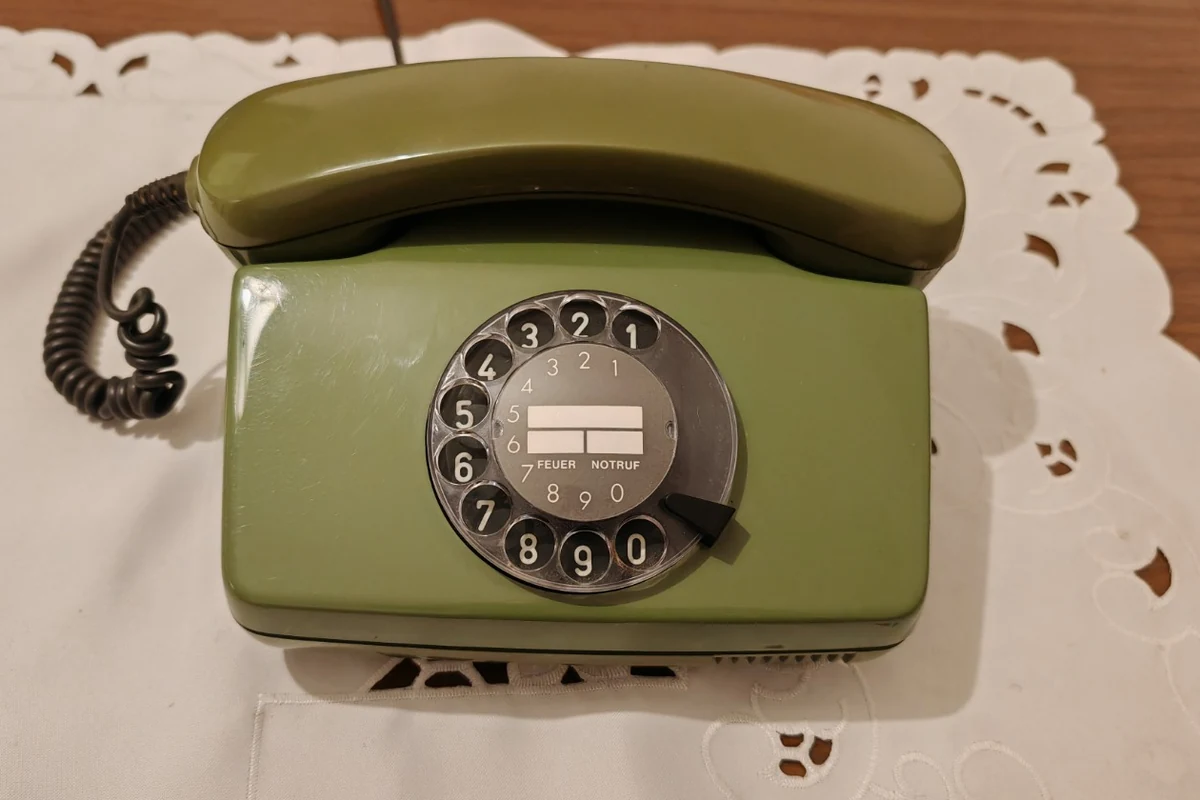
How the rotary dial sent a number
A call began by lifting the handset. This closed an electrical loop between the telephone and the exchange, signalling that someone wanted to make a call. The dial tone told the caller when to start entering the number.
Turning the dial wound its mechanism. As it returned, it briefly interrupted the current flowing through the loop. Those interruptions represented the chosen digit: five for a five, nine for a nine and ten for a zero. This is called pulse dialling.
The system used by this phone worked at a nominal rate of ten pulses per second, which explains why zero took longer than one. Each return of the dial sent another group of pulses, with a pause before the next digit. The principle and timing are described in International Telecommunication Union documentation.
A mistake on the final digit meant hanging up, lifting the handset again and starting the whole number from the beginning. There was no delete key. The basic FeTAp 791 had no number memory or automatic redial either, so even a second attempt at the same call meant working through the dial again.
Some phones with keypads also used pulse dialling. Their electronics produced the interruptions that a rotary dial made mechanically. A keypad alone did not tell you whether a telephone used pulses or tones to send its number to the exchange.
Where the power and ringing came from
A basic telephone like this needed no separate power adapter plugged into a household electrical socket. In the traditional analogue network, power came from the exchange through the telephone line. The microphone converted speech into an electrical signal, and the earpiece at the other end converted it back into sound.
For an incoming call, the exchange sent a ringing voltage along the line to operate the bell in the telephone. Meanwhile, the caller heard a separate ringing tone generated by the network. Lifting the handset stopped the bell and connected the conversation.
The whirr of the dial came from the mechanism itself, so it could still be heard with the phone disconnected. The bell and the tones in the earpiece depended on a working telephone connection.

A telephone rented from the post office
Standard telephones supplied through Bundespost were rented to subscribers and remained the postal authority’s property. The same organisation provided the connection, the set and its maintenance. These phones were designed for repair, with a case a technician could open using a screwdriver.
That ownership explains a small detail noted in the Roscheider Hof record: plastic plugs protected the screws so the housing could not be opened unnoticed. The phone on a customer’s table was still the network operator’s equipment.
One household number and the reach of a cord
The wall socket and the length of the cords determined where the phone could stand and how far the handset could travel. You went to the telephone to make or answer a call. On an ordinary line without additional services, a conversation occupied the connection until someone hung up.
There was no screen to show who was calling and no list of missed calls to check later. You found out who was on the line by answering. To call someone yourself, you needed the number in your memory, on paper or in a directory. On this phone, a number survives on the small card above the dial, although we do not know whose it was.
The household line also gave access to services that now need a little explanation. Our article about life before mobile phones and the internet in Yugoslavia recalls a telephone wake-up service. You gave the service your number and a time in the evening, then received a call the next morning.
By the time of the 2009 review of the first Android phone, the G1, in the Serbian magazine Svet kompjutera, the discussion had moved to applications, a physical keyboard and mobile data costs. Making a voice call had become one function among many.
What the label tells us about this FeTAp 791
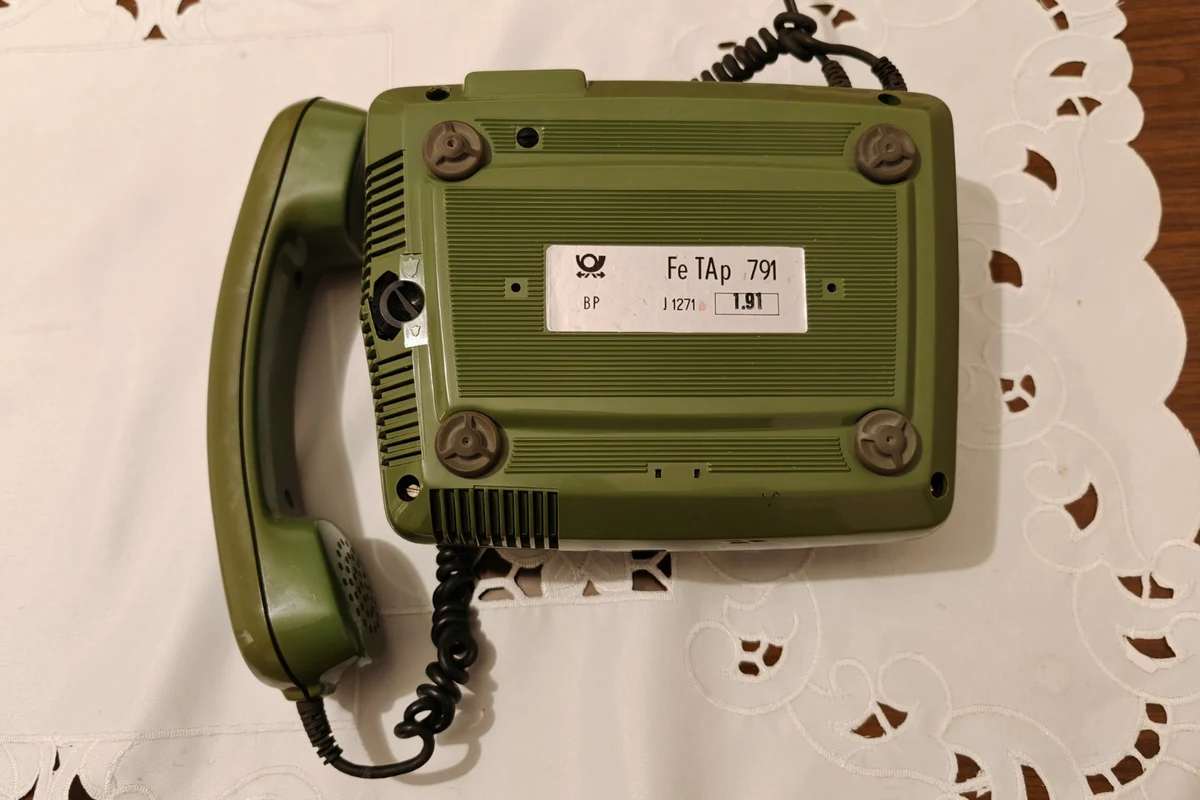
The underside is marked Fe TAp 791, with a postal emblem, the letters BP, J 1271 and the stamp 1.91. It is tempting to read that last mark as January 1991. Without documentation explaining the label’s coding, though, it is not enough to establish a manufacturing date.
The model family had several manufacturers. Museum collections include examples made by DFG and Heibl. The markings on this green phone have not been matched to a confirmed manufacturer.
Can a FeTAp 791 still be used today?
A working example can be used with a suitable telephone connection. It needs an analogue telephone port that accepts pulse dialling, or equipment that converts its pulses into a supported signal. An analogue socket on a router or telephone adapter does not, by itself, guarantee that the rotary dial will work.
If the port accepts only tone dialling, a compatible pulse-to-DTMF converter may provide a solution. Automated menus can pose another problem: this dial has only digits, so star, hash (#) and other tone commands require equipment capable of generating them. Before connecting a particular phone, check its condition, its cable and the capabilities of the telephone port.