
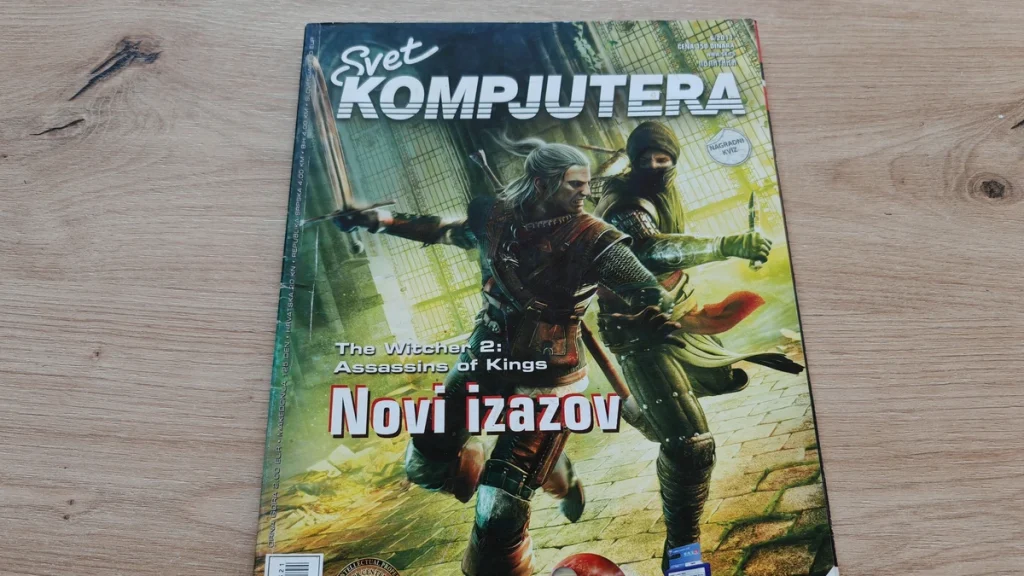
The Witcher 2 was the cover game for the June 2011 issue of Svet kompjutera, a Serbian computer magazine. I still have that issue in my collection of Svet kompjutera magazines. Geralt appears beneath the headline “Novi izazov”, which means “A New Challenge”. These days, opening that copy gives me a chance to see how the game was received while it was still new.
The score catches my eye straight away: 90, alongside the magazine’s “Game of the Month” badge. Then I start reading the review on page 93. There is plenty of enthusiasm, but also some quite specific criticism. Two additional opinions on the same page offer different reactions to the game. That is what makes this issue worth returning to.
How The Witcher 2 Was Received in 2011
The Witcher 2: Assassins of Kings launched on PC on 17 May 2011, so the June issue preserves a response from shortly after its release. The first game had already set expectations. Now the sequel had to show what else could be done with Geralt’s world. The Witcher 3 was still in the future.
When I read this review, I try to stay in that moment for a while. The writer is assessing a new game, including its strengths, its rough edges and the possibility of future additions. The later history of the series is still unknown. Reading with that in mind makes even familiar comments about graphics or combat more interesting.
The prices help bring the period into focus, too. The magazine cost 150 Serbian dinars. Inside, the game was listed at 4,999 dinars. Both figures remain on the pages of my copy, alongside the question that mattered whenever a demanding PC game arrived: could the computer you already owned handle it?
One DVD, 4,999 Dinars and a List of PC Requirements
The information panel lists the PC version on one DVD, priced at 4,999 Serbian dinars (RSD). It also gives two hardware configurations, labelled “Potrebno” and “Poželjno” in Serbian: required and preferred. Those details show what a reader of this magazine was being told in June 2011.
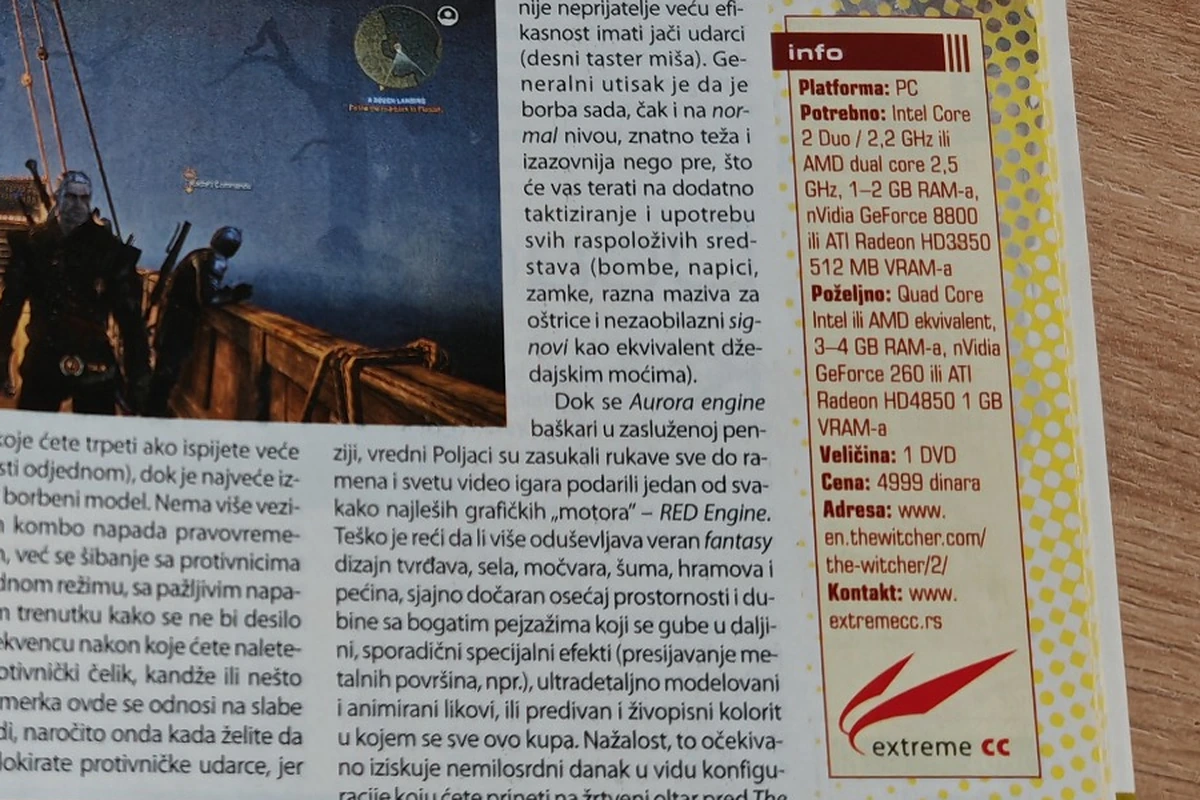
| Component | Required, as printed | Preferred, as printed |
|---|---|---|
| Processor | Intel Core 2 Duo at 2.2 GHz or AMD dual-core at 2.5 GHz | Quad-core Intel or an equivalent AMD processor |
| RAM | 1–2 GB | 3–4 GB |
| Graphics card | GeForce 8800 or Radeon HD 3850; 512 MB of video memory listed | GeForce 260 or Radeon HD 4850; 1 GB of video memory listed |
These are the figures printed in the magazine. The review’s author, Aleksandar Dinić, also warns about the game’s hardware demands and the need to reduce advanced graphics settings on less powerful systems. The table makes more sense when read alongside that warning. Meeting a listed specification still left room for compromises in how the game looked and ran.
I looked at a similar relationship between ambitious graphics and available hardware in my article about Crysis in 2007 and the cost of a PC capable of running it. Here, the hardware panel gives useful context for the praise elsewhere on the page. Every impressive view of Geralt’s world came with demands on the machine displaying it.
Why The Witcher 2’s Graphics Stood Out in 2011
The graphics made a strong impression on the reviewer. Dinić praises RED Engine, the environments, the detail of the characters and the sense of depth in the world. Reading that section, I can see how much the visual presentation contributed to his overall opinion of The Witcher 2 in 2011.
This is one of the things I enjoy about keeping old magazines. A small screenshot on paper, accompanied by a few lines of description, preserves what looked impressive at a particular moment. I can turn the page today with years of later games in mind, while the writer was looking at something that had only just arrived.
The hardware warning belongs beside those compliments. It helps explain the experience being described: an attractive game whose more advanced settings could push a computer hard. Seeing both on the same page gives the praise a little more weight.
A Score of 90, with Criticism of Combat and Length
The high score leaves room for criticism. Among the main complaints are the responsiveness of combat commands and the game’s relatively short length. The review describes problems when trying to dodge or block an attack and getting an unexpected response. That is a specific concern in combat where the timing of an action matters.
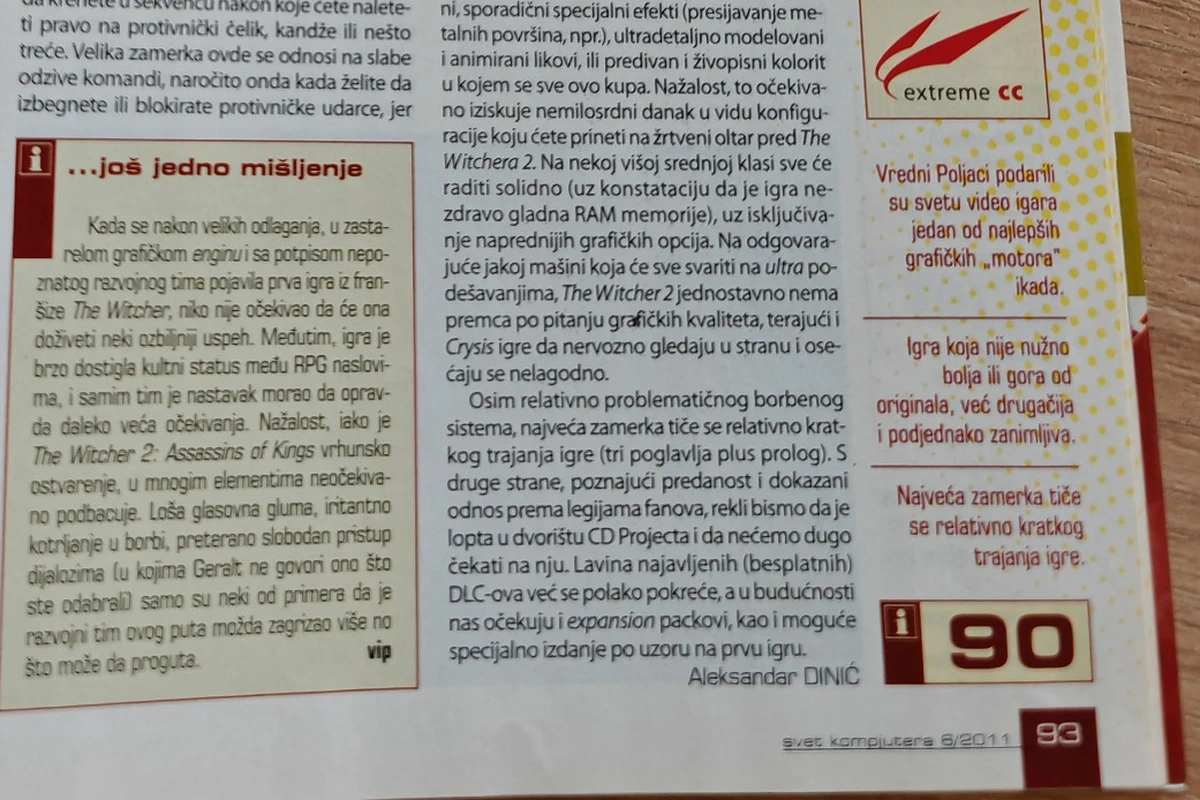
When I look at that 90 today, I find myself reading the surrounding paragraphs more carefully. They explain how the game could make an excellent overall impression while particular parts of it remained frustrating. The score is easier to understand with those details still attached to it.
The closing thoughts also preserve the uncertainty of the time. There are expectations about additional content and what might come next. A reader opening the June issue in 2011 still had to wait to see how those possibilities would develop.
Two More Opinions on the Same Page
The two smaller opinion boxes are the part I find most interesting. One is enthusiastic about the story, the quests and the different ways they can be approached. The other raises concerns about voice acting, rolling during combat and the difference between a selected dialogue option and what Geralt actually says.
Those reactions sit together on a single page. A reader interested mainly in the story might be drawn to one opinion. Someone who cared more about the feel of combat or dialogue could pay closer attention to the other. The magazine gives both responses space.
That makes the page useful to revisit. It shows where the enthusiasm came from and which details caused irritation. These are the reactions preserved by this particular magazine, so I read them as a small part of how The Witcher 2 was received in 2011.
Why I Keep Coming Back to This Issue
What I like about this copy is how much of the original reaction remains together. The cover introduces a new challenge. The review gives the game 90. The hardware panel reminds the reader what it takes to run it, and the extra opinions offer more than one way of judging the experience.
I had a similar reason for revisiting the first Android phone, the G1, in a 2009 issue of Svet kompjutera. Old reviews let me read early impressions with the benefit of knowing what happened later. With The Witcher 2, the different opinions are especially enjoyable because they show how much a response to a game can depend on what the person playing it values most.
So this June issue will stay in my collection. Whenever I open it, I can return to the point when the second Witcher was still a new release, with its achievements and frustrations being discussed on the same printed page.
Did you play The Witcher 2 when it first came out? What has stayed with you most: the story and atmosphere, the combat, or the effort it took to run it on your PC?
Sources
- Svet kompjutera, issue 6/2011: front cover and the review of The Witcher 2: Assassins of Kings by Aleksandar Dinić on page 93, accompanied by two additional opinions. The physical issue and photographs are from my private collection. The review in the magazine’s online archive is in Serbian.
- CD PROJEKT’s official company history, confirming the PC release date of 17 May 2011.