
Elmer’s bald head becomes a keyboard. An opera singer holds a note until the concert shell gives way. A monster stops chasing Bugs long enough to have his nails done. The funniest Bugs Bunny episodes often leave us with a scene we remember long after the title has slipped our minds.
These seven picks were directed by Chuck Jones and released between 1946 and 1957. They began as theatrical shorts in the Looney Tunes and Merrie Melodies series before becoming television favourites. The original titles and years below will help you find them again, with official YouTube excerpts alongside two of the selections.
1. Rabbit of Seville (1950)
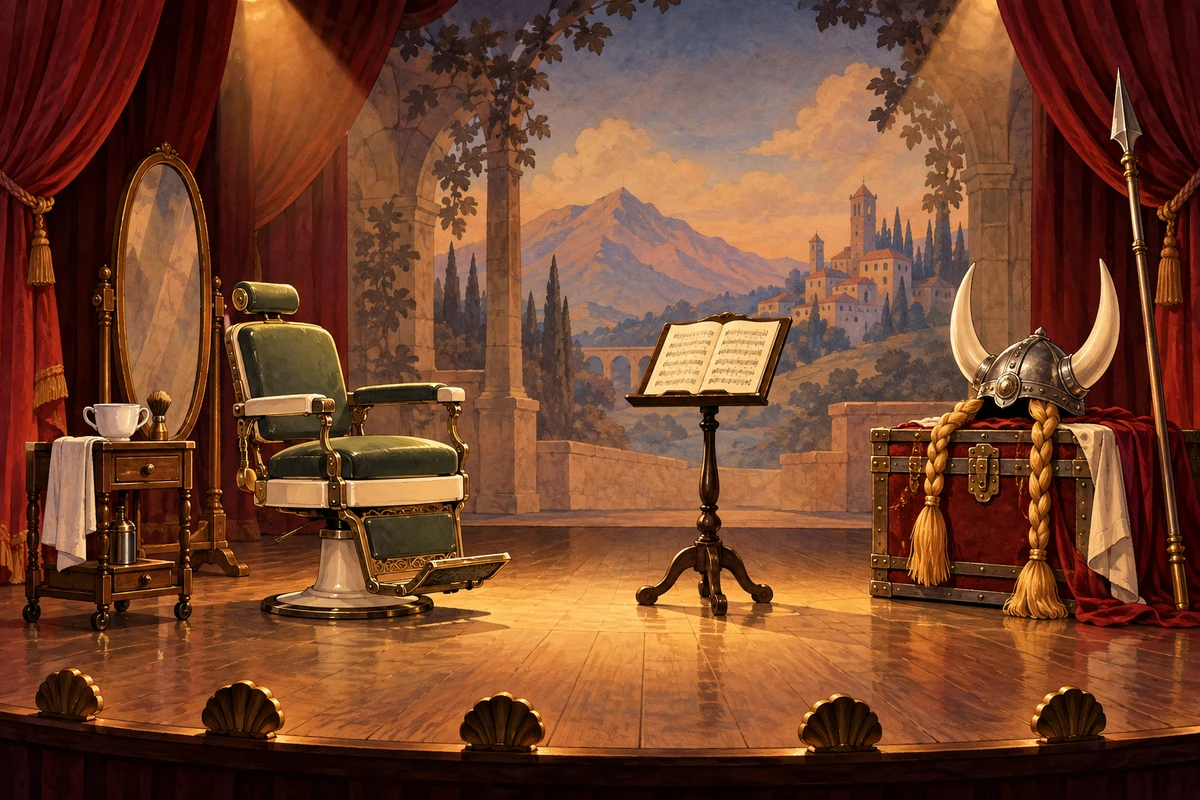
Elmer chases Bugs into the backstage area of an open-air theatre, where The Barber of Seville is about to be performed. Bugs raises the curtain, leaving the armed hunter in front of an audience. Before Elmer can resume the chase, he has become the customer in a barbershop routine.
Rossini’s overture sets the pace of the treatment. Brushes, razors and scalp massages follow its changes, with Bugs’s fingers playing across Elmer’s bald head as if it were a keyboard. Elmer keeps trying to recover his dignity while his barber finds another service to provide.
Even the opening theatre poster has a joke tucked into it. The names Eduardo Selzeri, Michele Maltese and Carlo Jonzi are Italianised versions of producer Edward Selzer, writer Michael Maltese and director Chuck Jones. The parody starts before Bugs puts on the barber’s apron.
Official WB Kids compilation. The Rabbit of Seville excerpt begins at 17:47. Open the excerpt on YouTube.
2. What’s Opera, Doc? (1957)
Elmer carries a spear and wears a magic helmet, singing his way through the hunt to music drawn from Richard Wagner’s operas. Bugs appears as Brünnhilde, complete with a horned helmet, long braids and an extravagantly plump horse. The pursuit gives way to courtship and a ballet duet.
The disguise is obvious to the audience, yet Elmer treats the romance with complete sincerity. That earnestness matters: the singing, gestures and tragedy are played with enough conviction for the ridiculous costumes to become even funnier. Maurice Noble’s towering scenery and bold colours give the tiny performers an enormous world to inhabit.
The ending briefly asks us to take Elmer’s grief seriously before Bugs interrupts the mood. In 1992, the film entered the US National Film Registry. Craig Kausen discusses its production and visual staging in his Library of Congress essay on three Chuck Jones films.
3. Long-Haired Hare (1949): Bugs Bunny conducts
Giovanni Jones is rehearsing an operatic aria when Bugs’s banjo music drifts over from a nearby hillside. The singer starts joining in almost despite himself, then marches over to destroy the instrument. Bugs tries other instruments, Giovanni loses his temper again, and the disagreement eventually reaches the concert hall.
Bugs enters as a caricature of conductor Leopold Stokowski. The musicians whisper “Leopold!” and defer to him before he has done anything. He accepts a baton, snaps it and conducts with his hands, echoing Stokowski’s habit of working without one.
Giovanni now has to follow the rabbit’s smallest gestures. Bugs makes him sustain a high note long past any reasonable stopping point. Giovanni’s strained face and shaking body make the effort painfully clear, but the conductor keeps asking for more. The grand concert ends with the stage shell collapsing. After all that punishment, Bugs returns to his banjo.
Official WB Kids excerpt, published as “The Conductor and The Fan Rabbit”. Watch on YouTube.
4. Bully for Bugs (1953)
Bugs is trying to reach a carrot festival when his tunnelling brings him into a bullring. He stops to ask the matador for directions and finds himself dealing with Toro, a bull who has no interest in helping a lost traveller. Being pushed around soon turns a navigation problem into a personal dispute.
One of Bugs’s solutions is to hide an anvil behind his cape. Toro charges into it, making the impact feel heavy enough to hurt even in a cartoon. The bull can also detach his horns, giving him a few mechanical tricks of his own.
Between the collisions, Bugs pauses, poses and reacts with offended disbelief. Those little delays let Toro’s size register before the next trick begins. The Chuck Jones Gallery’s account of the film includes a production layout drawing and discusses the attention given to the bull’s weight and the matador’s design.
5. Duck! Rabbit, Duck! (1953)
Snow is the first clue that this is the final film in Jones’s hunting trilogy. Daffy removes and burns signs announcing duck season, then tries to direct Elmer towards Bugs. He has prepared the landscape carefully; keeping control of the conversation proves harder.
When Bugs calls him a dirty skunk, Daffy repeats the insult indignantly. Bugs produces a “Dirty Skunk Season” sign, and Elmer takes it as permission to fire. The short pause before the shot gives us time to recognise the trap. Daffy understands it a moment too late.
The confusion eventually sends Elmer off hunting a baseball. This is the 1953 conclusion to the series that began with Rabbit Fire in 1951 and continued with Rabbit Seasoning in 1952. The winter setting and the succession of new hunting-season signs distinguish it from the earlier films.
6. Rabbit Fire (1951)
Here the argument begins with Daffy leading Elmer to Bugs’s burrow. The repeated claims of rabbit season and duck season become a contest over who will say the wrong thing first. Bugs reverses the exchange at just the right moment, leaving Daffy arguing for the outcome he was trying to prevent.
There is a particularly good vocal joke when the rivals impersonate each other. Mel Blanc makes Daffy imitate Bugs and Bugs imitate Daffy, so the performance has to preserve one character’s voice inside another. The Chuck Jones Gallery’s retrospective singles out that detail.
At the end, Bugs and Daffy tear successive hunting-season posters from a tree until they uncover “Elmer Season”. For once, the two rivals agree immediately. Their feud vanishes as soon as there is somebody else to chase, and Elmer suddenly has two hunters on his trail.
7. Hair-Raising Hare (1946): a monster’s manicure
A mechanical female rabbit lures Bugs into a mad scientist’s castle. Inside waits the huge, hairy, sneaker-wearing creature now known as Gossamer. The winding key in the decoy’s back and the monster’s everyday footwear make the horror setting look slightly absurd before the chase has properly begun.
Then Bugs stops running to give the monster a manicure. Gossamer obediently offers his hands while Bugs chats like a salon worker. The bowls used to soak his fingers contain mousetraps. A few moments of ordinary customer service have become another ambush.
The cinema audience also enters the joke. A call for a doctor produces a silhouette rising from the seats; later, the monster is horrified to discover people watching him. The creature that frightens Bugs has its own fear, and the spectators suddenly become part of the escape plan.
Which Bugs Bunny episodes should you start with?
For a short introduction, pair Rabbit of Seville with Rabbit Fire: one builds its jokes around an orchestral score, the other around an argument. Long-Haired Hare gives the musical revenge more room to escalate, while Bully for Bugs is a good choice for physical comedy.
For the character’s earlier development, read how Bugs Bunny was created. Which other Bugs Bunny episodes would you add to the selection?
Related articles
- Cartoon songs from childhood
- Classic cartoon episodes that scared us as kids
- Read our Serbian selection of Duško Dugouško episodes
Sources on these Bugs Bunny episodes
- Torino Film Festival: Rabbit of Seville, credits and Chuck Jones filmography.
- Library of Congress: Craig Kausen on What’s Opera, Doc? and two other Chuck Jones films.
- Long-Haired Hare: plot, music and the Stokowski impersonation.
- Chuck Jones Gallery: Bully for Bugs.
- Chuck Jones Gallery: Rabbit Fire and the hunting trilogy.
- Cartoon Research: the winter hunting-season gags in Duck! Rabbit, Duck!.
- Bugs Bunny: general character overview.