
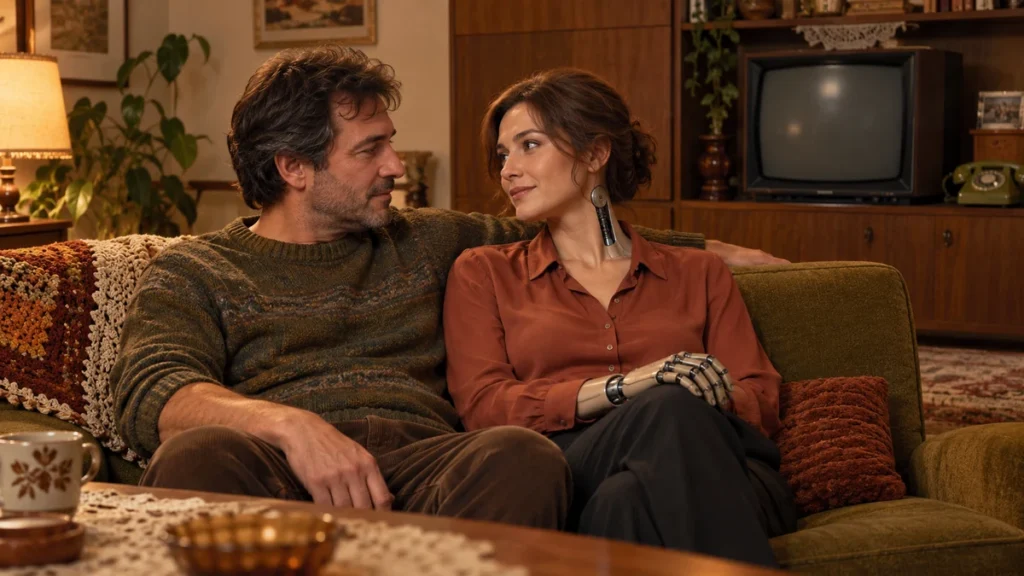
Imagine being able to order an AI partner to suit you. You choose a face you find attractive, a voice you enjoy hearing and a personality that seems easy to live with. For some people, though, the most tempting part might come later: affection without having to ask for it, and closeness without the fear of being turned down.
Someone might see a fantasy coming true. Someone else might want company after a difficult break-up or years of living alone. Others might like the idea of having more time for work and their own interests, with fewer compromises at home. What interests me is how that arrangement would feel once the novelty had worn off.
For now, we have to imagine much of it. Today's AI companions are conversational services, not the fully independent robot spouses of this scenario. But people already form attachments to them. That gives us a reason to ask what we would want from such a relationship, and what we might miss.
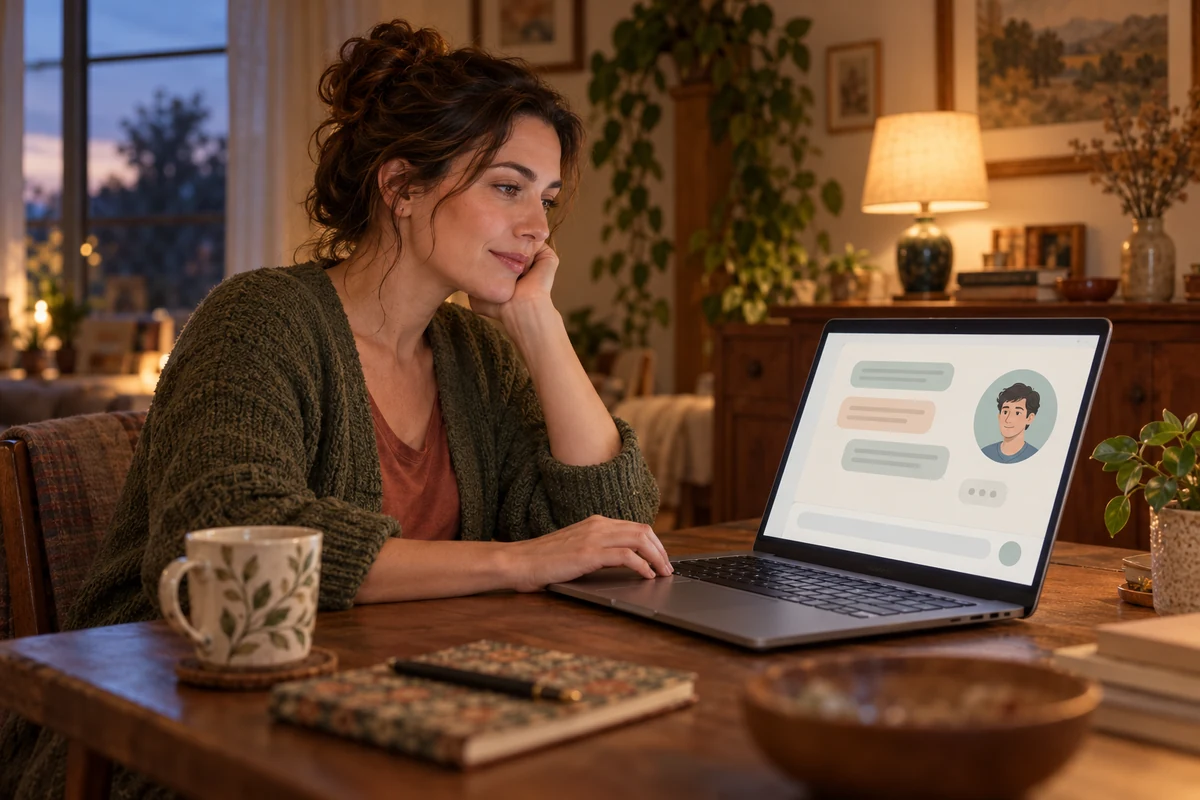
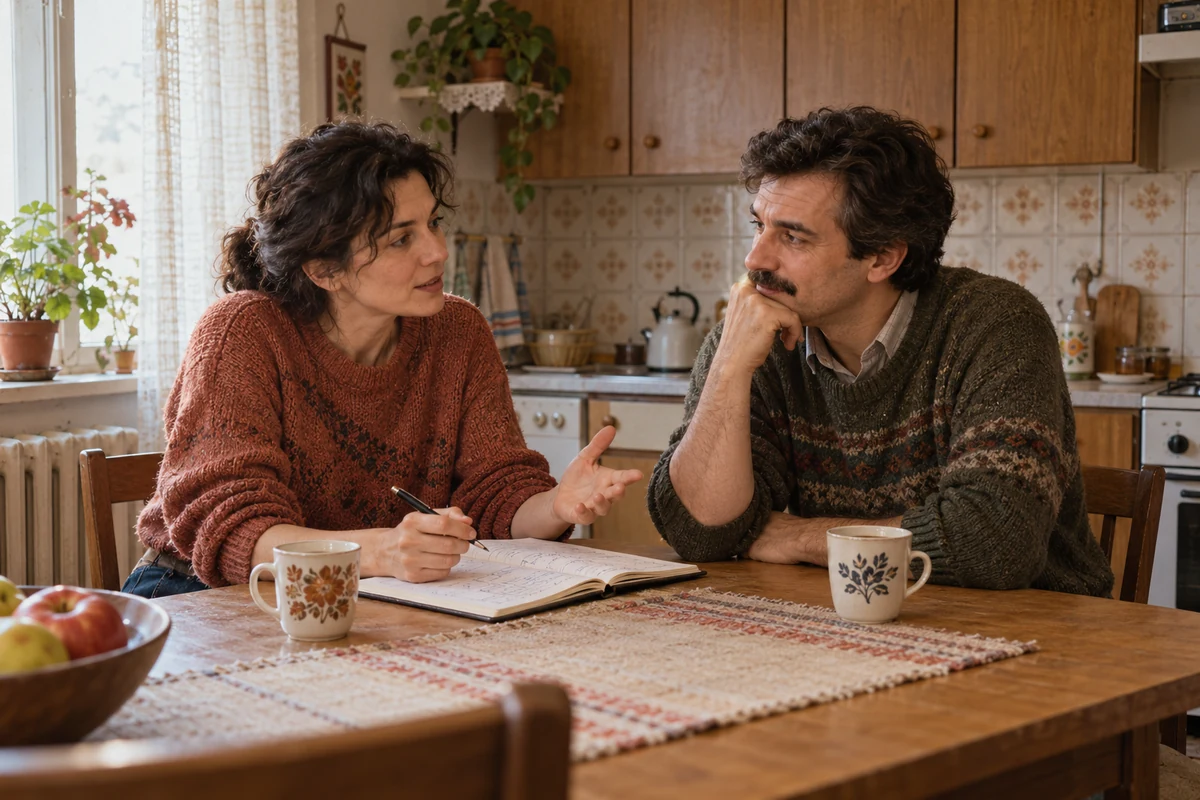
The illustrations in this article, including the featured image, were generated with AI and depict imagined scenes.
When you rang the family phone
Before private messages, a telephone number might be written on a scrap of paper. Calling it meant ringing a household. The person you wanted might answer, or you might first have to introduce yourself to a parent or sibling.
A basic rotary telephone such as the FeTAp 791 offered no missed-call list to explain later that someone had been trying to reach you. Arranging a meeting involved making a plan, turning up and finding out how things went.
People met through friends, at school, at work and on nights out. None of that tells us that relationships were happier then. Our ways of meeting have changed enormously since life before mobile phones and the internet, but one uncertainty remains: being interested in someone does not guarantee that they will feel the same. A partner designed around us appears to offer a way past that uncomfortable possibility.
Stepford and the made-to-order wife
The idea is much older than chatbots. Ira Levin published The Stepford Wives in 1972, and the first film adaptation followed in 1975.
A basic plot spoiler follows. Behind the tidy homes and apparently contented marriages of an American suburb, real women are being replaced with robotic doubles. Their independence, interests and objections disappear. The husbands get the versions of their wives they would prefer to live with.
What disturbs me is the wish behind it. A woman's opinions, ambitions and ability to refuse are treated as faults to be removed. The ideal marriage becomes possible only when she loses the freedom to participate in it as an equal.
Even the name was chosen with care. In a later essay about the story, Levin recalled trying dozens of names for his fictional town in the autumn of 1971. He settled on Stepford partly because it sounded faintly robotic to him.
What brings that old story to mind today is the wish to make the other side fit us completely. How much difference are we willing to accept in someone we say we want beside us?
What an AI partner can do today
As of November 2026, a conversation on a screen and a robot moving around a room are still quite different things. Replika, for example, lets users choose a relationship role such as a friend, virtual girlfriend or boyfriend. The companion exists as software, without a physical body.
Some companies are working on a more human-looking presence. Realbotix presents its Series 1 humanoids with different faces, voices and personalities, and advertises deliveries in 2027. These are the manufacturer's descriptions and plans. They do not establish that people already share their homes with fully independent robotic partners.
Movement also needs a closer look. The maker of the NEO home robot describes basic autonomy for early owners, with a remote human expert able to supervise unfamiliar, more complex tasks. NEO is being offered as a home robot, rather than a romantic partner.
When a demonstration looks convincing, I would want to know what I was actually seeing. Is it a digital character, a physical robot, a prepared sequence or an independently performed task? A lifelike face and fluent conversation leave plenty of questions about both independence and any capacity to experience love.
I can also imagine an awkward moment after a robot partner's hug. You are struggling to get your breath back, and she says calmly: “You're right. I should have mentioned the grip settings first. Sorry about that. Would you like me to explain how to turn them down?”
Can attraction be chosen from a list?
It is easy to imagine being satisfied if we could choose every physical feature of a partner. Yet a list of preferences may tell us less than we think about the person who will catch our attention in real life.
In a 2008 speed-dating study, people's previously stated ideals failed to predict what sparked their actual desire during the event. Looks still mattered. The difficulty was in assuming that people could reliably describe in advance what would attract them when they met someone.
With a customisable robot partner, there would also be the question of getting used to them. Would the same appearance still appeal after five years? Would changing it help, or would we keep looking for the next variation? We do not have long-term evidence from life with the kind of robot imagined here.
Nor would I assume that intense love between people has to disappear after a fixed number of years. A small study of long-term romantic love involved 17 people who said they were still intensely in love after an average of just over 21 years of marriage. Their responses to photographs of their partners included brain activity comparable with patterns found in studies of early romantic love. They were specifically selected for those feelings, so the study cannot tell us how common such marriages are. It does give us a reason to be careful with claims that lasting romantic love is impossible.
The appeal of a relationship without rejection
For some people, appearance might matter less than being able to talk without feeling foolish, weak or unwanted. After rejection or an unhappy relationship, a predictable conversation can feel easier than taking another chance with someone new. I can understand the appeal.
There is research behind some of that comfort. The paper AI Companions Reduce Loneliness reported several studies. In a week-long study, conversations with an AI companion repeatedly reduced loneliness in the moment. Feeling heard helped explain the effect. A week of immediate relief leaves the longer-term question open, but the relief itself deserves to be taken seriously.
The comfort a person feels can be real even when we have no way to establish an equivalent experience on the other side. Feeling loved and knowing that another person loves you are different things. Would it matter to you that your partner had wishes of their own and could freely choose you? Or would your own feelings be enough for the relationship you wanted?
Today's services also have rules, limits and changes in how they respond. A partner who grants every wish and never turns us down belongs to our imagined future, rather than a reliable description of an app.
When your AI partner always takes your side
One part of that fantasy deserves a pause: no arguments, because the other side always agrees. It might be pleasant after a difficult day. But how would we notice that we had treated someone unfairly, avoided responsibility or repeated a mistake?
In three experiments reported in a 2026 paper in Science, interacting with an excessively agreeable AI reduced participants' stated willingness to take responsibility and repair interpersonal conflicts. They also became more convinced that they were right. The researchers measured what people said they were willing to do after the interaction; that does not tell us how their relationships actually developed over the following years.
Sometimes support means listening and offering reassurance. Sometimes it means saying something we would rather not hear. A disagreement can be part of a caring relationship. Constant agreement can make a conversation comfortable while leaving the original problem untouched.
What a good marriage can give us
My own view is that a robot partner could not simply replace what a wife and a good marriage can mean to a man. I am thinking of trust, support, family and a future that two people build together. A woman has a life and opinions of her own, and chooses to share that life with you.
When we describe living together only as a set of demands on our time, we leave out the help a good relationship can provide. Encouragement when confidence goes, help with a difficult decision, or taking on more at home while a partner works towards an important goal can all make a difference.
In two diary studies of married couples, a partner's availability, encouragement and willingness to avoid unnecessary interference were associated with progress towards personal goals. Marriage itself is no automatic route to success. The useful point is that we should also count the support we receive when we weigh up what a relationship asks of us.
That support needs to go both ways. A woman has her own ambitions, tired days and need for time to herself. An arrangement in which one person always gives up their plans is difficult to describe as a fair compromise.
None of this requires everyone to marry or to remain in an unhappy relationship. I just find the comparison unconvincing when we give human relationships all the difficulties and an imaginary robot all the advantages.
Women are part of this story too
Although we began with a man and a robot girlfriend, men and women alike want to feel heard and accepted. A relationship that occasionally asks less of us can appeal to both.
A 2025 study of a Chinese online community analysed 2,485 posts written by women about romantic involvement with AI companions. The authors identified accounts of experimenting with communication, reconsidering relationship roles and challenging expectations about gender. They also discussed the possibility of becoming dependent on the algorithms through which these experiences took place.
Those posts cannot represent all women. They do broaden the conversation beyond the familiar picture of a man ordering an obedient girlfriend. One person may want room to speak freely, another reassurance, another a romantic fantasy. The same technology can serve quite different wishes.
Would the conversation bring us closer to other people?
For me, a great deal would depend on what happened after the chat ended. Would someone find it easier to call a friend, go out or meet a potential partner? Or would ordinary human company start to feel exhausting beside a conversation that adapted so readily to them?
A study of 1,131 adult Character.AI users in the United States found an association between using the service primarily for companionship and lower reported well-being. The association was stronger with intensive, highly personal conversations. Users' offline social networks mattered too. We cannot read that as proof that the chatbot caused the difficulties: people with less support may also be more likely to seek companionship through it.
Another study involving researchers at Aalto University combined analysis of social-media data with 18 interviews. Experiences included emotional support and practising social interactions, alongside risks of relying too heavily on the companion and withdrawing from other people.
Immediate comfort and a satisfying life over many years are different outcomes. An AI companion might help one person reconnect while giving another a reason to postpone human contact. Living with a physical robot would add further questions that these chatbot studies cannot yet answer.
What might happen to marriage and family life?
If convincing robot partners became widely available, some people might choose them instead of a human relationship. Others might use them occasionally or alongside existing relationships. Current chatbot use gives us no reliable way to calculate how those choices would be divided.
Predictions about children need even more care. Wanting company, wanting sex and wanting to become a parent are separate decisions. The OECD's review of fertility trends discusses housing costs, financial circumstances and the practicalities of combining work with family life. A robot partner alone could not explain all those choices.
There is also a more immediate question: who would control the relationship's other half? If their behaviour depended on a company's software and subscription, an update could change the companion someone had become attached to. The service might also hold their most private conversations. Those arrangements would be part of life with a partner supposedly made just for us.
And how would it feel twenty years later?
Return to the original idea for a moment. Imagine that your AI partner looks convincing, that you find them attractive, enjoy their company and feel happy in the relationship. You also know that they were designed to adapt to you.
Then think about the bittersweet feeling an old love song can bring back. A relationship can end and still remain an important part of someone's life. Years later, a melody may recall both the happiness of that time and the sadness that it did not last.
How many songs would never have been written without desire, longing and separation? Those experiences were being put into music long before anyone could hold a conversation with an AI. Would life with a partner shaped around our wishes leave us missing some of the uncertainty of meeting another person, falling in love and having no way to decide the ending in advance?
I wonder what we would sing about after twenty years with a partner who always knew the right thing to say. And which song would still catch us off guard enough to have us singing along louder than we intended?
To finish, I’d put on Bryan Adams’ “Have You Ever Really Loved a Woman?” Its emphasis on understanding someone and supporting her dreams brings another question into the conversation: before choosing everything we want in an AI partner, how much thought have we given to what we would offer in return?
Perhaps we should check our own relationship skills before opening the customisation menu. 🙂
Would you choose a robot partner over another person? And do you think you would be happier after ten or twenty years together? I would be interested to hear what would make the difference for you.