
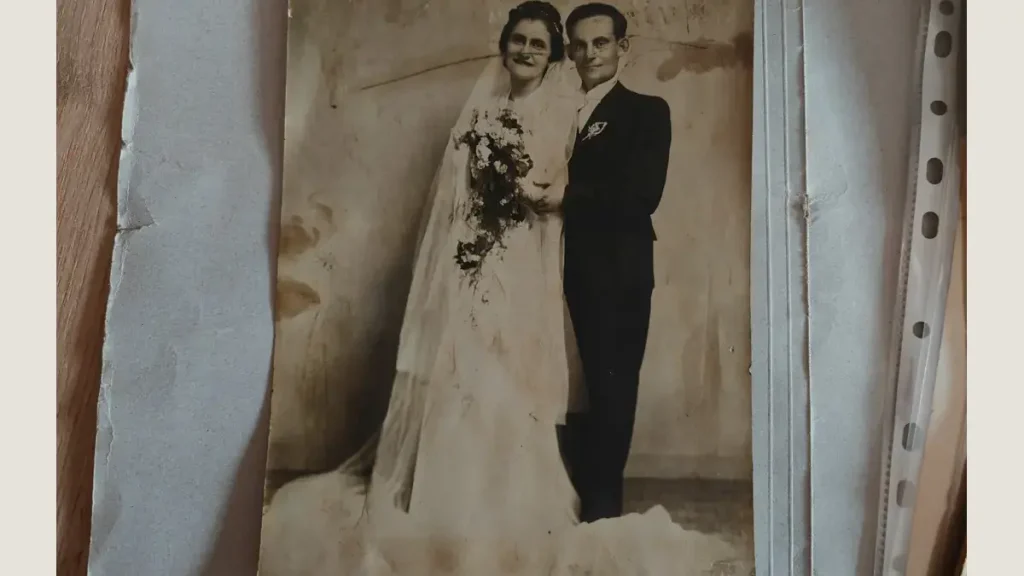
Nadežda and Budimir left behind several photographs, their names in old documents, a death notice and one preserved transcript of a letter. Yet that letter does something no official record can—it gives Nadežda her voice back.
In the first part of this family story, my mother Slavica spoke about the life of her mother, Slobodanka, a child who lost both parents at an early age. In the second part, we followed the surviving traces of Budimir Bosiljčić, a fighter pilot whose fate after the Second World War was never reliably established.
This third part belongs to Nadežda. I do not want her to be remembered only as a woman who died at the age of twenty, or simply as Slobodanka’s mother and Budimir’s wife. I want us to know her through the words she chose herself—the words of a young woman who loves, longs, worries and waits impatiently for her husband.
Nadežda’s voice among old documents
Official documents may be precise, but they are almost always silent. They record a date, a place, a name and a cause of death. They do not record how someone spoke to the person they loved, what they hoped for or which tender names they used when they had no reason to imagine that their descendants would one day read those words.
The family archive contains a document headed “Transcript”. Beneath it are the place and date: Palanka, 3 January 1940. A note at the end states that the transcript is faithful to the original. We therefore cannot claim that the paper before us is the one Nadežda personally held in her hands. We can, however, read the words copied from her original letter into this surviving document.
We do not know when the transcript was made, who typed it or why its fidelity to the original had to be formally certified. Those questions remain unanswered. What the document undoubtedly preserves is the deeply personal content of a letter Nadežda sent to her husband.
Nadežda and Budimir at the beginning of their life together
We know only as much about Nadežda’s life before marriage as the family documents and Budimir’s letter to his father reveal. On 18 January 1938, Budimir wrote that he had become engaged to Nadežda Arsenović from Pančevo, the daughter of a captain in the river shipping service. He stated that she was seventeen and had completed four years of secondary school, including the lower matriculation examination.
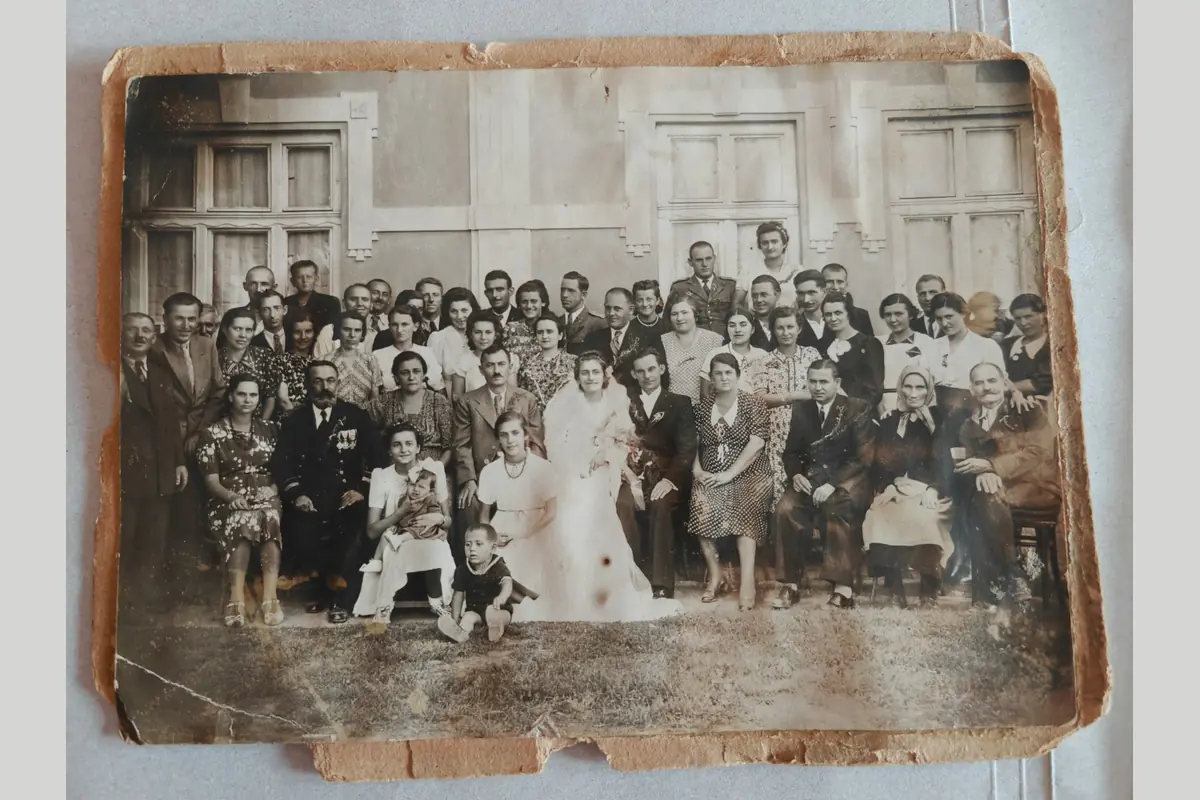
Budimir and Nadežda married in 1939. Their wedding photograph shows two young people at the beginning of their life together. He is in uniform and she is dressed in white. Members of both families surround them, gathered at a moment when no one could have known how brief the life they were celebrating would be.
Several months later, in early January 1940, they were temporarily apart. Nadežda was staying in Palanka, while the letter shows that Budimir was expected to travel by train from Belgrade. She gives him two possible departure times, estimates when he would arrive and promises to wait for him at the station.
That ordinary detail—the timetable of a train that disappeared long ago—gives the letter a special sense of life. Nadežda is no longer merely a name in a register. We see a young woman counting the hours until her husband arrives and imagining the moment she will see him on the platform.
“My dear, beloved husband Budo”
The letter begins without hesitation. Nadežda addresses Budimir as “my dear, beloved husband Budo” and immediately tells him that she had been waiting impatiently for his letter. She goes on to use a whole series of private terms of affection: kitten, chick, puppy, piglet, kitty, Mino and “ћиш” (transliterated as “ćiš”). We do not know exactly what that final word meant to them, but that is precisely why it feels so real. This is not a literary letter written for the public. It is an intimate conversation between two young spouses.
What follows is an English translation based on the preserved Serbian transcript. Nadežda’s unusual forms of words, repetitions and affectionate names have been retained as closely as English allows. Punctuation and paragraph breaks have been adjusted slightly for readability. One passage that cannot be read with confidence is marked in square brackets.
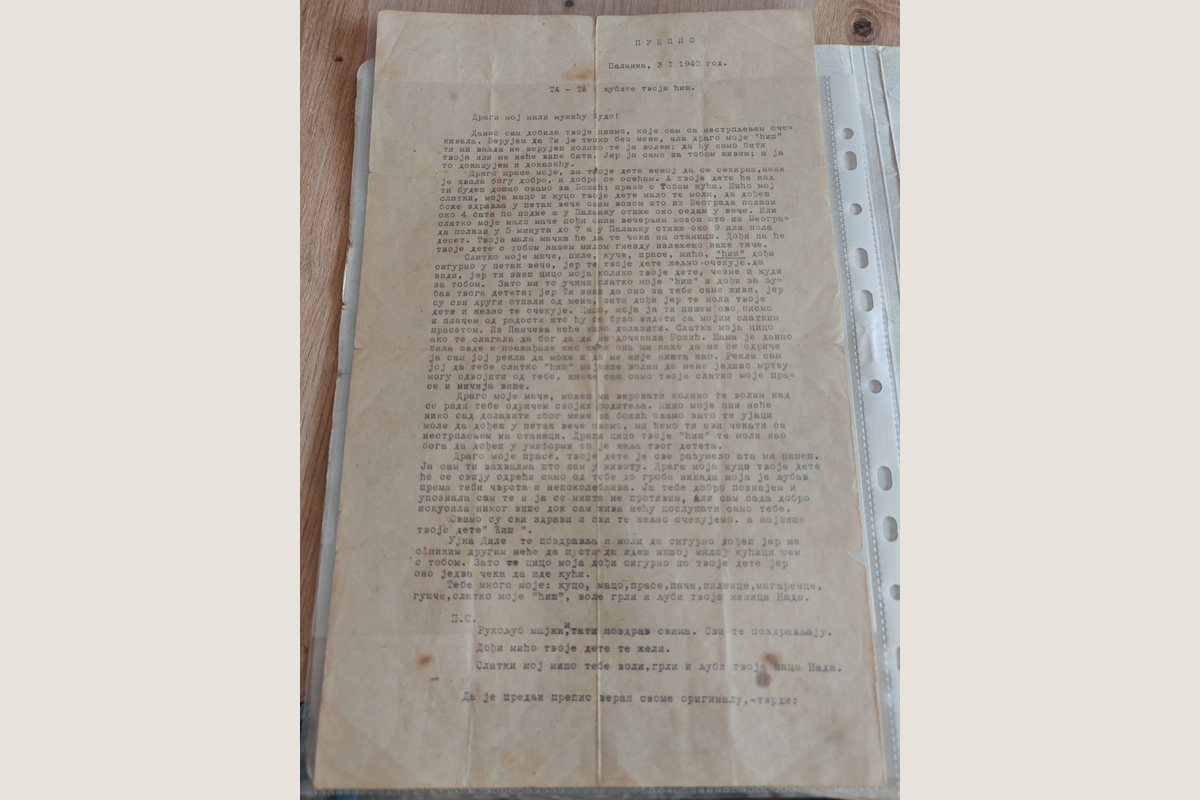
English translation of Nadežda’s letter
TRANSCRIPT
Palanka, 3 January 1940
“TA–TA” kisses you, your “ћиш”.
My dear, beloved husband Budo!
Today I received your letter, which I had been waiting for impatiently. I believe it is hard for you without me, but my dear “ћиш”, perhaps you do not believe how much I love you; I shall be yours alone, or I shall no longer exist. For I live only for you, and I am proving it and shall prove it.
My dear piglet, do not worry about your child. Thank God, I am well and feeling well. And when you come here for Christmas, your child will go straight home with you.
My sweet Mino, my kitty and puppy, your little child asks you to come, God willing, on Friday evening on the train that leaves Belgrade at about four in the afternoon and arrives in Palanka at around seven. Or, my sweet little kitten, take the evening train that leaves Belgrade at five minutes to seven and arrives in Palanka at about nine or half past nine. Your little kitty will wait for you at the station. Come, and your child will go with you to our dear little nest, where we will hatch our little birds.
My sweet kitten, chick, puppy, piglet, Mino, “ћиш”, be sure to come on Friday evening, because your child longs to see you. You know, my darling, how much your child yearns for you. So do this for me, my sweet “ћиш”, and come for the love of your child, for you know that your child lives only for you, because everyone else has turned away from me. So come, because your child is asking you and waiting for you with longing.
My Mino, I am writing this letter to you and crying with joy because I shall soon see my sweet piglet. No one will be coming from Pančevo. My sweet darling, if I am lying to you, may God not let me live to see Christmas. Mama was here today and we quarrelled, and she told me that she was disowning me. I told her she could and that I was not sorry at all. I told her that I love you, my sweet “ћиш”, more than anyone, and that only death could separate me from you. Otherwise, I am only yours, my sweet piglet, and no one else’s.
My dear kitten, can you believe how much I love you when I am giving up my parents for you? My Mino, none of them will be coming here for Christmas because of me, so my uncles are asking you to come here on Friday evening. We shall all wait for you impatiently at the station. My dear darling, your “ћиш” begs you as if begging God to come in uniform—that is your child’s wish.
My dear piglet, your child understood everything you wrote to me. I am grateful to you that I am alive. My dear puppy, your child will give up everyone, but never you, not until the grave. My love for you is firm and unshakable. I know you well and I have come to know you, and I object to nothing. But I have now learnt my lesson well: for as long as I live, I shall never listen to anyone again, only to you.
Everyone here is well and we are all eagerly waiting for you, most of all your child, “ћиш”.
Uncle Dile sends his greetings and asks you to be sure to come, because [unclear in the preserved transcript] will not let me go to our dear little home unless I go with you. So please, my darling, come and collect your child, because your child can hardly wait to go home.
Your wife Nada, your puppy, kitty, piglet, duckling, little chick, little donkey, little goose and sweet “ћиш”, loves you dearly, embraces you and kisses you.
P.S. Kiss your mother’s hand for me; greetings to your father and to everyone. They all send their greetings.
Come, Mićo, your child longs for you.
My sweet Mino, your kitty Nada loves you, embraces you and kisses you.
I certify that the foregoing transcript is faithful to its original:
What the Letter Reveals About Nadežda and Budimir
The letter is not historical proof of every part of their marriage, nor can a single document tell us everything that happened between two people. It does, however, show us directly how Nadežda spoke to Budimir at that moment and how she described her feelings.
She loves him without reservation. She misses him. She plans to wait for him at the station. She asks him to come in uniform. She writes about their “dear little nest” and future children, whom she calls “our little birds”. At the same time, her words reveal a serious conflict with her mother and Nadežda’s feeling that she must choose between her husband and her family.
We do not know every reason for that conflict, and it would not be fair to fill the gaps with later family divisions. The letter was written in January 1940, before the war reached Yugoslavia. We should therefore remain with what is actually written on the page: Nadežda was hurt, she felt that “everyone else had turned away” from her, and she told Budimir that she would remain by his side.
One sentence sounds especially powerful today: “Only death could separate me from you.” When she wrote it, it was an expression of devotion. When we read it knowing what would happen only fourteen months later, it carries a weight Nadežda could not have foreseen.
Twenty-four days between birth and death
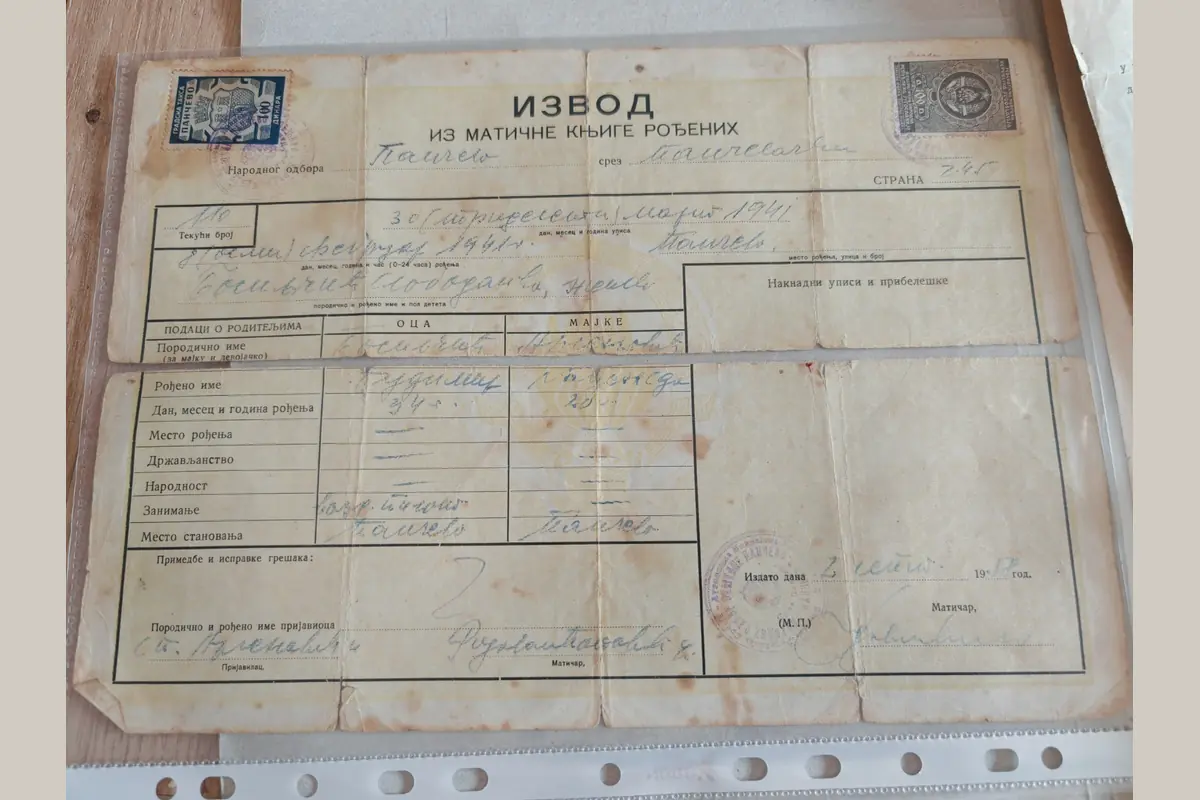
Budimir and Nadežda welcomed their daughter Slobodanka on 8 February 1941 in Pančevo. Her birth certificate preserves her name and the names of her parents. On that document, the beginning of one life stands beside a family future that had yet to unfold.
Only twenty-four days later, on 4 March 1941, Nadežda died. A church record gives pulmonary tuberculosis as the cause of death. The death notice states that she was only twenty years old.
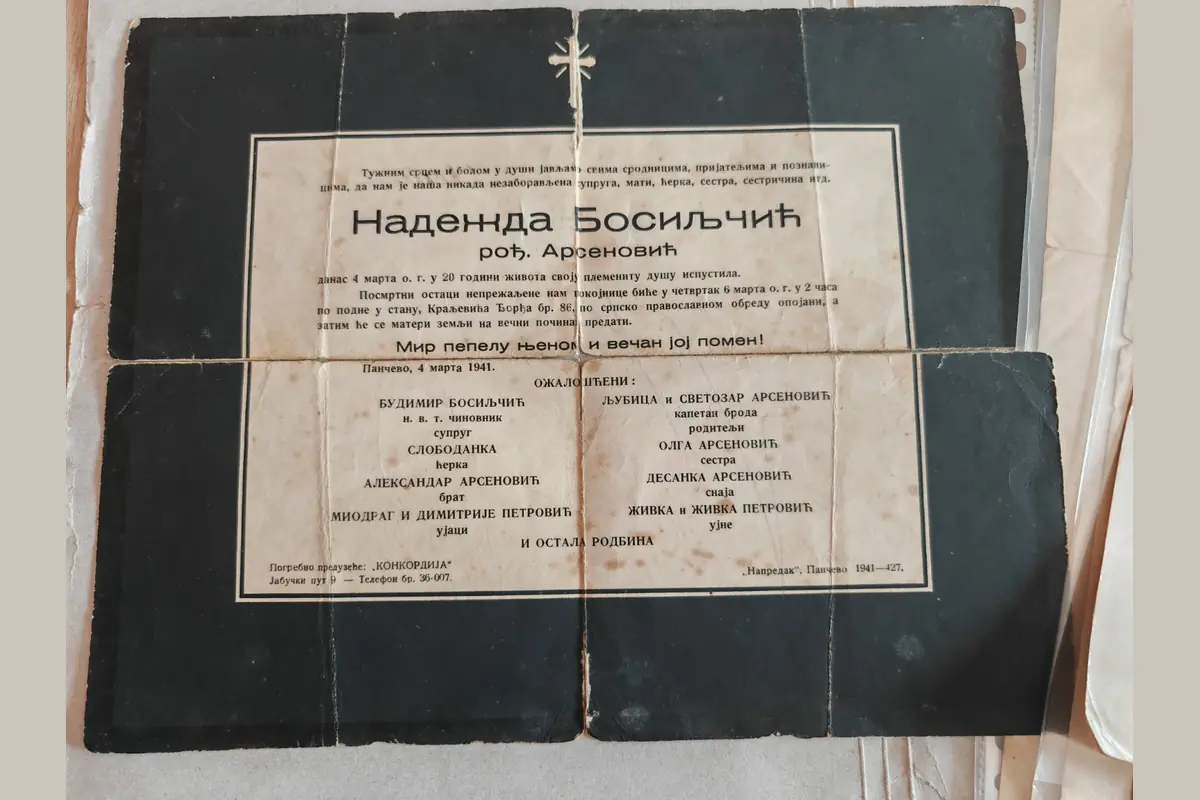
It names her husband Budimir, her daughter Slobodanka, her parents, brother, sisters and other relatives. An entire circle of people surrounds one brief sentence stating that Nadežda had “breathed out her noble soul” that day.
At the beginning of April, only a month after Nadežda’s death, war reached the Kingdom of Yugoslavia. According to the family account that Slobodanka later passed on to her children, Budimir took his newborn daughter to his mother Hristina in Banjani. They were separated soon afterwards, and Slobodanka never had the chance to know her father.
The little girl whose birth her parents had hoped for in their letters lost her mother after just twenty-four days and then lost her father’s presence as well. The “dear little nest” Nadežda wrote about never had the chance to become the life they had imagined.
“Yes, that belonged to Nada”
Many decades later, my mother Slavica found Olga, Nadežda’s sister. She has already described that meeting in the story about her mother Slobodanka, so I will not retell it here in full. One moment, however, belongs directly to Nadežda.
Slavica described to Olga a small wooden tray, carved and painted by hand, as well as the old containers for coffee, sugar and salt that had remained in the family. Olga knew what they looked like and remembered their colours. She then brought out two similar trays and quietly confirmed:
“Yes… That belonged to Nada.”
To someone else, these might be no more than old household objects. To Slavica, they were the first tangible connection to the grandmother she never had the chance to know. After documents that speak of birth and death, a single tray returned Nadežda to everyday life: to a home, a table, coffee, sugar and salt.
Photographs of these objects still need to be added to this article. They would matter not because the objects are valuable or rare, but because they belonged to a young woman whose life ended before she had time to leave more memories behind.
What Nadežda and Budimir Left Behind
When we look at family history only through official records, Nadežda’s life appears painfully short: birth, marriage, the birth of a child and death. The letter changes that picture. It contains impatience, jealousy, tenderness, anger, hope, family conflict and dreams of children. There are trains, a station, a uniform and a young woman crying with joy because she believes she will soon see her husband.
We do not know what kind of life Nadežda and Budimir might have built if war and illness had not changed everything. Nor do we know whether the words preserved in the transcript came from her only letter or merely one of many that disappeared. We know that this one survived.
Because of it, Nadežda is no longer merely a name on Slobodanka’s birth certificate and a death notice from March 1941. She speaks again. She calls Budimir her kitten, piglet and “ћиш”. She asks him to come by train. She wants to see him in uniform. She writes that her love is firm and unshakable.
Slobodanka could not remember her mother’s voice. My mother Slavica never knew her grandmother. I never had the chance to know her either. But when we read this letter, there is no longer complete silence between Nadežda and us.
Her voice remained on paper—and so did a love that time could not erase.
Note: This article is based on photographs and documents from the family archive, as well as the family account passed down by my mother, Slavica. Where a document does not provide a complete answer, this is clearly stated. The transcript of Nadežda’s letter will be compared with the preserved document once more before publication.