

Snoopy can become a fighter pilot without leaving his doghouse. A pair of sunglasses turns him into a college student; a typewriter makes him an aspiring novelist. Those familiar roles developed over years of newspaper strips, long before many viewers encountered him in television reruns. Some of the most interesting facts about Snoopy concern that gradual transformation.
Charles M. Schulz drew on a real family dog, kept much of his fictional beagle’s world out of sight, and eventually saw his characters’ names attached to spacecraft. The original Peanuts strip and its animated adaptations also tell slightly different parts of the story.
1. Snoopy arrived two days after the first Peanuts strip
Peanuts began on October 2, 1950, appearing in seven American newspapers. Snoopy made his first appearance on October 4, 1950. He belongs to the strip’s earliest cast, although he was absent from its opening installment.
Schulz developed the character through short, repeated encounters with readers: a few panels at a time, across many years. The elaborate personalities familiar from the television specials emerged during that development.
2. A real dog named Spike helped inspire him
Schulz drew on his family’s black-and-white mixed-breed dog, Spike, when creating Snoopy. The connection reaches back well before Peanuts. In 1937, a drawing Schulz had made of Spike appeared in Ripley’s Believe It or Not!, becoming his first published illustration.
The drawing accompanied an account of the dog’s habit of swallowing unusual objects. A family pet had given the young artist both a subject to draw and something peculiar enough to interest a newspaper feature.
3. He was almost called Sniffy
Schulz initially intended to name the character Sniffy. As HISTORY recounts, he changed his plans after spotting a comic magazine featuring another dog with that name.
He then remembered his mother’s suggestion that the family should call a future dog Snoopy. The change happened before Peanuts launched: Sniffy was a proposed name during the character’s creation.
4. Snoopy’s appearance and personality changed over time
Compare early Snoopy strips with later ones and the difference is clear. He began as a puppy who moved on four legs, barked and played catch. Over time, Schulz developed a character who could walk upright, dance, skate and imagine elaborate alternative lives.
The Charles M. Schulz Museum records that Schulz regarded Snoopy as the character who underwent the greatest changes in both appearance and personality. Walking on two feet expanded what he could do within a panel. A dog who could stand and perform like a person had far more opportunities for a joke than one limited to ordinary canine behavior.
For another character whose familiar appearance took time to develop, read how Bugs Bunny was created.
5. Schulz never showed the inside of Snoopy’s doghouse
Snoopy’s possessions include books, records, a Van Gogh painting and even a pool table. Yet the interior of his doghouse is never shown in Schulz’s comic strip. Readers learn about its contents through references in the stories.
The Schulz Museum identifies the 1981 animated special It’s Magic, Charlie Brown as an occasion when viewers do see inside. In the strip, the small house keeps its improbable contents hidden.
6. The Flying Ace began with model airplanes
Snoopy first imagined himself as a World War I Flying Ace on October 10, 1965. Schulz credited his son Monte’s interest in plastic model airplanes as a principal inspiration for the role.
With a flying helmet, goggles and scarf, Snoopy could turn his doghouse into a Sopwith Camel and battle the Red Baron. The familiar roof remained beneath him while his imagined situation changed completely. That gap between an ordinary backyard and an aerial adventure gives the routine much of its humor.
7. Joe Cool made his debut in 1971
Joe Cool first appeared on May 27, 1971. Wearing sunglasses, Snoopy becomes a college student preoccupied with looking cool and enjoying campus life.
The official Peanuts character profile describes him hanging around the student union, finding time for Frisbee and pizza, and showing considerably less enthusiasm for attending class. Where the Flying Ace imagines heroic combat, Joe Cool imagines social status. Snoopy’s confidence can serve either fantasy equally well.
8. His animated performances needed a voice actor
In the comic strip, thought balloons let readers follow Snoopy’s inner commentary. Animation gives him another means of expression: laughter, cries, growls and other vocal sounds, alongside his movements.
Animator and director Bill Melendez supplied Snoopy’s familiar voice in the classic television specials. He also voiced Woodstock. The Schulz Museum’s Animating Comics exhibition explains that Melendez recorded his own voice and sped up the tape to produce their characteristic sounds. Those performances add expression without giving Snoopy the same conversational dialogue as Charlie Brown and the other children.
For a later look at how recorded performances guided drawings and timing, see how cartoons were made in the 1990s.
9. Snoopy has five named siblings in the comic strip
Five of Snoopy’s siblings are named in the original comic strip: Spike, Belle, Marbles, Olaf and Andy. In a strip published on June 18, 1989, Snoopy says that his litter contained eight puppies.
The animated special Snoopy’s Reunion (1991) supplies two further names, Molly and Rover. This explains why lists sometimes give him five named siblings and sometimes seven: they are drawing on different versions of Peanuts. The television special fills in names beyond those used in Schulz’s newspaper strip.
10. Apollo 10 used Snoopy and Charlie Brown as spacecraft names
One of the most interesting facts about Snoopy is his connection with NASA. It includes the Silver Snoopy Award, presented personally by astronauts to employees and contractors for outstanding contributions to human spaceflight safety or mission success.
The connection also reached the Moon. On Apollo 10 in May 1969, the lunar module was named Snoopy and the command module was named Charlie Brown. The lunar module’s task included checking the area intended for the following mission’s landing, making the idea of “snooping around” an apt explanation for its name.
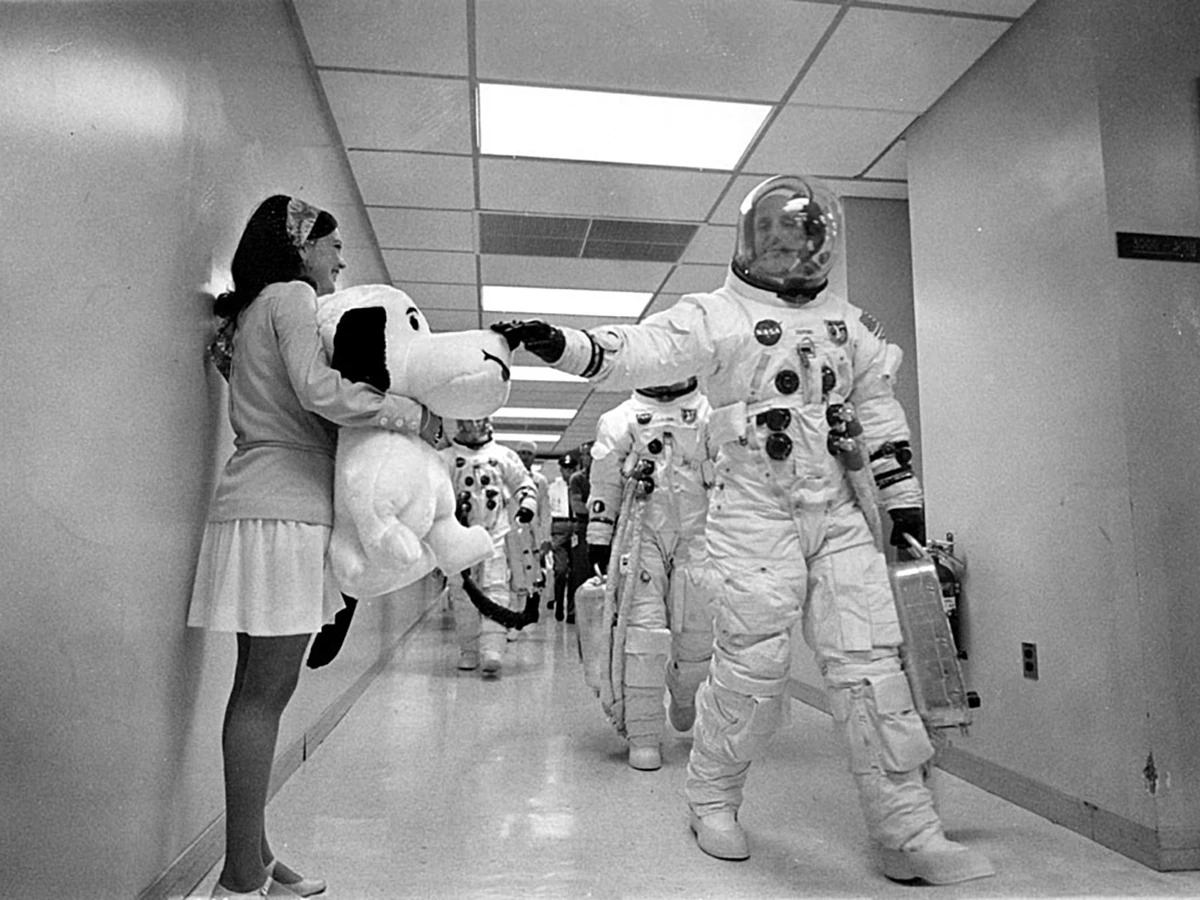
Apollo 10 was a rehearsal for the first lunar landing. Its lunar module flew close to the Moon’s surface, but the mission did not land there. That achievement followed with Apollo 11.
Read next: Tom and Jerry facts worth noticing on a rewatch.
Sources and further reading
- Peanuts Worldwide: official character profiles for Snoopy and Joe Cool.
- Charles M. Schulz Museum: Schulz’s life and career timeline.
- Charles M. Schulz Museum: Celebrating Peanuts, including Snoopy’s development.
- Charles M. Schulz Museum: frequently asked questions, including Snoopy’s siblings and doghouse.
- Charles M. Schulz Museum: Snoopy and the Red Baron.
- Charles M. Schulz Museum: Animating Comics exhibition walkthrough (PDF).
- HISTORY: 9 Things You Might Not Know About Peanuts, including the proposed name Sniffy.
- NASA: NASA and Peanuts Celebrate Apollo 10’s 50th Anniversary.