
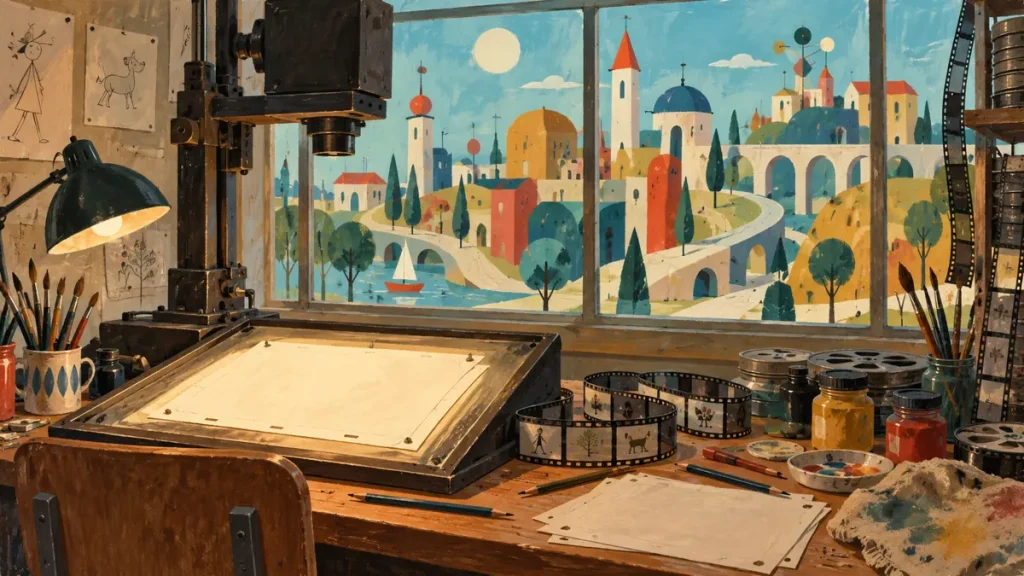
Professor Balthazar is remembered as a gentle scientist living in a colourful city filled with unusual people, animals and everyday problems. Behind that simple idea, however, stands an important chapter in European animation history.
The series grew out of Zagreb Film and the creative environment known as the Zagreb School of Animated Film. Its success was not based on action, famous voices or complicated dialogue. Instead, it used distinctive drawing, expressive movement, music and peaceful problem-solving to reach viewers of different ages and languages.
How Professor Balthazar began
Zagreb Film was established in 1953, while its dedicated animation studio began operating in 1956. During the following years, the studio became internationally known for films that moved away from realistic, Disney-inspired animation and developed a more stylised visual language.
The story of Professor Balthazar began with the 1967 animated short Izumitelj cipela, usually translated as The Inventor of Shoes. Zlatko Grgić directed and animated the film, while the screenplay was written by Grgić and Borivoj Dovniković. Branko Varadin created the backgrounds, Aleksandar Bubanović composed the music, and the film was produced by Zagreb Film and Windrose Film.
In the story, Balthazar invents extraordinary shoes that can fly, dance, jump and move like a car. The film already contained the idea that would define the later series: a problem appears, Balthazar studies it and produces an imaginative solution that improves someone’s life.
Zagreb Film’s present-day catalogue lists Izumitelj cipela as Season 1, Episode 3. Historical sources and the studio’s biography of Grgić, however, describe it as the film that started the internationally successful series. It is therefore best understood as the original Balthazar film, later incorporated into the first production cycle.
The short also received the Golden Pelican award at the Balkan Film Festival in Mamaia in 1968, showing that Balthazar attracted attention even before the character became the centre of a full series.
Zlatko Grgić did not create the series alone
Zlatko Grgić was central to the creation of Professor Balthazar. He was a director, animator, screenwriter, cartoonist and one of the best-known representatives of the second generation of Zagreb animation authors. His work was distinguished by lively drawing, dynamic movement and a strong sense of visual comedy.
However, Professor Balthazar was never the work of only one person. The main creative team behind the series included Grgić, Boris Kolar and Ante Zaninović. Together, they developed its stories, direction, drawing and animation.
Other artists also made essential contributions. Zlatko Bourek designed imaginative backgrounds, with work by Branko Varadin and Srđan Matić, while Tomica Simović composed the music for the series. Borivoj Dovniković was Grgić’s co-writer on the original film, and Aleksandar Bubanović composed its soundtrack.
This collaboration explains why the series feels so visually complete. Its city, machines, citizens, music and movement were not separate decorative elements. They were different parts of the same storytelling system.
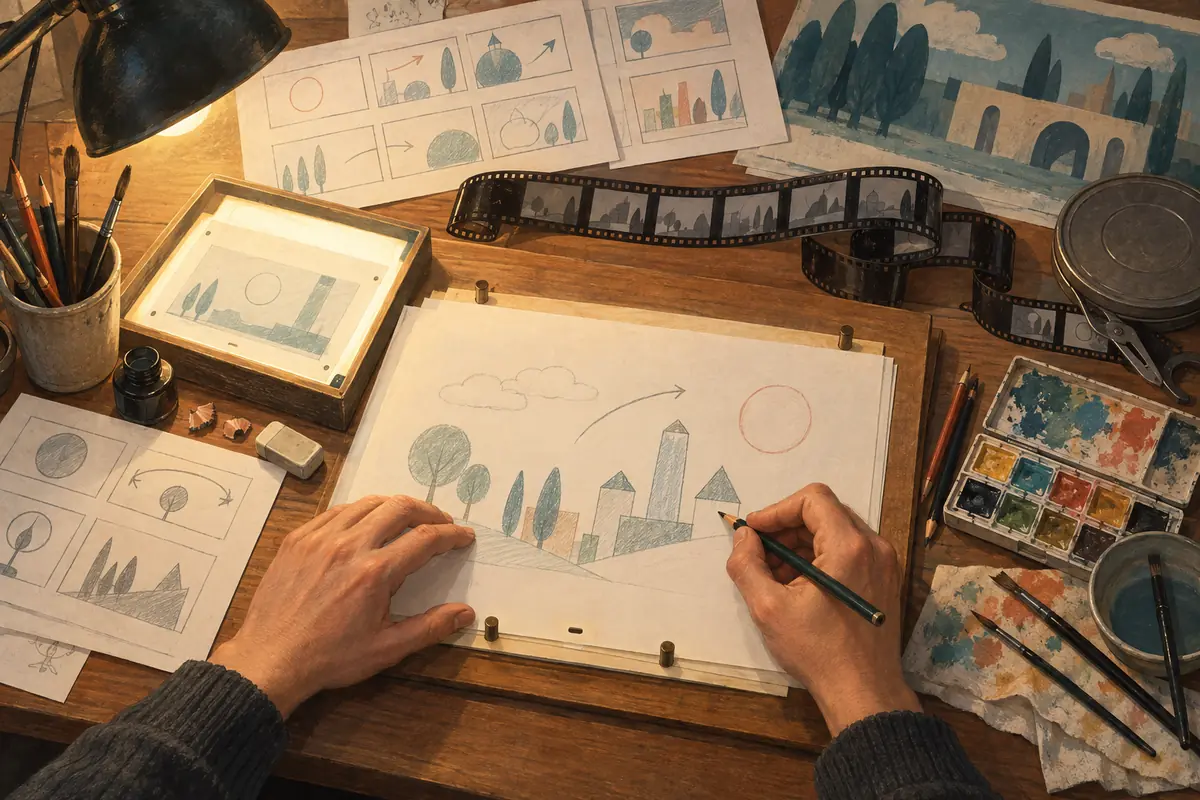
Professor Balthazar and the Zagreb School of Animated Film
The term “Zagreb School of Animated Film” did not describe a literal school with lessons, classrooms or a single artistic programme. It referred to a group of authors connected with Zagreb Film who developed distinctive approaches to animation.
The expression gained international recognition after seven Zagreb Film productions were presented at the Cannes Film Festival in 1958. Critics Georges Sadoul and André Martin used the term to describe the new animation emerging from Zagreb.
These films often relied on stylised drawings, simplified movement, modern graphic design, irony and ideas expressed through visual metaphor. Individual directors still had very different styles, which is why Zagreb Film itself notes that the label should not be understood as one fixed visual formula.
Professor Balthazar inherited many of these qualities. Its world is clearly designed rather than realistic. Buildings bend, machines behave in impossible ways and characters are reduced to expressive shapes. At the same time, Grgić’s energetic animation gave the series more movement and visual comedy than some earlier examples of reduced animation.
This combination helped Professor Balthazar remain accessible to children while preserving the artistic character associated with Zagreb Film. Readers interested in the broader development of the medium can also explore our overview of the history of animation.

Four production cycles and 59 episodes
Professor Balthazar was produced between 1967 and 1978. According to the Croatian Filmski leksikon, the complete series consists of four production cycles and 59 episodes.
| Production cycle | Episodes | Typical length | Spoken structure |
|---|---|---|---|
| First cycle | 13 | Approximately 10 minutes | Off-screen narrator |
| Second cycle | 13 | Approximately 10 minutes | Off-screen narrator |
| Third cycle | 13 | Approximately 10 minutes | Off-screen narrator |
| Fourth cycle | 20 | Approximately 5–6 minutes | No spoken text |
| Total | 59 | Produced from 1967 to 1978 | |
The first three cycles followed a format close to the classic animated short. Their stories usually had enough time to introduce a citizen of Balthazar City, establish a problem and follow the professor’s path towards a solution.
The fourth cycle used shorter episodes and removed spoken narration entirely. The stories were carried by images, movement, sound effects and music, bringing the series even closer to the visual storytelling traditions of Zagreb animation.
The length of these episodes was also well suited to economical storytelling. Our article about why classic cartoons were often only seven to ten minutes long explains how this format encouraged animators to make every scene meaningful.
How Professor Balthazar solves problems
Balthazar is not a conventional action hero. He does not defeat villains, use physical force or solve disagreements by proving that he is stronger than everyone else.
He observes what is happening, considers the needs of the person asking for help and searches for a solution. His unusual machine then transforms that thought into an invention, object or idea capable of restoring balance to the community.
The machine may look magical, but the stories do not present Balthazar as a wizard. The Filmski leksikon emphasises that his solutions are the work of an intelligent and humane person rather than the result of magic. The machine is a visual expression of imagination, patience and practical thought.
Another important detail is that his inventions are normally created for someone else. Balthazar does not use his knowledge to gain wealth, power or admiration. He listens to people whose problems may appear small and treats those problems as worthy of attention.
This calm process gives the episodes a rhythm that feels different from much modern children’s animation. There is time to understand the situation before the solution arrives. That is also one reason the slower pace of classic cartoons can still feel so satisfying today.
Narration, music and visual storytelling
Narration without dialogue-heavy scenes
It is sometimes claimed that Professor Balthazar contains no spoken language. That is only partly correct. The first three production cycles use an off-screen narrator, while the fourth is entirely without spoken text.
The characters themselves do not depend on long conversations. Their personalities, emotions and intentions are communicated through movement, expression and the situations in which they appear. The narrator provides context, but the images continue to carry much of the story.
Music as part of the action
Music does more than fill quiet moments. It establishes the rhythm of a scene, supports changes in mood and helps the audience follow the action without extensive explanation.
Aleksandar Bubanović composed the music for the original 1967 film, while Tomica Simović composed the music associated with the main series. The playful sound complements Balthazar City, where even an ordinary walk or the operation of a machine can become a small visual performance.
A city built from shapes and colour
Balthazar City does not try to imitate a real location. It is assembled from curves, geometric buildings, decorative patterns, open spaces and improbable machines. The backgrounds create the feeling of a complete community while remaining flexible enough for visual jokes and surreal inventions.
The simplified designs also make emotions easy to read. A viewer does not need to understand every word to recognise worry, confusion, excitement or relief. Shape, movement, colour and music communicate those feelings directly.
From a Zagreb studio to an international audience
The series was produced through cooperation involving Zagreb Film and the Cologne-based company Windrose-Dumont Time. This international production connection helped place Professor Balthazar beyond the boundaries of its original studio environment.
Zagreb Film records that the series achieved major success on television abroad, while the Filmski leksikon identifies Scandinavian countries as an especially successful market. Rather than repeating uncertain lists of countries or broadcasters, the reliable conclusion is that Balthazar became one of Zagreb Film’s most internationally recognised television creations.
Its visual construction made that journey easier. Narration could be adapted for another language, while character movement, clear cause and effect, music and visual humour remained understandable without major changes.
The final production cycle went even further by removing spoken text. Once the story depended entirely on images and sound, there was almost no language barrier left to cross.
Why Professor Balthazar became culturally important
Professor Balthazar is culturally important because it connected artistic animation with popular children’s television. It preserved many principles associated with the Zagreb School—stylisation, irony, authorial design and pacifist ideas—without becoming inaccessible to a broad audience.
The Filmski leksikon describes the series as the only creation in the history of the Zagreb School that consistently used those artistic principles while also achieving significant commercial success. It also highlights the programme’s peaceful and environmental messages, as well as its unusual position as a European children’s animated series centred on a human hero.
Its preservation has therefore been treated as more than an exercise in nostalgia. Zagreb Film began restoring and digitising Professor Balthazar in 2007. By 2016, all four production cycles had been restored. The original film negatives are preserved by the Croatian State Archives.
Restoration allows new audiences to see the colours, lines and background work more clearly, while protecting a significant part of Croatian and former Yugoslav animation heritage.
Why the series still works across languages and generations
Professor Balthazar does not require viewers to understand a particular period, political system or television schedule. Its stories begin with recognisable experiences: someone feels lonely, something in the community stops working, a citizen cannot achieve a goal or an unusual situation creates a practical problem.
The professor responds with curiosity rather than judgement. Intelligence is presented as useful only when it is joined by empathy. Technology is not there to dominate the world, but to make life a little easier for another person.
Children can follow the clear visual story and enjoy the inventions. Adults can notice the design, pacing, humour and the philosophy behind Balthazar’s decisions. That balance helps explain why the series remains understandable without depending entirely on nostalgia.
Professor Balthazar emerged from a specific studio, city and animation movement, but its central idea is universal: careful thought and kindness can solve problems that force cannot.