
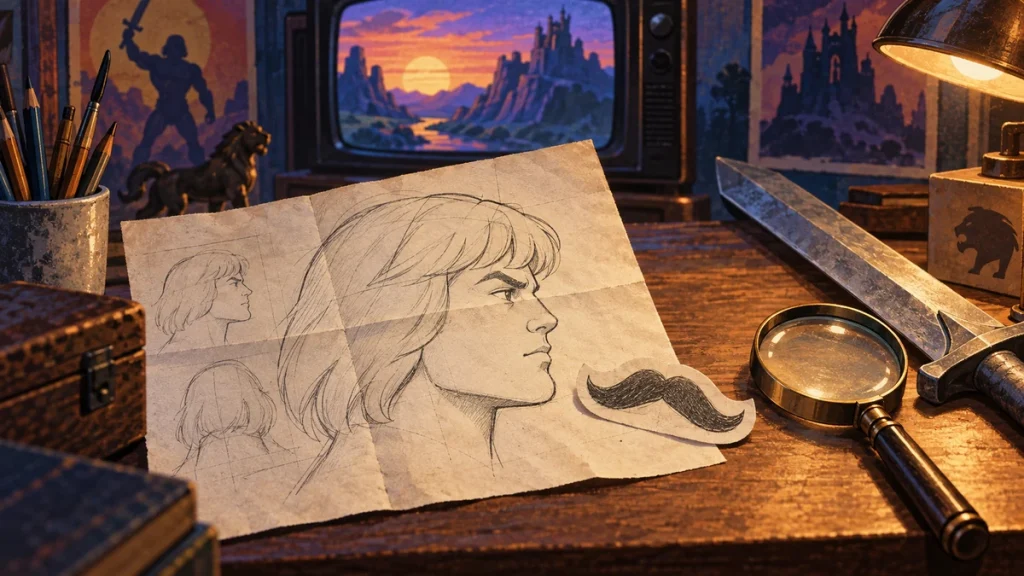
He-Man has the sword, the armour and the build of a fantasy warrior. He does not have a mustache. So was there a particular reason for that clean-shaven face? I could not verify a direct explanation from Mattel’s original toy designers or Filmation’s team. Claims that it made him look younger, easier to animate or more appealing to children are possible interpretations, not documented decisions.
There is, however, a useful story behind the question. The He-Man most people remember grew out of a toy, illustrated stories and then a television series. Looking at those versions separately shows what changed and what did not.
He-Man was clean-shaven before the cartoon
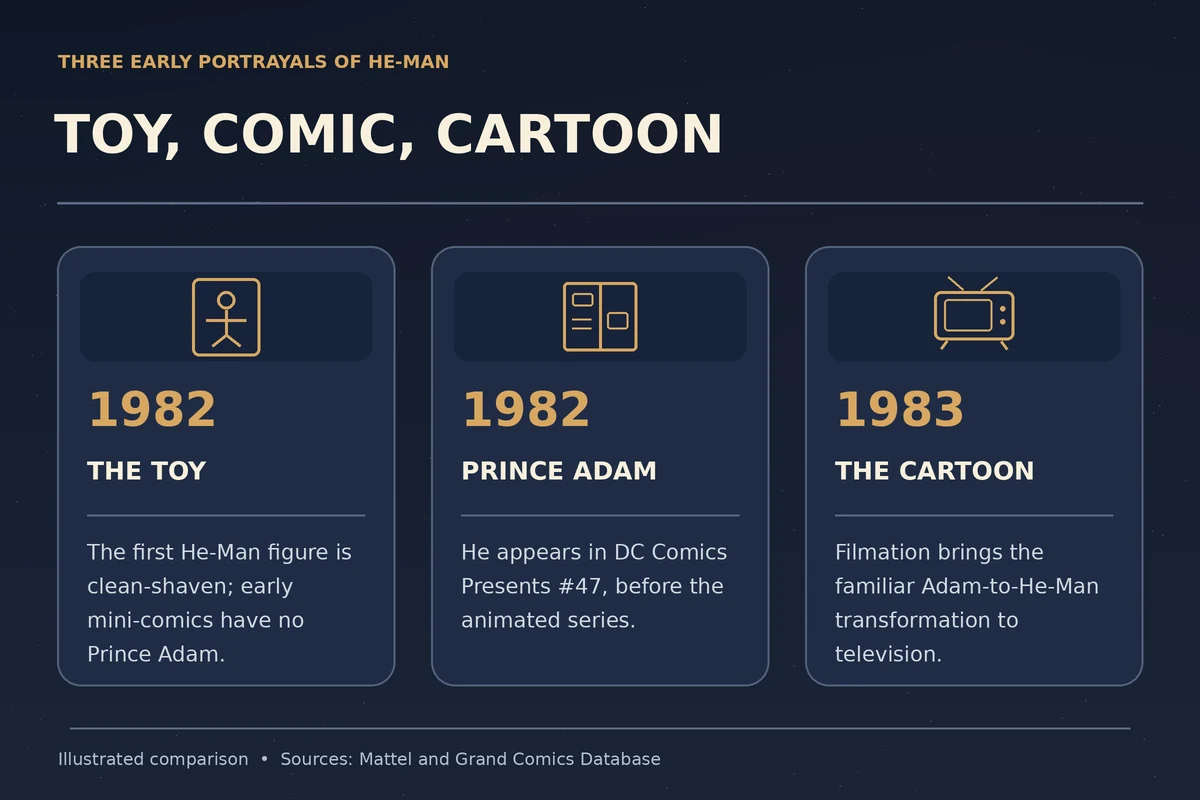
Mattel dates the original Masters of the Universe toy line to 1982, with He-Man among its first figures. You can compare the original figure in a collector’s archive: it had no mustache. The first mini-comic, He-Man and the Power Sword, presented him in a fantasy adventure illustrated by Alfredo Alcala. Its version of the character had no Prince Adam secret identity.
These sources matter because the animated series did not invent a clean-shaven He-Man. The look was already present in the early toy and its accompanying artwork. The figure, the comic illustrations and the later cartoon should still be treated as separate designs: their faces, hair and costumes were not identical.
Where does Prince Adam fit in?
Prince Adam was already part of He-Man’s story in 1982. DC Comics Presents #47, a Superman and Masters of the Universe crossover, includes Adam. The early mini-comic packaged with the toys tells a different version without him. Those stories developed alongside one another; there was no single, settled origin at the beginning.
When Filmation’s He-Man and the Masters of the Universe arrived in 1983, the transformation from Prince Adam into He-Man became central to the television version. Adam’s clothes differ from He-Man’s battle harness, boots and sword. Both have clean-shaven faces.
It is reasonable to notice that matching faces suit the idea of two identities belonging to one person. That observation does not tell us why the original He-Man figure lacked a mustache. The early toy stories did not depend on Prince Adam at all, and I have not found a designer saying that facial hair was removed for the transformation.
What did the people behind the design say?
In an interview about the original artwork, Mattel designer Mark Taylor discussed the fantasy hero he had drawn before He-Man and his work on the toy line’s visual development. In a separate interview, fellow Mattel designer Roger Sweet described his early He-Man prototypes and later work with Taylor and others. They did not give the same account of who originated the character, so it would be misleading to credit every design choice to just one man.
Neither interview supplies a specific reason for He-Man’s bare upper lip. The published toy and animation show the result; the sources examined here do not record the discussion that led to it.
Another character actually gained a mustache
Man-At-Arms offers a revealing comparison. Mattel describes his vintage toy appearance as having no mustache, while its cartoon-inspired figure reflects the familiar television character with a mustache. In the Roger Sweet interview, a reader asks why the original Man-At-Arms figure had no mustache. Sweet says the designer styling that toy decided it did not need one.
That is a documented answer to a question about Man-At-Arms, not He-Man. It also shows why toy and cartoon details cannot be treated as interchangeable. One character gained facial hair on television; He-Man remained clean-shaven across the best-known early versions.
So why no mustache?
The honest answer is that we can identify the clean-shaven design, but we cannot establish its precise motive from the available evidence. There is no verified statement in the sources checked here saying Mattel ordered a younger-looking hero, that Filmation found mustaches too difficult to animate, or that Prince Adam’s disguise required He-Man to shave.
We can analyse the effect: without facial hair, his face stays much the same as Adam’s in the cartoon, while the transformation changes his clothes and heroic role. That is an observation about the finished programme. It is not a quotation from its creators or a reason we can project back onto the 1982 toy.
He-Man’s original figure was clean-shaven, and Filmation kept him that way. Why that choice was first made remains undocumented in the sources we have. The more interesting discovery is how much of He-Man’s story changed around that familiar face.
For a separate discussion of later screen adaptations, see our He-Man cartoon and film comparison. If it is the feeling of returning to these shows that interests you, we also wrote about why cartoons from the 1980s and 1990s stay with us.